Chanel’s J12 has remained an icon since its creation and yet it can still surprise with each new launch
A Case for Adaptability

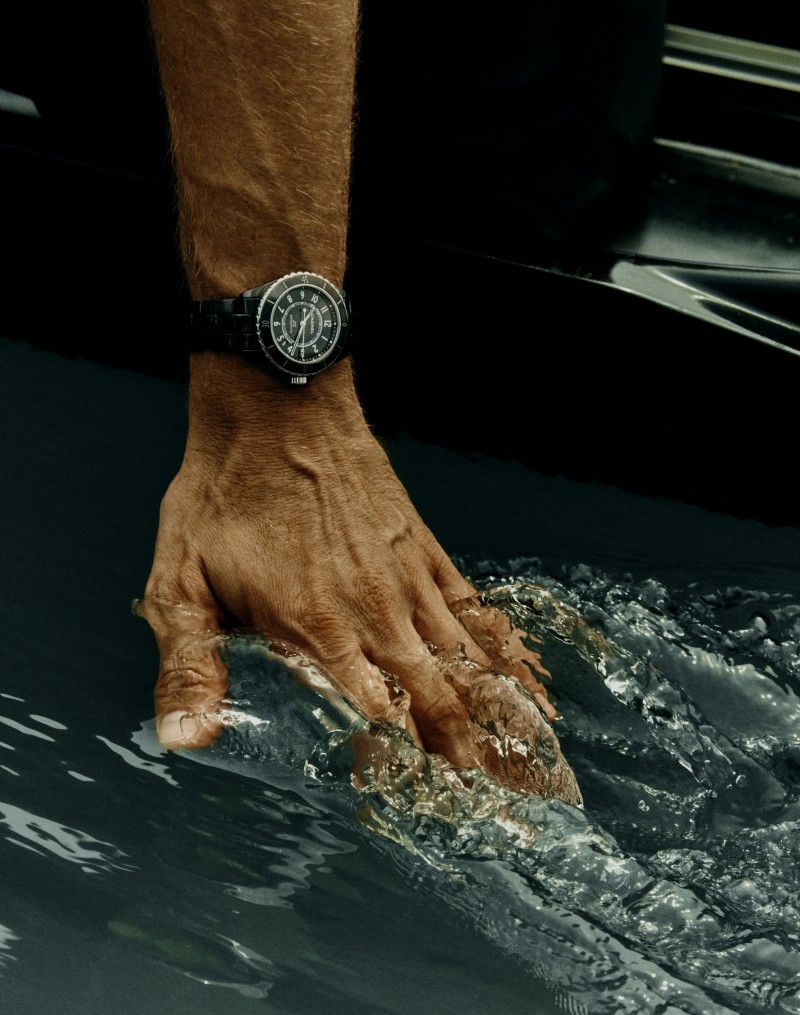
Be water, my friend These were the words immortalised by the late Bruce Lee. And in a nutshell, the philosophy calls for adaptability. Just like water takes the form of any vessel it is put in, or absorbs force with a sense of fluidity and grace, dispersing the violent energy transforming them into mere ripples on the surface, water is mouldable to fit its most immediate needs. Yet, as formless as it is, given enough time, water can cut through stone. It is at once soft and sturdy.
The reason, however, this particular bit of philosophy works perfectly as an opening to a story about the Chanel J12 is that it serves as a great way to describe what is happening with the collection. For about 20 years since the J12 was first launched in 2000, there were only two colours of the J12, and two case sizes, 33 and 38 mm to choose from. Then in the last five years, the J12 blossomed. Redesigned for the contemporary age, updated with serious watchmaking movements, and last year, for the first time ever, the J12 came in a new blue colour, and with it a new matte finishing as well. And the expansion isn’t slowing down. This year Chanel is updating this iconic collection once again adding new sizes and a new finishing for the iconic black J12.
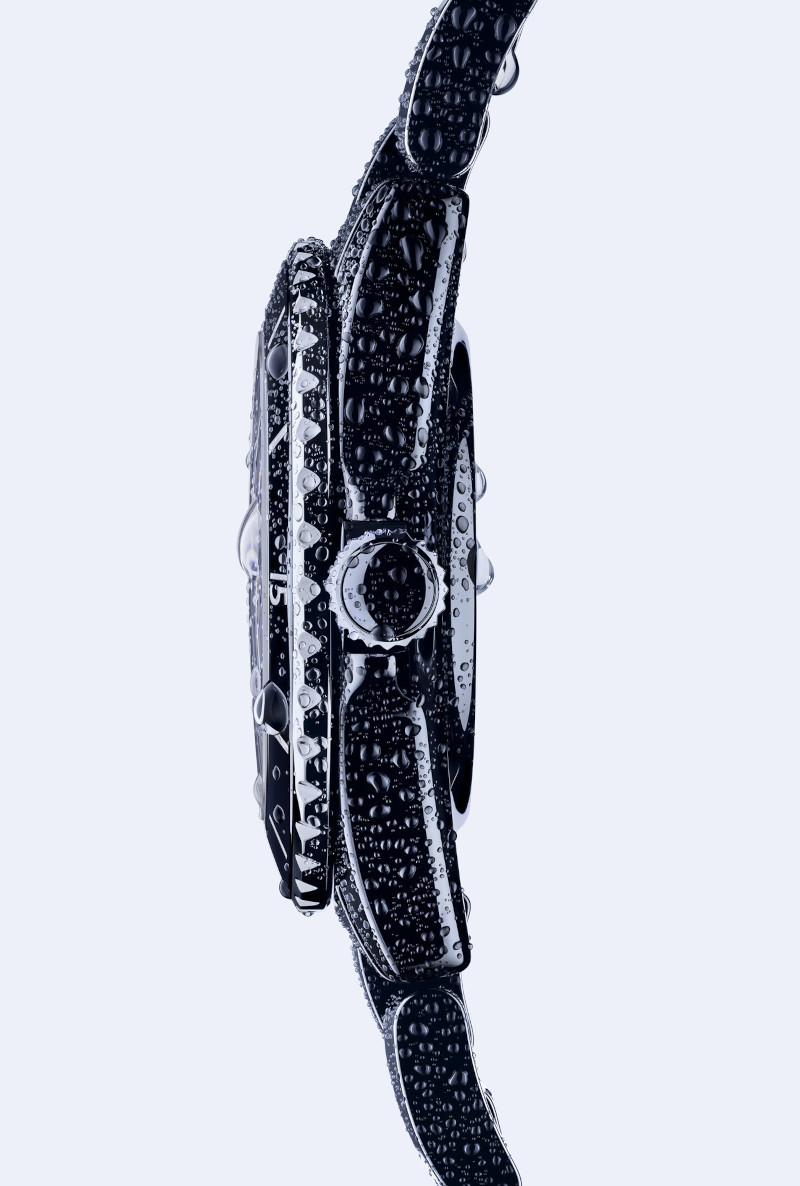
Its newfound versatility is one thing, but the watch as always exudes the robustness that comes with using ceramic. During its launch, it was already a material ahead of its time, in 2026, it has become a material that most brands want to use in their collections but struggle with its difficult manufacturing process. A watch that combines both versatility and robustness; Doesn’t this philosophy now seem like a perfect analogy to explain where the collection stands today?
To understand the evolution of the J12, naturally one must first return to the year of its birth, at the start of a new millennium, the year 2000. The watch was the brainchild of Jacques Helleu, Chanel’s Artistic Director overseeing perfumes, beauty, watches, and fine jewellery, for more than four decades. As with many great timepieces, the J12 began as a personal pursuit: Helleu wanted a watch he himself would wear, one that matched his own impeccable sense of style. He had long admired the sculpted lines of racing machines, but it was the majestic silhouettes of America’s Cup yachts that truly captivated him. The name “J12” itself pays homage to the J‑Class category of these 12‑metre vessels.
The America’s Cup has always been fertile ground for luxury inspiration. Picture a race that distills human skill, engineering innovation, and flawless team orchestration into a single, high‑stakes contest. It unfolds on open water, pitting a challenger against a defender, with the winner claiming not just the trophy but the glory and the right to boast until the next duel. Even today, Chanel’s passion for boat racing persists with them being the first Timekeeping Partner and Title Sponsor of The Boat Race, one of the world’s oldest and most famous amateur sporting events, taking place over over 4.25 miles of tidal Thames in west London between Putney and Mortlake.
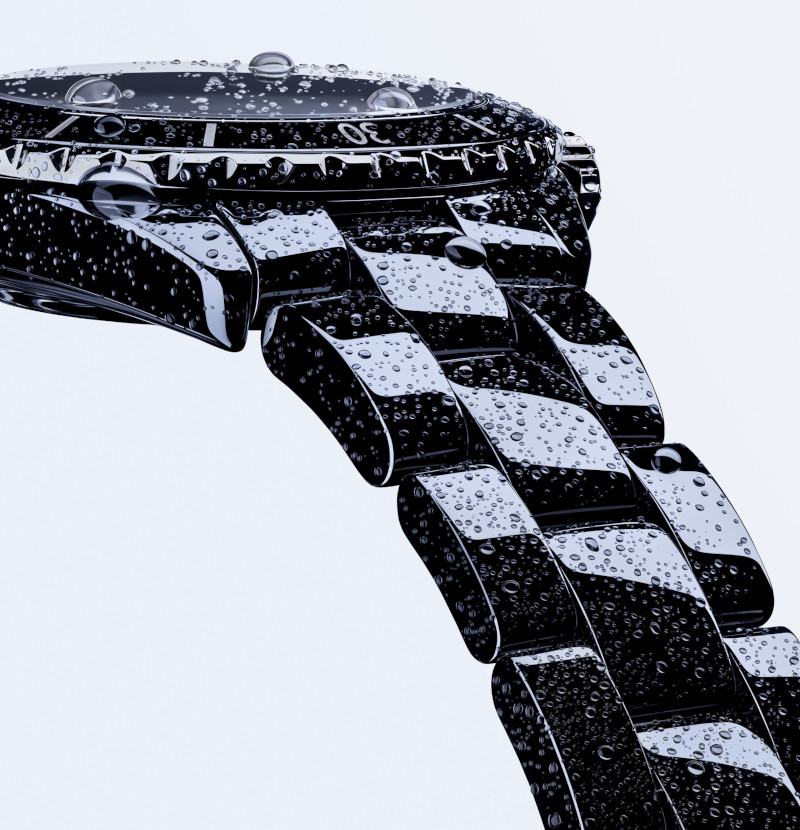
This blend of motorsport dynamism and nautical elegance became the foundation of the J12’s identity. From its earliest pencil sketches, the watch was envisioned as unapologetically sporty yet inherently timeless. And for a creation inspired by speed and performance, only the most advanced material would do. Thus, the J12 emerged with a full black ceramic case and bracelet — a bold choice at the time.
Today, ceramic feels almost commonplace in watchmaking, but in 2000 it was anything but. Its extreme hardness made it notoriously difficult to shape, and it was far more familiar as a protective coating on aerospace components than as a watch case. So, when Chanel unveiled the J12 with its sleek, glossy 38mm ceramic silhouette (followed by the white ceramic version in 2003), it instantly became an icon — a watch that sat on the wrist with the permanence and purity of a gemstone.
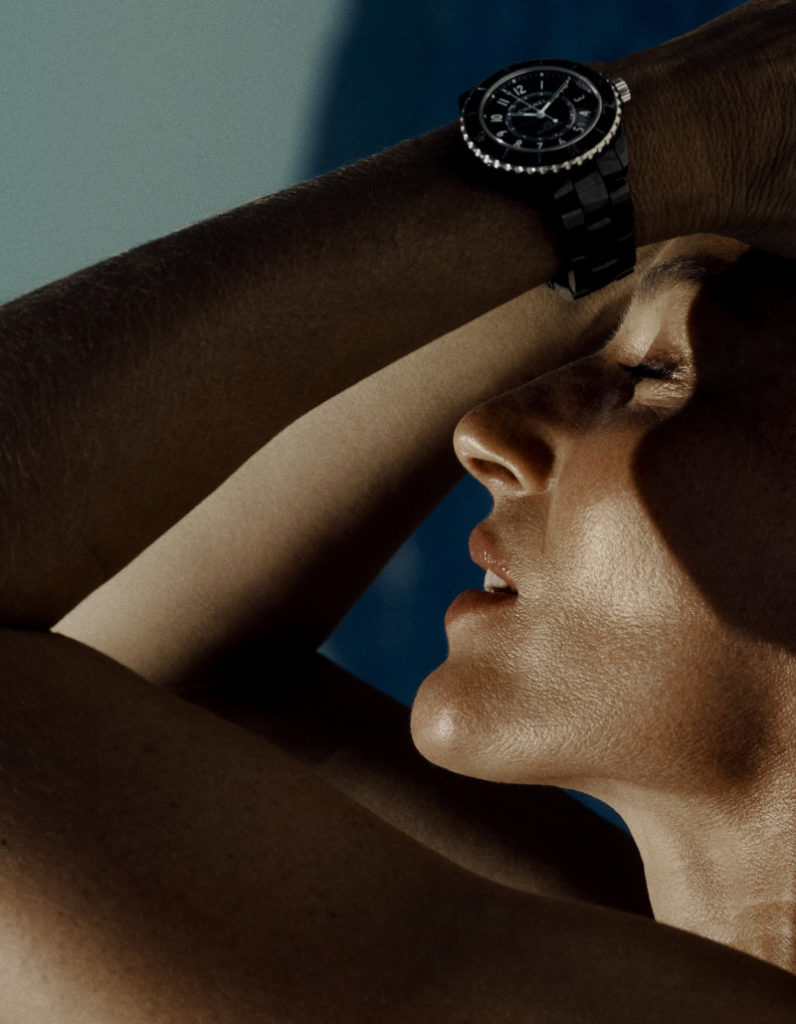
The Chanel J12 is frequently celebrated as the first true watch icon of the 21st century. And with that accolade came a challenge for the maison: how do you guide a globally recognised icon forward without compromising what made it iconic in the first place?
The responsibility of ushering this emblem of Chanel into a new era eventually fell to Arnaud Chastaingt, the current Director of the Chanel Watch Creation Studio. His task was as delicate as it was daunting: to modernise the J12 without disturbing the very essence that cemented its legend. How do you evolve something that, by its nature, resists change? Chastaingt has had an immensely important influence on the history of Chanel watchmaking and the evidence is compelling. Since he took on the role as the director of the Watchmaking Creation Studio back in 2013, he has expanded the line of Chanel watches beyond just the J12 and Première to include BOY·FRIEND, CODE COCO and MONSIEUR which have all since become staples of Chanel watchmaking. So, if anyone could reimagine the J12, it would be him.
In 2019, nearly two decades after the J12 first appeared, it underwent its inaugural transformation. By stepping into the realm of contemporary watchmaking, the J12 unlocked an entirely new creative chapter. In this first year of renewal, the watch introduced a series of subtle yet meaningful aesthetic refinements. The bezel gained additional notches and a refreshed typeface for its numerals and markers; the crown was slimmed down; and the inner railway track on the dial was reworked with new indicators. The brilliance of this evolution lay in its restraint: at a glance, it looked almost identical to the J12 of 2000. Only upon closer inspection were the quiet sophistication of its updates revealed.
The aesthetic evolution was paired with a deliberate repositioning of the J12 as a credible force in contemporary watchmaking. And at this level, simply making superficial adjustments to pre‑made movements and assembling them into the J12 was never going to suffice. Thus, they had to move away from cookie‑cutter movements and instead adopt a true manufacture movement, the Caliber 12.1, through a collaboration with, and eventual investment in, Kenissi.
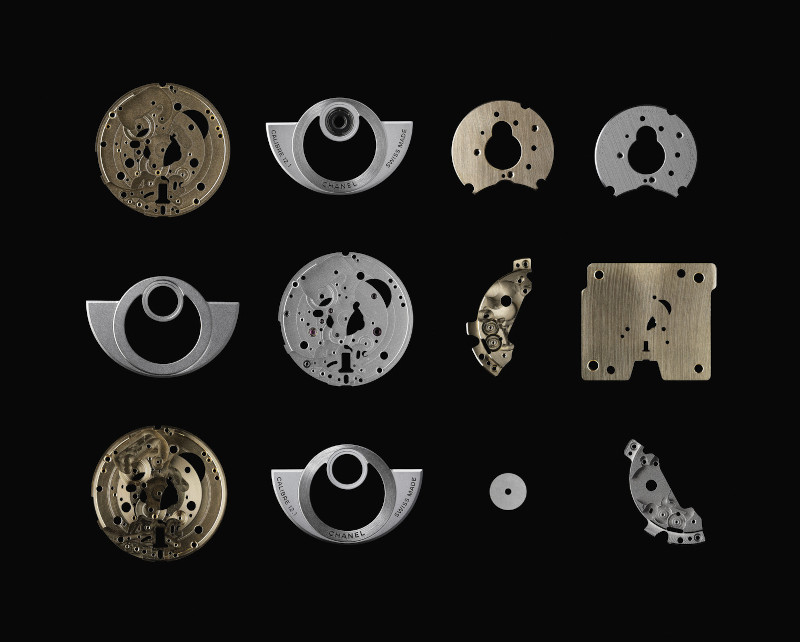
The Calibre 12.1 represented a new era for the J12 giving it a movement that could withstand the scrutiny of the Contrôle Officiel Suisse des Chronomètres (COSC). The movement is Chronometer certified meaning that it must adhere to the deviation rate of -4/+6 seconds per day making it as accurate as it is reliable. The movement also guarantees 70 hours of power reserve, well in excess of traditional standards. The best part of it all is that it manages to do all this with no fewer than 191 components squeezed into mere millimetres of thickness. In 2019, Chanel announced the purchase of a 20 per cent stake in Kenissi, just a year after they announced an investment in F.P. Journe. This effectively signalled that the brand was serious about its place in the horological food chain.
Through this partnership with Kenissi, they were not only able to equip the J12 collection with a manufacture movement that is both precise and reliable, but in 2022 they also introduced the Calibre 12.2 — a smaller‑sized mechanical movement, also made by Kenissi, for their smaller J12 size. This reduced version of the Calibre 12.1 was designed specifically to fit their smaller 33 mm models. Whereas most other brands choose to place quartz movements in watches of this size, Chanel decided it was worth investing in the creation of a smaller mechanical movement to offer its female clientele a more sophisticated expression of the J12.
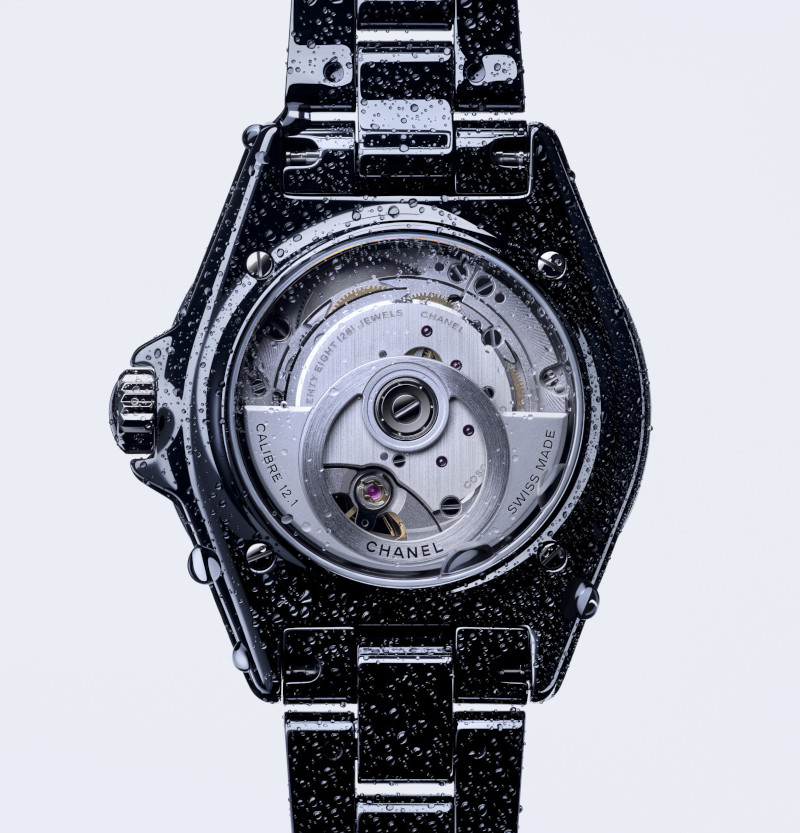
Both Calibre 12.1 and Calibre 12.2 have a distinct visual aesthetic. Visible from the transparent caseback, the circular rotor, specifically crafted by the House, resembles an observatory clock. Through the openworked oscillating weight, the lively mechanism is fully visible and forms a perfect circle, a design that highlights Chanel’s obsession with balanced proportions and the discreet power of lines.
From the very beginning, the J12 was defined by its glossy black exterior, the original icon in its purest form. In 2003, Chanel unveiled a full‑white ceramic version, and for years this monochromatic duo of black and white became the visual language of the collection, regardless of function, movement, or design inspiration. Last year, however, Chanel announced a major update to their collection offering the iconic J12 in blue. A blue so far on the darker end of the spectrum that it is almost black.
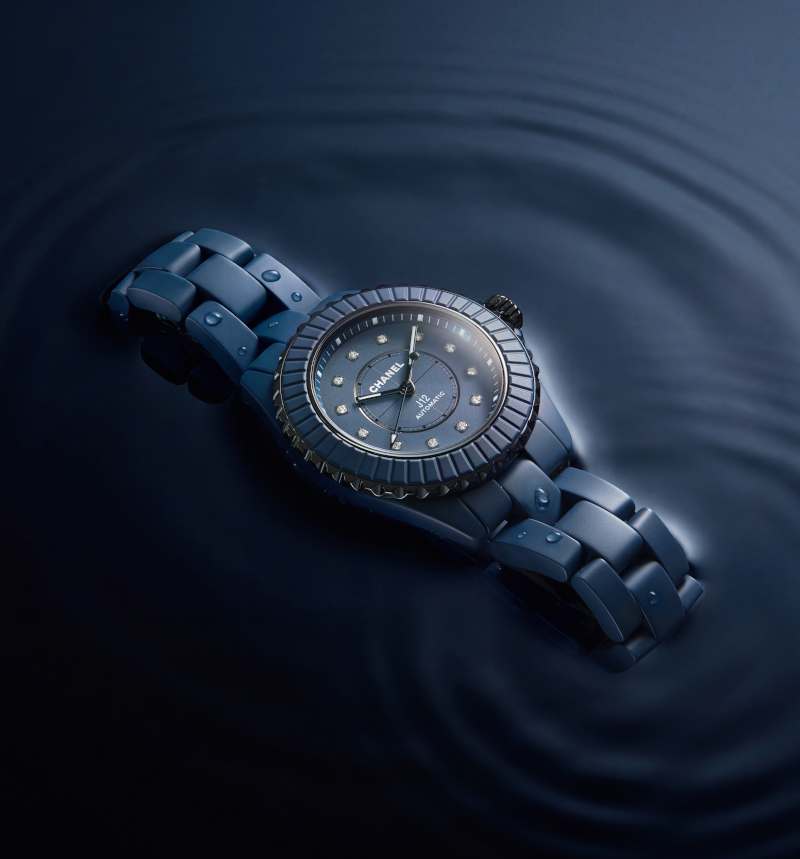
They spent five years developing this particular shade of blue and it is hardly excessive when you consider the complexities of ceramic production. Unlike traditional metal cases, which are forged into solid tubes before being cut and milled, ceramic components are pressure‑moulded directly into their final shapes. They then undergo a sintering process, where extreme heat, up to 1,300°C hardens the material into its finished form. To introduce colour, pigments are mixed into the ceramic compound before moulding. However, heat can dramatically alter these pigments. The maximum temperature reached, the duration at peak heat, the cooling rate, and even the length of the cooling period can all influence the final shade of colour on ceramic.
Needless to say, the nearly three decades that Chanel has worked with ceramic has given them a vastly better understanding of how to bend this material to their will. This savoire faire is also the reason why they are able to offer the J12 with a fully ceramic bracelet. Unlike the relatively larger form of the watch case, the bracelet is composed of numerous tiny links. Smaller components mean less surface area, which can influence how the material behaves during sintering and therefore alter its outcome. Even after the sintering is done, Chanel still has to precisely shape the material to its final silhouette which requires a series of extremely precise mechanical processes. The result, however, is worth the effort as the J12’s ceramic construction is seven times more resistant than steel and can withstand extreme conditions tested via millions of abrasive grains, thousands of impacts and dozens of hours under the sun’s UV rays.

Last year with the arrival of a new colour, Chanel had also added a new matte finishing to the J12 collection which transforms it entirely. While the mirror polished J12 will remain as the iconic model for the collection, the matte finishing on the J12 expanded the possibilities. It gave the J12 a more dynamic aesthetic transitioning from a more eye-catching accessory on the wrist into a quieter, more subtle form of luxury.
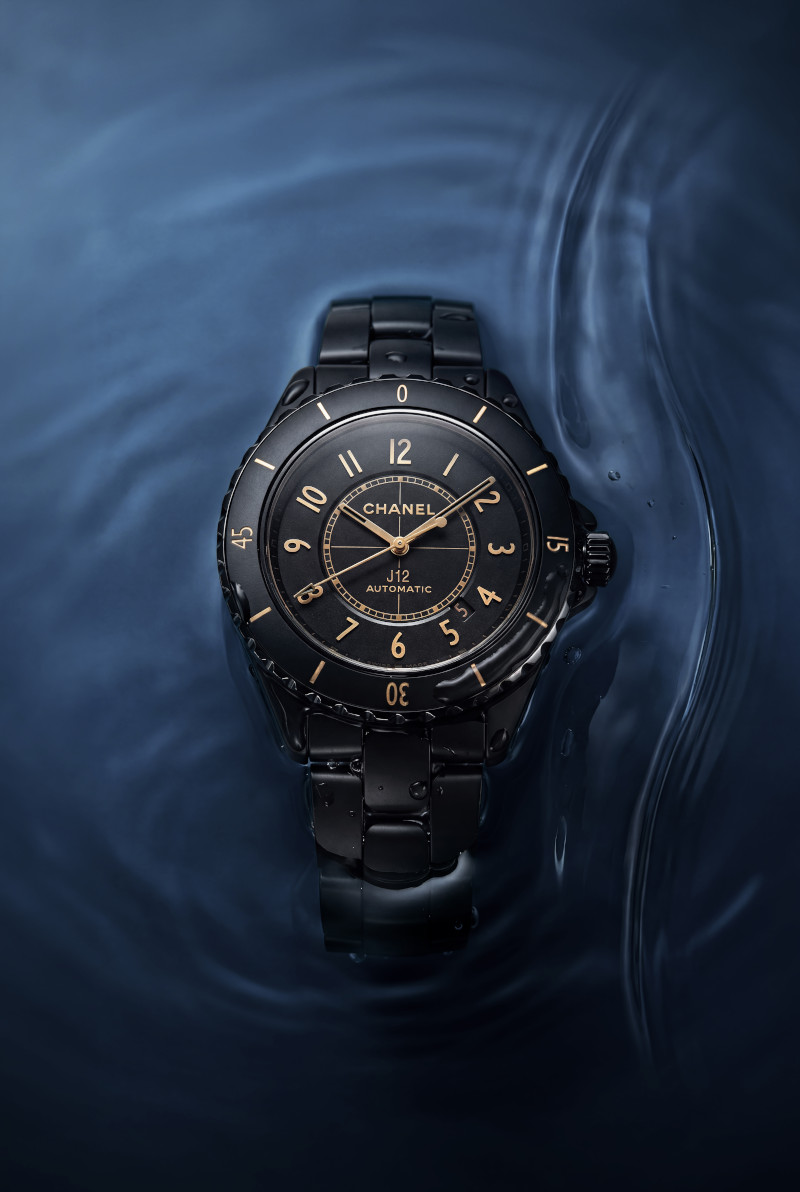
Finally, this year, the matte finish accompanies Chanel’s black J12 in the form of the J12 Golden Black. The changes are subtle, but once again the J12 is completely transformed. The combination of sand‑gold numerals on the bezel and matching indices creates an elegant yet sporty interpretation of the J12. And yes, this is the watch that introduces the first matte‑black finish in the collection. Adding to its sportiness, the J12 Golden Black also debuts a new 42 mm diameter, giving those with larger wrists the ability to wear a J12 without it appearing comically small.
At the other end of the spectrum, Chanel will also debut another new size for the J12 this year: 28 mm. The 28 mm J12 Golden Black will feature a quartz movement, as there is currently no mechanical calibre suited to such a small case size. It will also come with a polished finish instead of the matte finish found on the 42 mm model. The 28 mm, however, will not be limited to the Golden Black colourway; instead, it will be offered in six new models, including one paired with a black rubber strap.
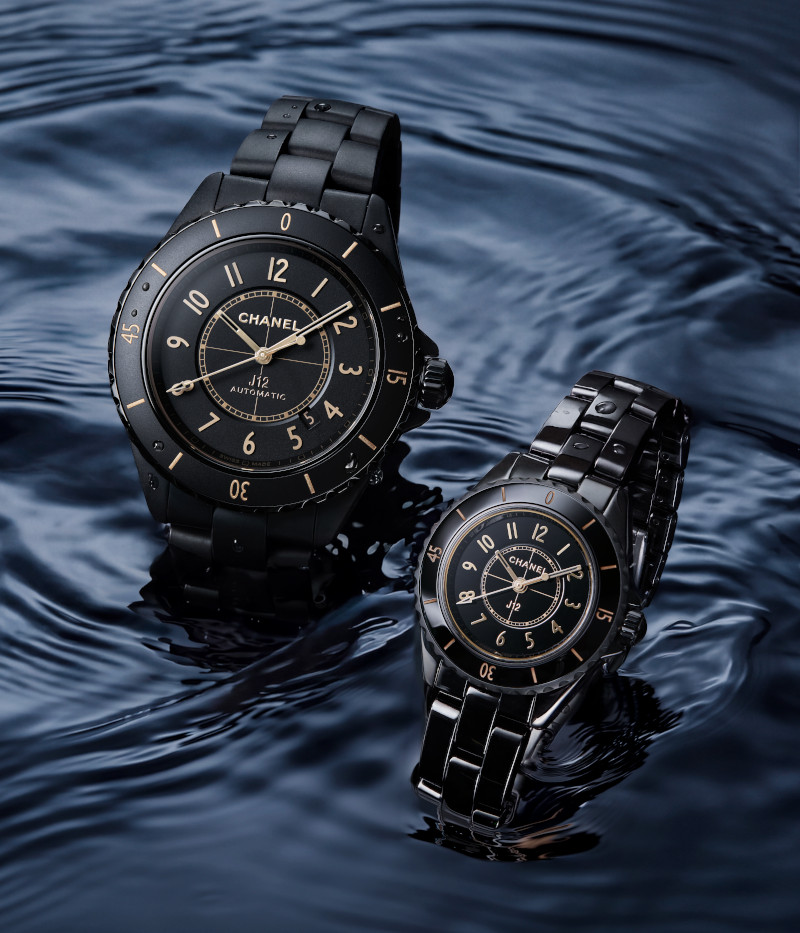
The full J12 range now spans 28 mm, 33 mm, 38 mm, and 42 mm, meaning there is a proportionate option for nearly every wrist. Then come the colours and finishes: polished or matte, black, white, or blue. The range is remarkable. With all these options, the J12 collection has become incredibly versatile. It represents a departure from the monolithic ethos of the original J12, evolving into a collection that celebrates diversity in its wearers. Thankfully, the design codes of the J12 have become so iconic within the industry that even with resized cases and new colours, a cursory glance is enough to identify the watch as a Chanel J12. It remains the same watch through and through, only now, there is a near‑perfect fit for almost every taste. So, I ask you again: has the J12 become water?