Blancpain's latest Villeret update is complexity disguised as simplicity
Blancpain updates one of its simplest yet most historically rich collections, the Villeret, with new colours and a host of …
If I were to ask, right now, what Blancpain is known for, the answer would invariably be the Fifty Fathoms. Quick, what is the other collection that Blancpain produces? It is only the most invested of the watch nerds that can immediately answer Villeret. It is true that Blancpain is often synonymous with the watch that has sparked many debates about the world’s first dive watch, the Fifty Fathoms. However, all things considered, this feat represents but a drop in the ocean (sorry, couldn’t resist) of Blancpain’s history.
What if I told you that within Blancpain exists a separate timeline where its movements, especially the ultra-thin ones, were once renowned in the industry and even supplied to brands like Patek Philippe, Audemars Piguet, and Vacheron Constantin? The legacy of this savoir-faire suddenly becomes conspicuous when you shift your attention to the Villeret collection, where most of the traditional complications are found. There is no better time to pay attention, because recently Blancpain updated this collection with 16 new references within three iconic models. At the centre of it all is a gorgeous, earthy colour palette of brown and beige that recalls the magic of the golden hour.
The Blancpain insignia clearly indicates that the brand was first established in 1735, making it one of the oldest watchmaking brands still in existence today. However, to really understand Blancpain in its current form, there are actually two separate timelines that eventually merge in relatively recent times. The first is, of course, the one with Jehan-Jacques Blancpain, who registers himself as a watchmaker in Villeret back in 1735. Jehan-Jacques’ grandson, Frédéric-Louis, would later go on to upgrade the Villeret workshops and, in turn, his son Frédéric- Emile Blancpain would then rename the company to Fabrique d’horlogerie Emile Blancpain and turns it into the largest watch manufacture in Villeret.

Then begins the next chapter in Blancpain history, where Frédéric-Emile Blancpain, upon his death, leaves the company to his long-term assistant, Betty Fiechter, in 1932, who became the first female CEO of a leading watch company. Then, in 1950, Betty brings her nephew, Jean-Jacques Fiechter, into the fold, co-managing Blancpain until she retires 20 years later. The story of how Jean-Jacques Fiechter and his personal experience with diving gave birth to the now legendary Fifty Fathoms dive watch has already been immortalised and recounted numerous times, especially so in 2023 when the brand celebrated the 70th anniversary of the Fifty Fathoms.
Before moving on to the next chapter of Blancpain after Fiechter’s stewardship, its best we rewind the timeline to 1859 for the second track that is paramount to Blancpain’s history. For this, we journey more than 100km southwest of Villeret to the Vallée de Joux, more specifically Le Brassus, where Louis-Elysée Piguet transforms an old mill into his watchmaking workshop. Louis- Elysée Piguet is a name that is not quite commonplace in today’s horology landscape. No, he is not the Piguet from Audemars Piguet, but rather, he is the founder of what will go on to become the important movement manufacture, Frédéric Piguet.
I can’t go into the entire history of Frédéric Piguet here, as I neither have the space nor the knowledge for this. However, what I can say is that the gist of it is that they were important players in the horology innovation space and were important movement suppliers to some of the biggest names in the watchmaking industry. One such example is the Frédéric Piguet Calibre 21, which, at 1.75mm thick, held records as one of the thinnest movements. It was made in 1925, and the movement, along with its derivatives were used by the so-called holy trinity of watchmaking: Patek Philippe, Audemars Piguet and Vacheron Constantin, and even brands like Jaeger-LeCoultre and Cartier.
At about this point, one must be wondering why all of this is relevant to our story about Blancpain, and the point of convergence lies in the chapter right before the Blancpain we know today which is a part of The Swatch Group. In 1961, Blancpain became part of the Société Suisse pour l’Industrie Horlogère (SSIH) alongside Omega, Tissot and Lémania as the movement producer for the group. However, by 1982, Blancpain was no longer as active as it once was, and it was Jacques Piguet, the heir to the family business created by Louis-Elysée Piguet, who bought Blancpain from the SSIH.
Jacques Piguet’s intention was to link Frédéric Piguet movements with the Blancpain brand. And to accomplish this, he teamed up with Jean-Claude Biver, who together coined the now immortal slogan “Since 1735, there has never been a quartz Blancpain watch. And there never will be.” To demonstrate how serious they were at the time about preserving traditional watchmaking, they set out to create a collection of six masterpieces: a complete calendar moonphase, ultra-thin, perpetual calendar, minute repeater, split-seconds chronograph, and flying tourbillon. And the true reason all of this is relevant to a story about an update to the Villeret collection is that these six masterpieces were all created with a design philosophy that is still very much alive in the Villeret collection of today. Just do a quick online search for these masterpieces, and you will see the resemblance.
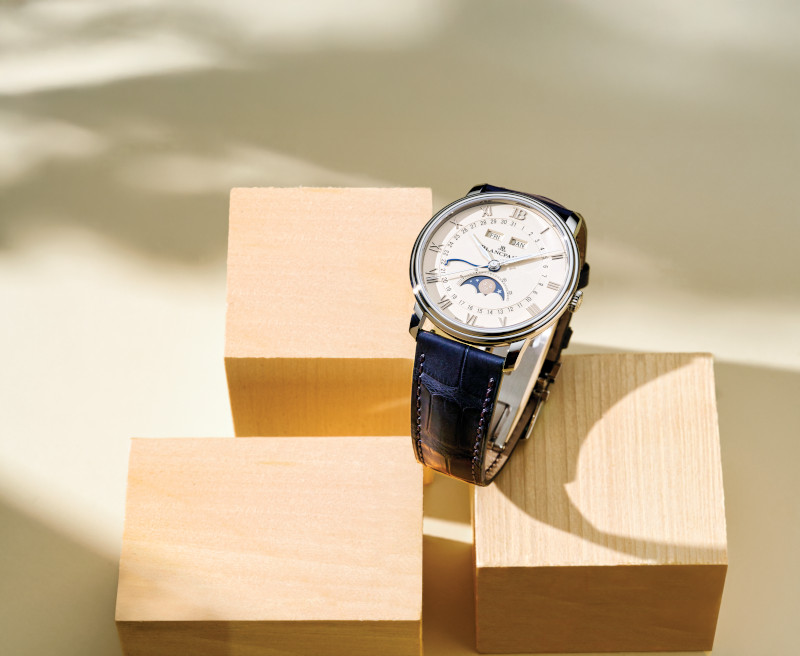
Just to showcase the success of this philosophy and perhaps to highlight the appetite for traditional mechanical watches that persists until today, Hodinkee indicates that Jacques Piguet and Jean-Claude Biver acquired Blancpain in 1981 for CHF 21,500 and in 1992, he sold both Blancpain and Frédéric Piguet to the SMH (Swiss Corporation for Microelectronics and Watchmaking Industries) which will later on become the Swatch Group, for a whopping CHF 60 million. In 2010, Frédéric Piguet was merged into Blancpain, and this is also the reason why, although the name of the collection and indeed the birthplace of Blancpain is in Villeret, they no longer have facilities there. Instead, they operate out of three locations, Le Brassus and Le Sentier, both locations tied to Frédéric Piguet’s manufactures and a watch finishing department in Delémont, which was created in June 2022 through the merger of the Manufacture with Simon et Membrez SA. In fact, remember the old mill that Louis-Elysée Piguet bought in 1891 in Le Brassus, it is now a Blancpain workshop, renamed “The Farm”, where the most demanding and challenging complications are produced.
Even though we have established that the modern Blancpain no longer has a presence in Villeret, the town still remains an important place in the brand’s history. Villeret, pronounced “ville-ray,” has a quirky backstory whereby an anagram of the word was used as the name of the company. It was about the time when Betty Fiechter took over the running of the brand, and due to Swiss law, they had to rename the company because it was no longer family owned. And it was then they renamed the company Rayville SA, an anagram of Villeret. And if you’ve ever seen a Fifty Fathoms watch with the name Tornek-Rayville on the dial instead of Blancpain, there is a whole other story about how this company was formed to supply the United States Military divers in the 1960s. But, I digress. Anyway, the gist of it is that the name Villeret remains incredibly important to Blancpain. It was in Villeret that Jehan-Jacques Blancpain first registered himself a watchmaker back in 1735, and thus, today, the most classical expression of Blancpain’s watchmaking is cradled within the collection of the same name.
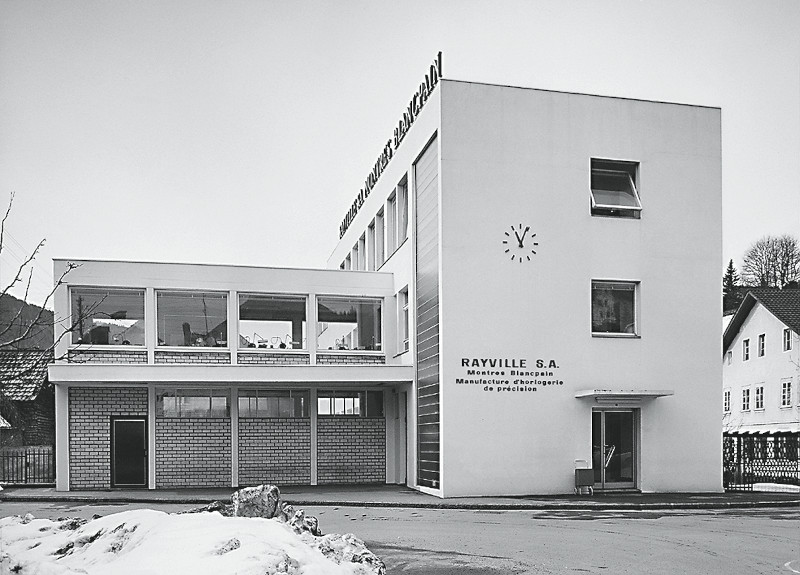
It was during the Jacques Piguet era of Blancpain where perhaps the spirit of today’s Villeret collection took form. The dedication to preserving and, more so, advancing mechanical watchmaking was a bold statement when you consider that during this time in the 1980s, many timekeepers were turning to quartz movements, which were more affordable to produce and could be done in greater quantities. The complete calendar moonphase launched in 1983 marked a turning point in the brand’s history. “This timepiece was more than a tribute to horological tradition,” recalls Marc A. Hayek, President and CEO of Blancpain. “It opened new perspectives and reignited interest in mechanical watchmaking.”
The list of references within the Villeret collection reads like a compendium of horology. It starts from the deceptively simple ultra-thin model and works its way up in terms of complexity to include tourbillons, complete calendars, perpetual calendars, minute repeaters and a combination of complications. One particular Villeret model that I remember being impressed by was a reference combining the Tourbillon and Carousel which then led me to discover the important distinction between the two. Even when they achieved the highly complex and, at the time, world premiere, Chinese Calendar in 2012, it was housed in the Villeret collection. The underlug correctors for perpetual calendars which was also patented in 2005, the Villeret collection. And the latest, world premiere, the Grande Double Sonnerie, which is discussed at length further back in this issue, you guessed it, the Villeret collection.
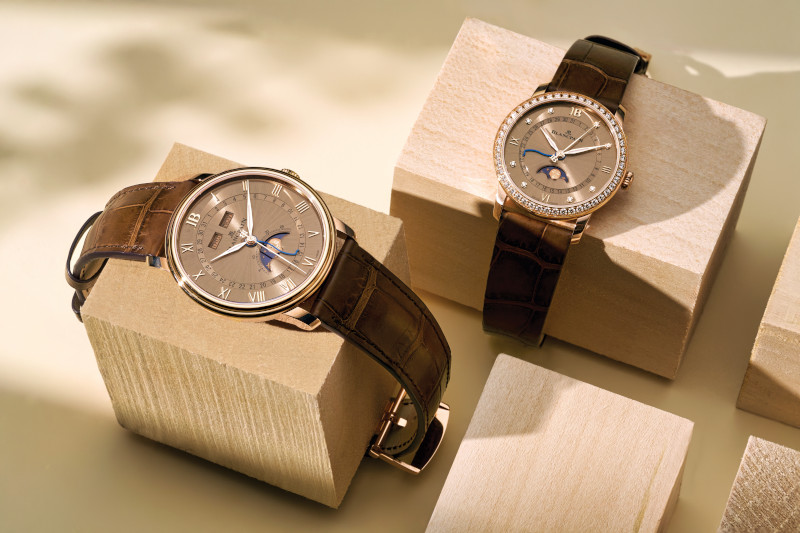
The point is, while the Fifty Fathoms can oftentimes be the dominant collection within Blancpain, because everybody loves a good dive watch story, the Villeret collection traces the roots of Blancpain as watchmakers. It blows past the 1953 timeline of the Fifty Fathoms going back centuries instead of decades, to a time when the Blancpain name and Louis-Elysée Piguet were renowned for the ingenious design of their movements.
The Villeret collection officially adopted its name in 2003, but as we have previously established, its true impetus dates back to 1983 with the launch of the, then, smallest complete calendar moonphase of its time. Not only did this first timepiece make a statement about Blancpain’s commitment to mechanical watchmaking, but it also represents the merging point with Frédéric Piguet and with it, its centuries of horology know-how. The timepiece from 1983 also defined the codes of the Villeret collection, namely its double stepped case and understated aesthetics, a design philosophy which still persists in the modern Villeret collection.
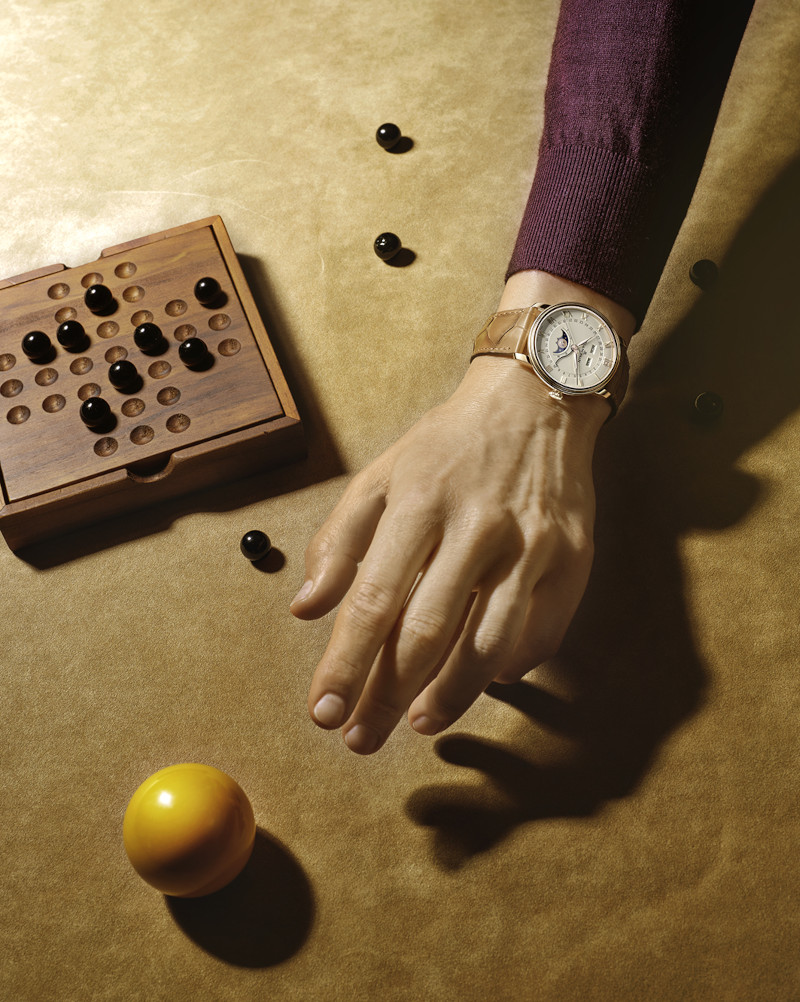
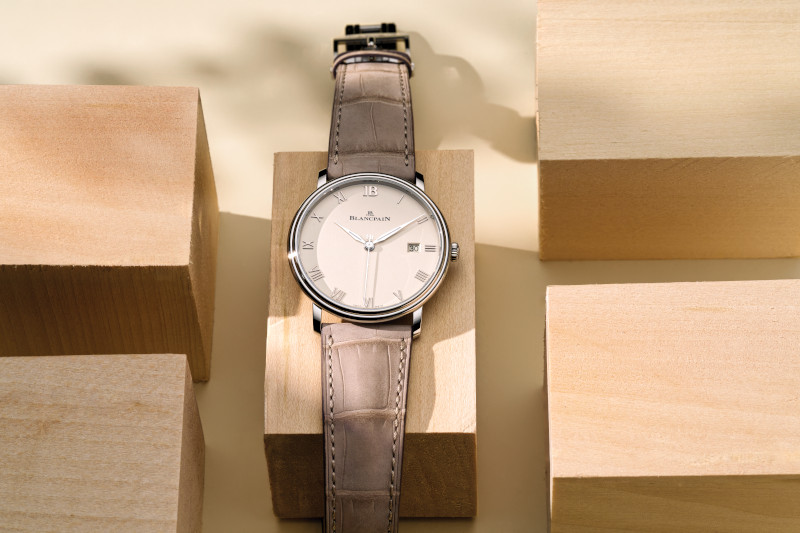
Last year, when Blancpain announced an update to the Villeret collection in the form of the Golden Hour, we thought it was just a couple of new colours for the dial. We were, undoubtedly, mistaken because unpacking this release, which comprises 16 new references across three references and two case sizes, it is obvious that this represents a new path forward for the storied collection. The dial, of course, represents a huge part of this update with new autumnal shades, including a stately opaline and a sublime golden brown dial with a sunburst pattern that will add to the variety of the Villeret silhouette. However, under the scrutiny of a loupe, the new Golden Hour collection represents far more than just a colour update. There are plenty of design details that have been subtly adjusted to bring the overall package to the next level.

The signature double stepped case has been adjusted so the bezel is slimmer, giving the watch the aesthetics of a larger dial without having to actually increase the case size. Then, the thinner profile, along with the reworked lugs and larger crown, work together to lighten the case without compromising on its presence on the wrist. Additionally, the 12 on the dial has also been replaced with a “JB” symbol to further pay tribute to Jehan- Jaques Blancpain, the founder. On the back, the oscillating weight has now been open worked to a larger degree so that it doesn’t hinder the view of the movement through the caseback. And with the addition of a system of interchangeable straps and clasps, the watch is now a lot more pleasant to wear.
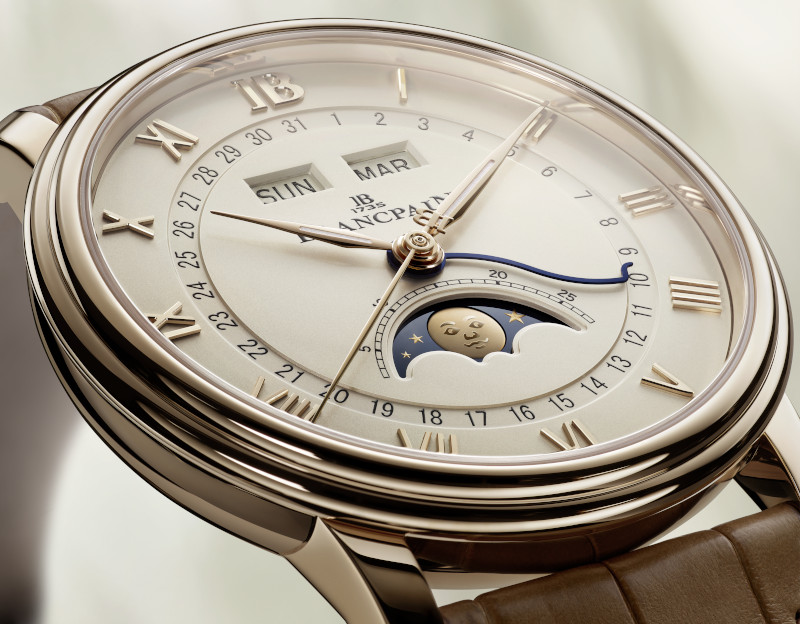
By far, my favourite update to the Villeret collection is the change to the iconic moonphase indicator. Firstly, the aperture has been enlarged so you see more of the moon, and now their expressive moon face has been transformed to an applied gold moon dome that has been satin finished. Reading this, it may not seem like such a big deal, but put the old and the new moonphase side by side, and the improvements to its legibility are obvious. And speaking of legibility, all 16 references have also been given Super-LumiNova on their hands.
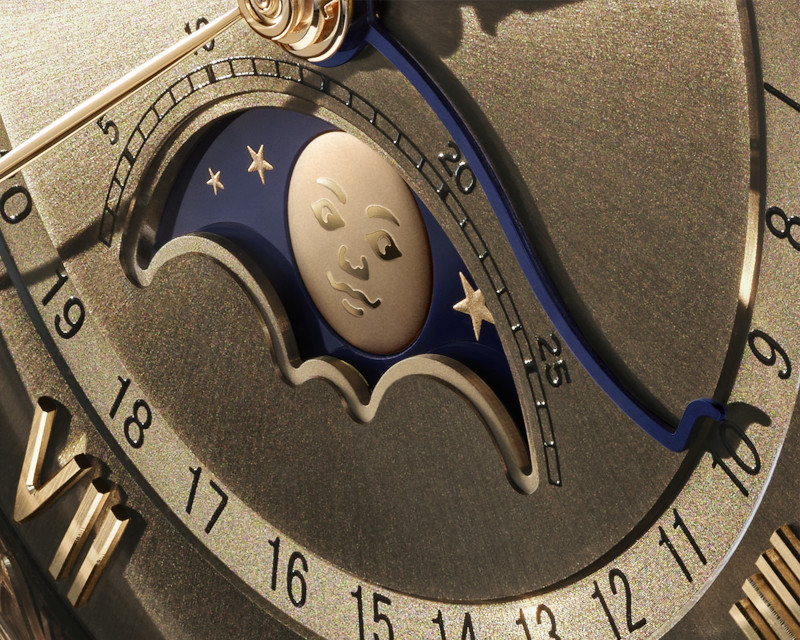
These improvements to the Villeret collection will be adopted across the three references in the Golden Hour update. This includes the complete calendar with a moonphase indicator in a 40mm case (Villeret Quantième Complet), an ultra-thin automatic three-hand model also in the same case size (Villeret Extraplate) and a moon phase calendar in a smaller 33.2mm case (Villeret Quantième Phases de Lune). Each of these models will come with a choice of the opaline or golden brown and will offer either a stainless steel or 18K red gold case.
“The Villeret embodies the very essence of Blancpain,” concludes Marc A. Hayek. “Each of its evolutions, therefore, requires great attention. It is both the expression of our watchmaking tradition and the proof that timeless elegance can always be reinvented with subtlety. One is never overdressed or underdressed with a Villeret.”