Cartier’s Tressage demonstrates the ability to treat metal like silk
There is a particular kind of magic that happens at Cartier—an alchemy that transfigures the rigid into the fluid. To …
There is a particular kind of magic that happens at Cartier—an alchemy that transfigures the rigid into the fluid. To them, a watch is rarely just a timekeeper; it is a “watchmaking sculpture,” a term the maison uses to describe pieces that occupy that rare, atypical territory between high jewellery and horological precision. Its Tressage collection is a stunning inhabitant of this space—a series of four timepieces that beautifully tell the time while celebrating the very act of making and creation.
To understand the Tressage—taken from the French word for braiding—one must first understand the woman who made the maison roar: Jeanne Toussaint. Appointed Cartier’s first female Creative Director in 1933, Toussaint—famously nicknamed “La Panthère” by Louis Cartier—was a visionary who loathed the flat, abstract geometries of her era. She craved volume and obsessed over the tactile.

It was under her steady hand that Cartier moved toward a more three-dimensional, figurative style, one where gold was gadrooned, braided, and woven like silk. This year’s collection specifically channels the spirit of the Cartier Libre line, where the maison’s design studio is given free rein to dismantle house motifs and reassemble them through a contemporary, often radical, lens.
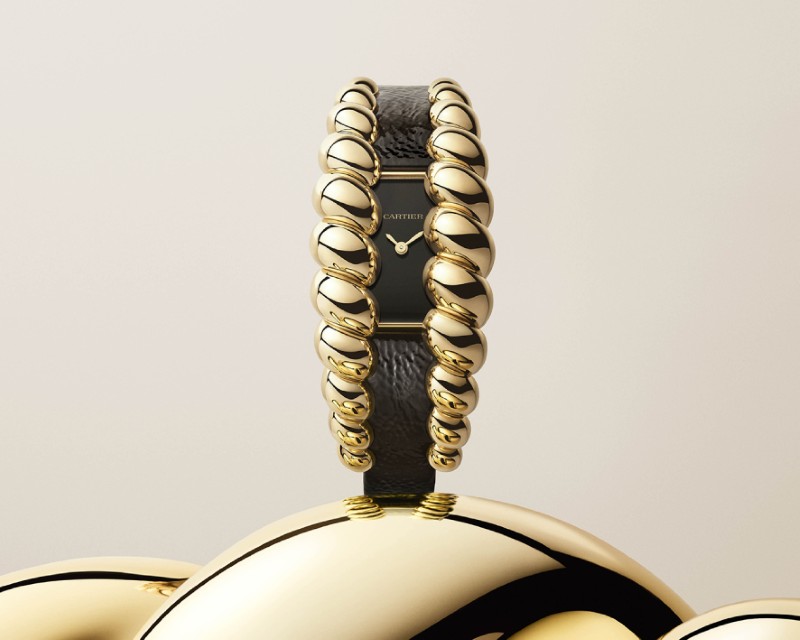
Toussaint’s legacy is a thumbprint on every piece of the Tressage collection. She had a unique ability to transform the hardest materials into something that conveyed a sense of softness—what Cartier calls “constraint and release.” The Tressage watch takes this concept and amplifies it. By enlarging and elongating the brancards, the vertical sidebars traditionally found on the iconic Tank, Cartier’s artisans have sculpted a voluptuous, twisted form that wraps around the wrist like a golden rope.
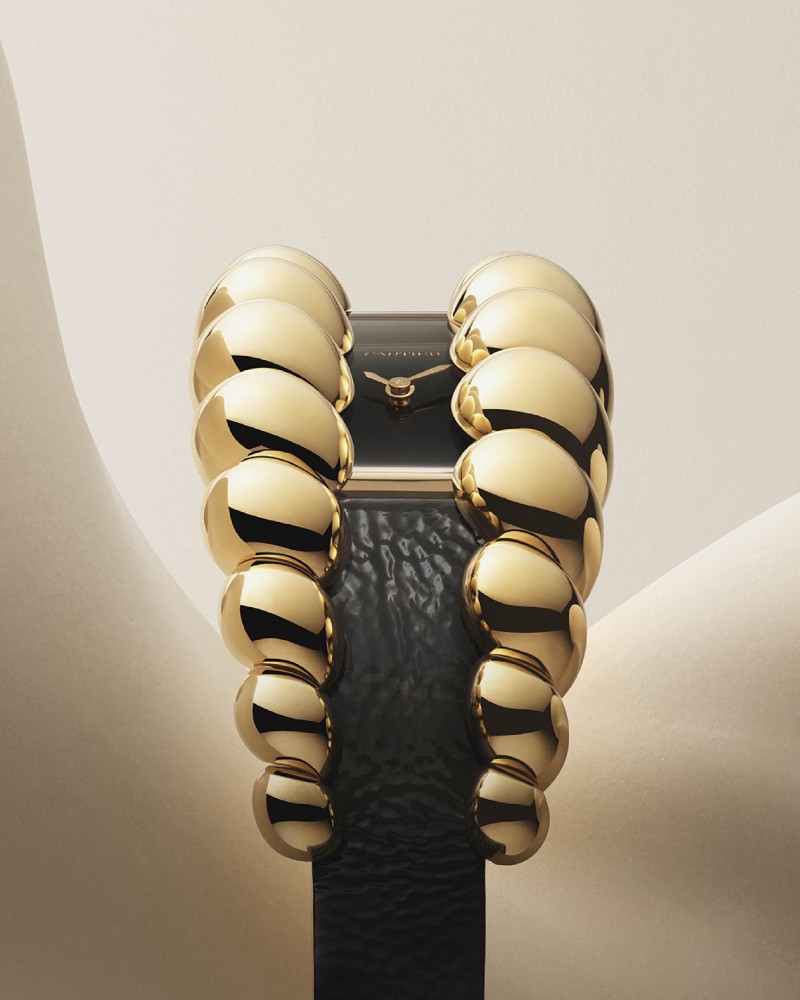
On the wrist, the ergonomics are surprising. Despite their substantial appearance— measuring 56.2 mm in length—the watches wear with remarkable lightness. The case is meticulously curved to match the natural arc of the human wrist, a design philosophy that stems directly from Cartier’s heritage as a jeweller. In the same way a high-jewellery necklace is engineered to move with the body, the Tressage is designed to be felt as much as seen. It is a “second skin” approach that ensures the watch never feels like an imposition, but rather an extension of the wearer’s own anatomy.
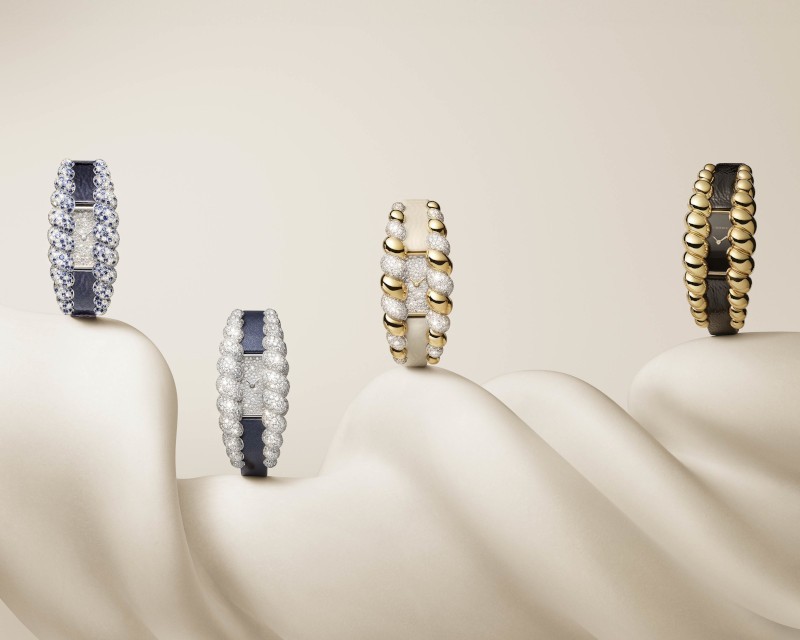
The collection is expressed through four distinct aesthetic lenses, each offering a different dialogue between metal and stone. For those who appreciate the stark, cinematic elegance of Art Deco, the first model is a revelation. Crafted in 18-carat yellow gold, it features smooth, polished gadroons that spiral around a minimalist black lacquered dial. There are no indices here, no diamonds to distract—just the raw, warm glow of gold against a void of deep black. Paired with a shiny black calfskin strap, it is a piece of graphic tension that feels both ancient and incredibly modern.
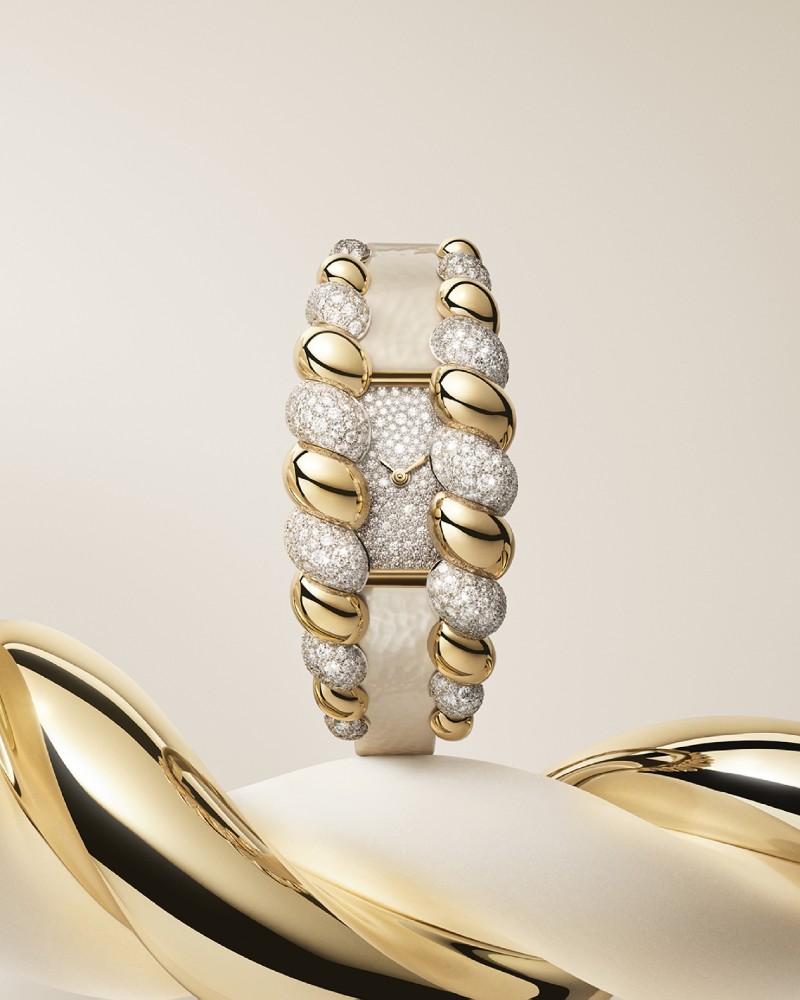
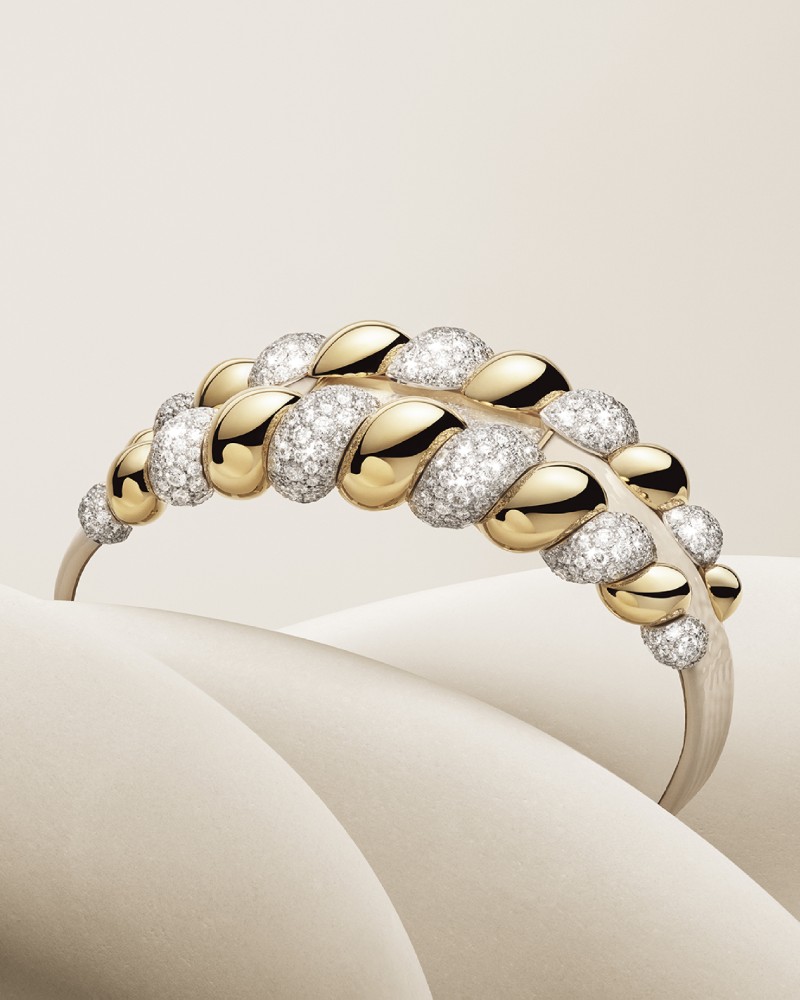
The second iteration introduces a more complex interplay of light. Here, Cartier mixes yellow gold with white gold, alternating smooth ropes of metal with bands of brilliant-cut diamonds. This model features a white gold dial finished with a snow-setting technique, where diamonds of varying diameters are placed so closely together they mimic the irregular, shimmering crust of fresh snow. With 466 diamonds totalling 6.3 carats on the case and buckle, it is a softer, more luminous take on the twisted silhouette.
If the previous models were studies in contrast, the third is a study in absolute brilliance. Fully rendered in white gold and entirely paved with 916 diamonds (totalling 12.2 carats), this version is a spectacle of high-jewellery craftsmanship. The braid here is formed entirely of light, with the snow-set dial blending seamlessly into the diamond-encrusted brancards. Paired with a navy blue calfskin strap, it evokes the cold, sharp elegance of a winter night, where every surface seems to vibrate with reflected light.
The apex of the collection is perhaps its most artistic. This final model splices a gradient of 330 sapphires (5.9 carats) among 570 diamonds (5.7 carats). The sapphires transition in hue as they spiral down the gadroons, creating a sense of movement and depth that feels almost organic—like a conical shell or a creature from the deep. The navy blue strap echoes the deep tones of the stones, creating a harmonious, monochromatic flow that feels like a modern tribute to Toussaint’s love for unexpected colour combinations.
Beyond the stones and the gold, there is a technical feat in the proportions. The Tressage watch sits 11.5 mm high, yet because of the deep curvature of the case back, it avoids the top-heavy feel common in larger jewellery watches. Each watch is powered by a high-precision Swiss quartz movement. While mechanical purists might look for something more cerebral, the use of quartz here is a tactical necessity—it allows the design team to push the radical, asymmetrical proportions of the braid without being hindered by the height or diameter of a mechanical movement.
Ultimately, the Tressage collection is a reminder of Cartier’s unique position in the world of luxury. Much like Jeanne Toussaint herself, the maison refuses to be categorised. It is, in many ways, proof that even in the precision-driven world of watchmaking, there is always room for the magician’s touch.