Luminox’s New Bear Grylls Survival Master Is Both Cool And Life-Saving
In the world of extreme survival, there is one singular truth: if you aren’t prepared, the environment will eventually find a way to break you. It’s a reality British adventurer and television presenter Bear Grylls has navigated from the peaks of Everest to the deepest reaches of the Amazon. For the 51-year-old former SAS trooper, a watch is also a vital tool that must survive the same punishment as the person wearing it. The latest collaboration between the survival icon and Luminox, the Survival Master LM3741.OLIVE, is built on this very foundation of resilience.
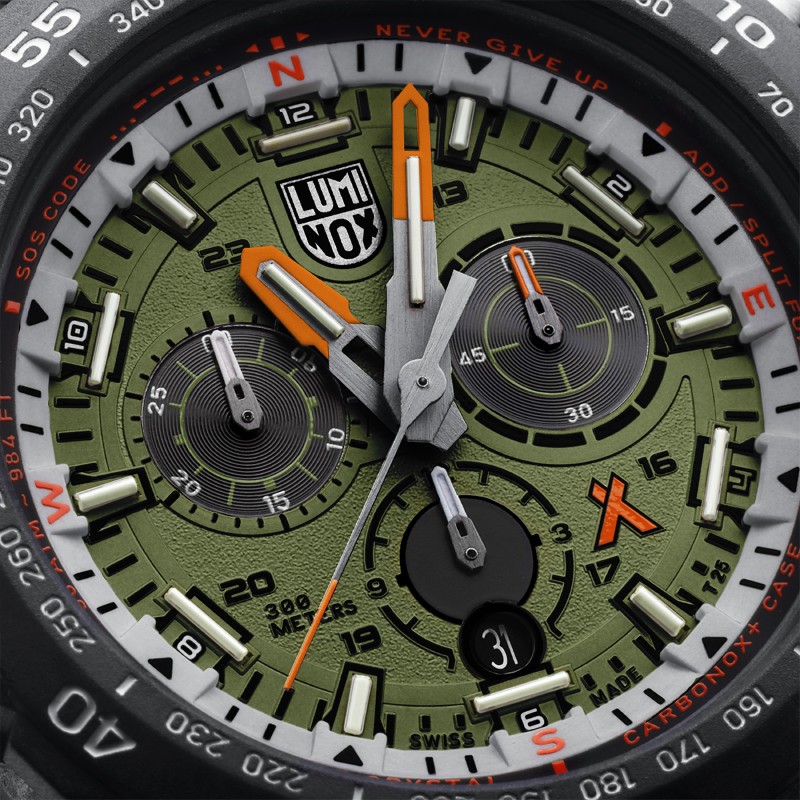
Limited to just 500 pieces worldwide, this new iteration introduces an earthy, olive-toned aesthetic designed for camouflage within natural foliage, seemingly a deliberate shift toward subtlety. On the wrist, the olive vulcanised rubber strap and matching dial blend into the background of a jungle or forest floor, yet the watch remains a quiet but unmistakable presence.
What defines a Survival Master in the eyes of a connoisseur, however, is the integration of genuine utility into the design. At 45mm, the case is crafted from Carbonox+, an ultra-robust carbon-based material that provides the structural integrity of steel at a fraction of the weight. It is exceptionally durable and lightweight, ensuring it doesn’t become a burden during a technical climb or a long trek through demanding terrain. This robustness is powered by a Swiss-made Ronda quartz movement, a calibre chosen for its unwavering precision and shock resistance in the field— essential when a mechanical hairspring might falter under extreme vibration.
The dial is where Grylls’ personality and survival ethos truly shine. Beyond the three-eye chronograph layout and date function, the dial incorporates an SOS Morse Code guide—a small but vital reminder for emergency communication when technology fails. The high-contrast silver hour and minute hands move across a matte olive surface, while the orange compound crown, designed for improved grip even with wet or gloved hands, reflects Bear’s iconic colour identity. Flip the watch over, and you find his signature and personal motto on the caseback: Never Give Up.
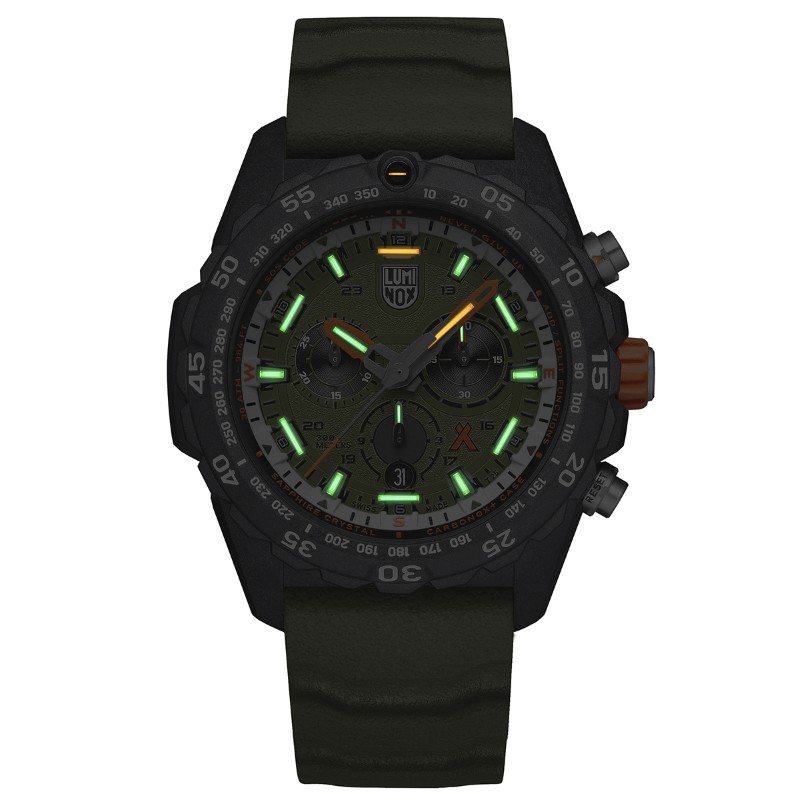
For those operating in the dark, the watch features 18 Luminox Light Technology (LLT) tubes. Unlike traditional luminescent materials that requires a light source to charge, these tritium gas tubes provide constant, self-powered visibility for up to 25 years. Whether you are at the bottom of a 300-metre dive—the watch’s maximum water resistance— or in a lightless cave, the time remains perfectly legible.
Perhaps the most charming and practical addition is the detachable compass fitted to the strap, a nod to the old-school principles of navigation that Grylls champions: quick, analogue, and always reliable. A symbol of preparedness for those who, as Grylls puts it, “crave the outdoors and thrive on unpredictability,” the watch truly embodies a spirit of adventure, resilience, and survival.
The beloved Jaeger-LeCoultre Master Control finally in a vintage 36 mm size
In 1992, Jaeger-LeCoultre took a decisive step in articulating its vision of modern classical watchmaking with the launch of the Master Control line. The collection marked a deliberate return to the elegance of mid-century round watches while staking a technical claim through the maison’s newly devised 1000 Hours Control testing protocol—an exacting regime that subjects the fully cased watch to six weeks of performance trials, far exceeding standard chronometric tests and encompassing real-world conditions such as positional variation and temperature change. The result was a family of timepieces that married austere proportion with mechanical rigour, and in doing so carved a distinct identity within Jaeger-LeCoultre’s broader oeuvre.
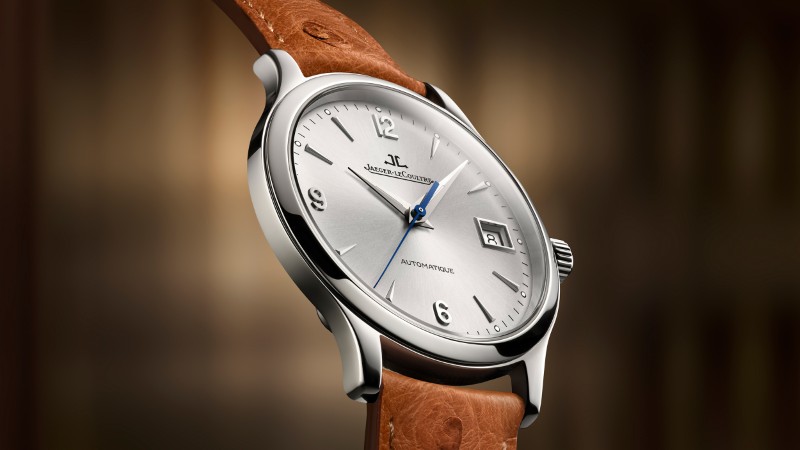
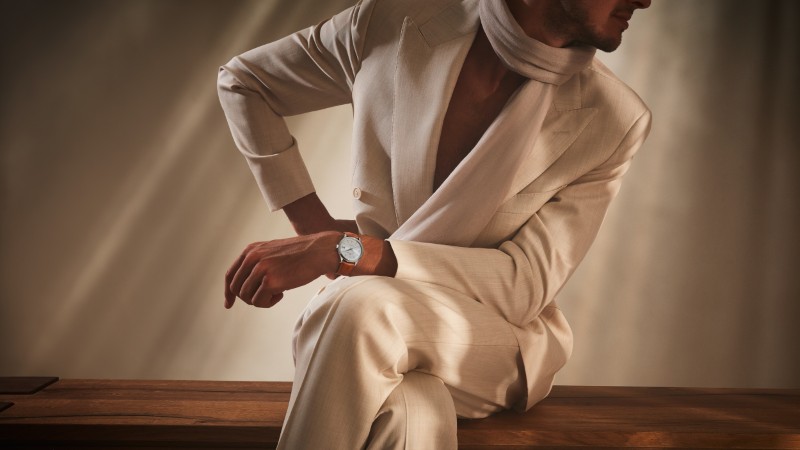
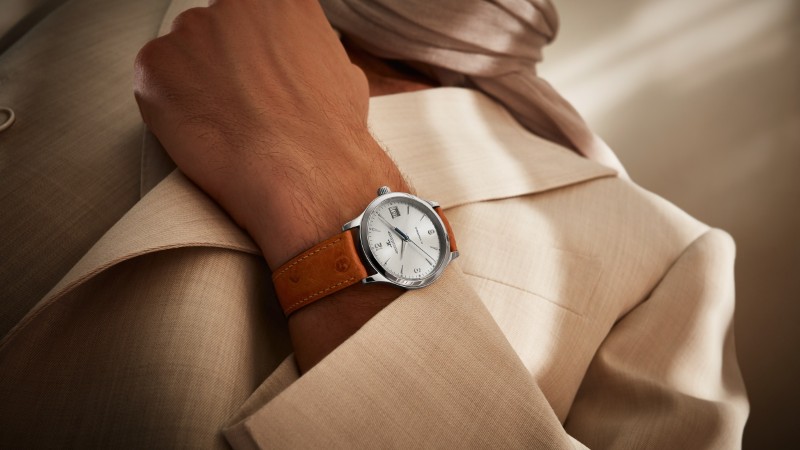
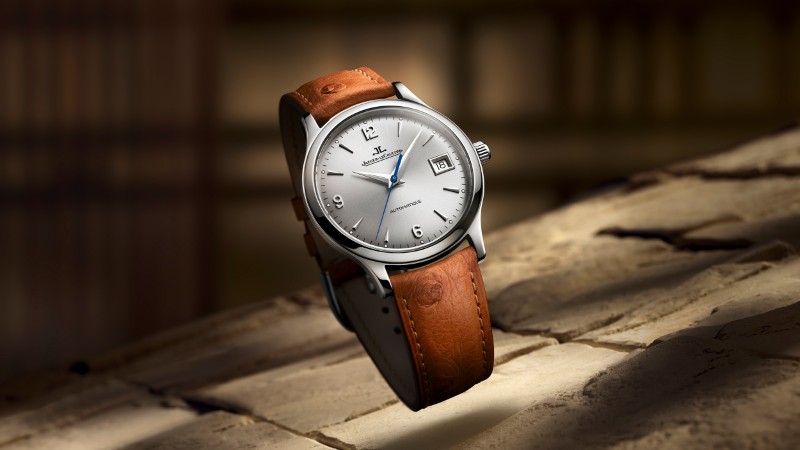
The new Master Control 36mm Classic revisits this lineage with a degree of fidelity that feels both purposeful and timely. Limited to 500 pieces and drawing on a 1995 reference as its stylistic ancestor, this new interpretation is not an exercise in archaism but a reminder of why proportion matters in a catalogue increasingly dominated by larger, more assertive cases. At 36mm in diameter and a slender 8.15mm in thickness, the watch possesses a poised presence on the wrist. Its restrained dimensions echo the quietly confident aesthetics of the original series, even as subtle refinements—a slightly larger aperture in keeping with contemporary sensibilities—lend it relevance for today’s wearer.
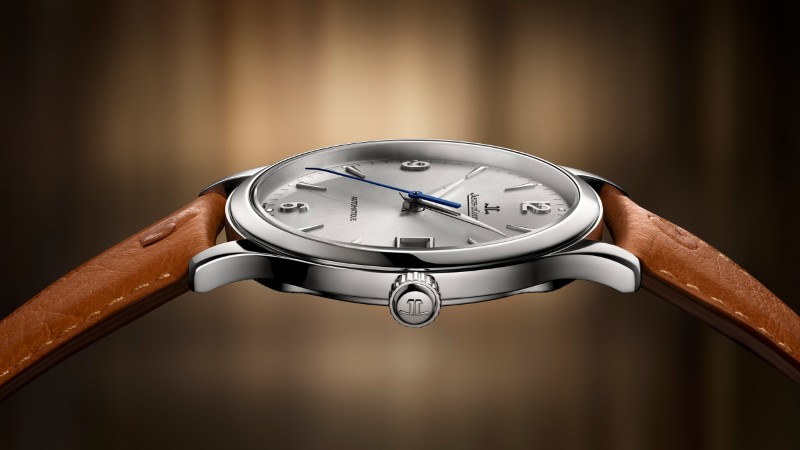
Stylistically, the dial speaks the Master Control’s visual vocabulary with crystalline clarity. A silver sunray finish provides a discreet backdrop for elongated triangular indices and dauphine hands, punctuated by a central blued seconds hand which has a hue that alters with the light. The execution is measured rather than expressive, privileging legibility and composure over ornamentation. Paired with a brown ostrich leather strap, the overall effect is one of calibrated elegance that looks neither retro for its own sake nor anachronistic in the present.
Beneath the dial sits Jaeger-LeCoultre’s automatic Calibre 899 in its latest configuration—a movement that, over successive generations, has become a pillar of the maison’s approach to understated precision. Offering a 70-hour power reserve, it combines robust performance with a slim profile that reinforces the watch’s refined case architecture. More importantly, its inclusion underscores that this is not merely a stylistic homage but a fully realised contemporary timepiece built to exacting standards.
The Master Control 36mm serves as a reminder that classical watchmaking need not be defined solely by complication or spectacle. Instead, it underscores proportion, restraint and craft as enduring values. In revisiting a model rooted in Jaeger-LeCoultre’s pivotal 1990s innovation—both in design and internal certification—the maison reasserts a commitment to horological fundamentals that feels both relevant and quietly authoritative.
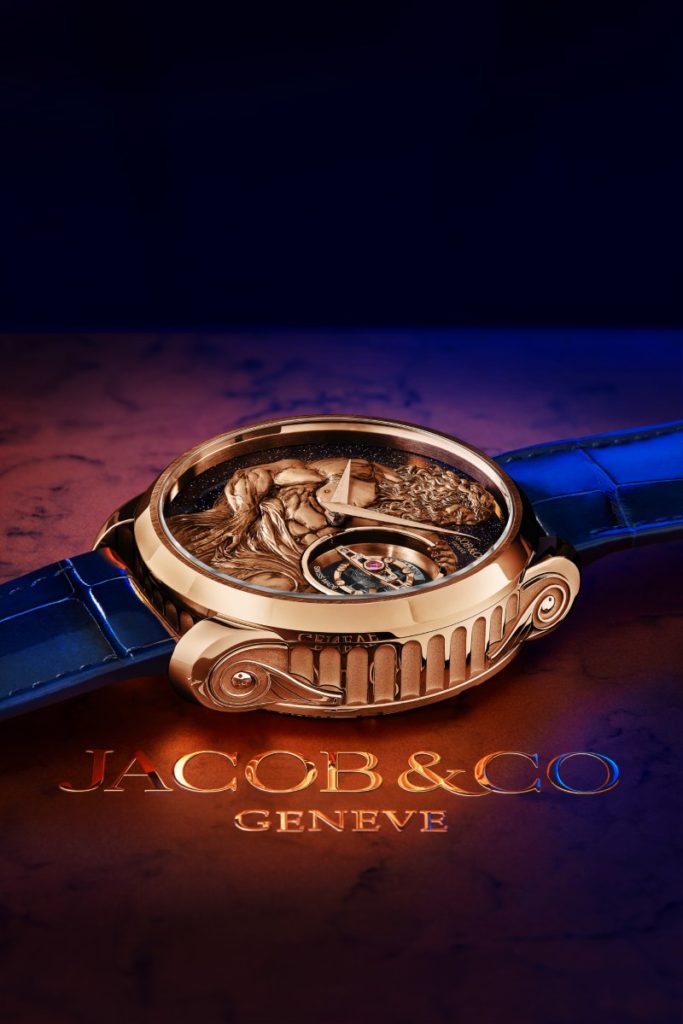
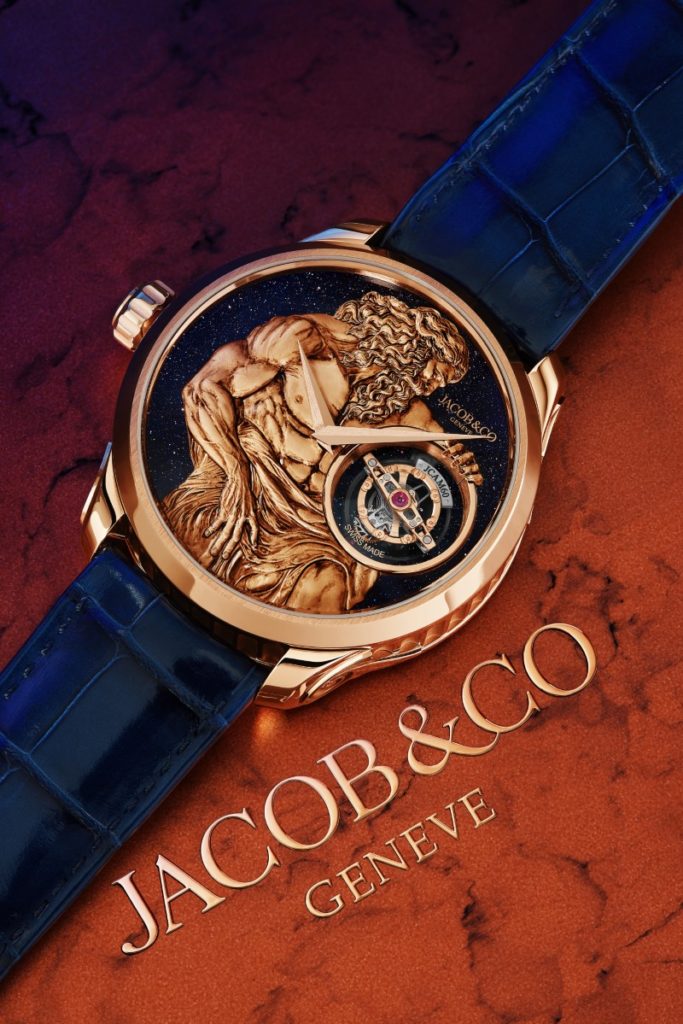
Jacob & Co.'s four second tourbillon breaks records
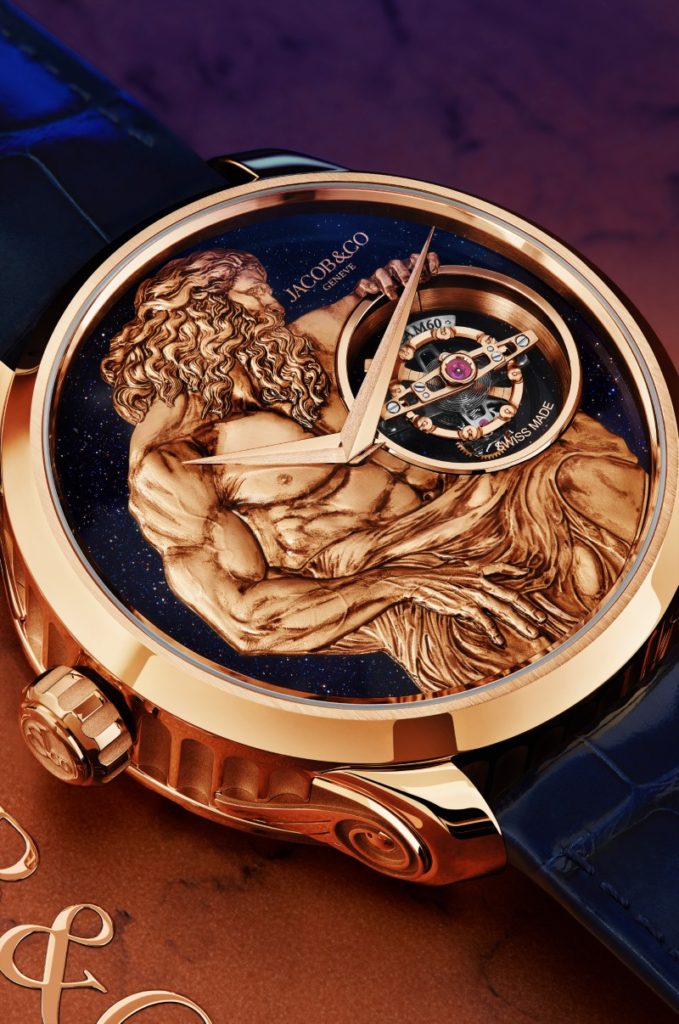
The tourbillon has long served as watchmaking’s theatre of virtuosity. Yet in the God of Time, Jacob & Co. transforms that theatre into velocity. At its centre spins what the brand describes as the fastest tourbillon ever created: a carriage completing one full rotation every four seconds. As we all know, the one-minute tourbillon remains the overwhelming norm, so such speed represents a deliberate recalibration of this regulating organ’s architecture, Abraham-Louis Breguet’s most iconic creation.
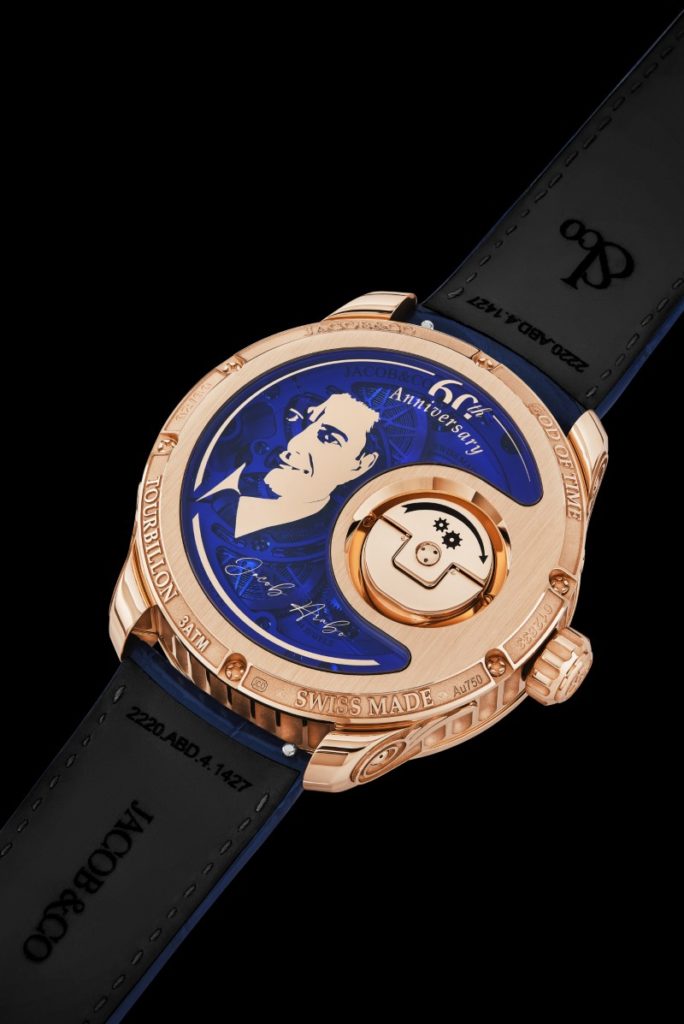
Achieving a four-second rotation—15 times faster than the classical standard—demands more than bravado; it requires a fundamental reconsideration of mass, energy and control. Developed from a blank page, the hand-wound Calibre JCAM60 is built around a tourbillon carriage weighing a mere 0.27 grams. Predominantly fashioned from titanium to reduce inertia, the 12mm carriage integrates a constant-force mechanism to buffer the enormous energy demands needed to generate such speed.
The physics are uncompromising: as rotational speed increases, the power required rises exponentially. To sustain a 60-hour power reserve while driving this high-velocity regulator, Jacob & Co. employs two sets of twin stacked barrels. A remontoire-style constant-force system positioned just before the escape wheel releases energy in precise increments at the escapement’s 3Hz frequency, acting as a safeguard against overwhelming torque.
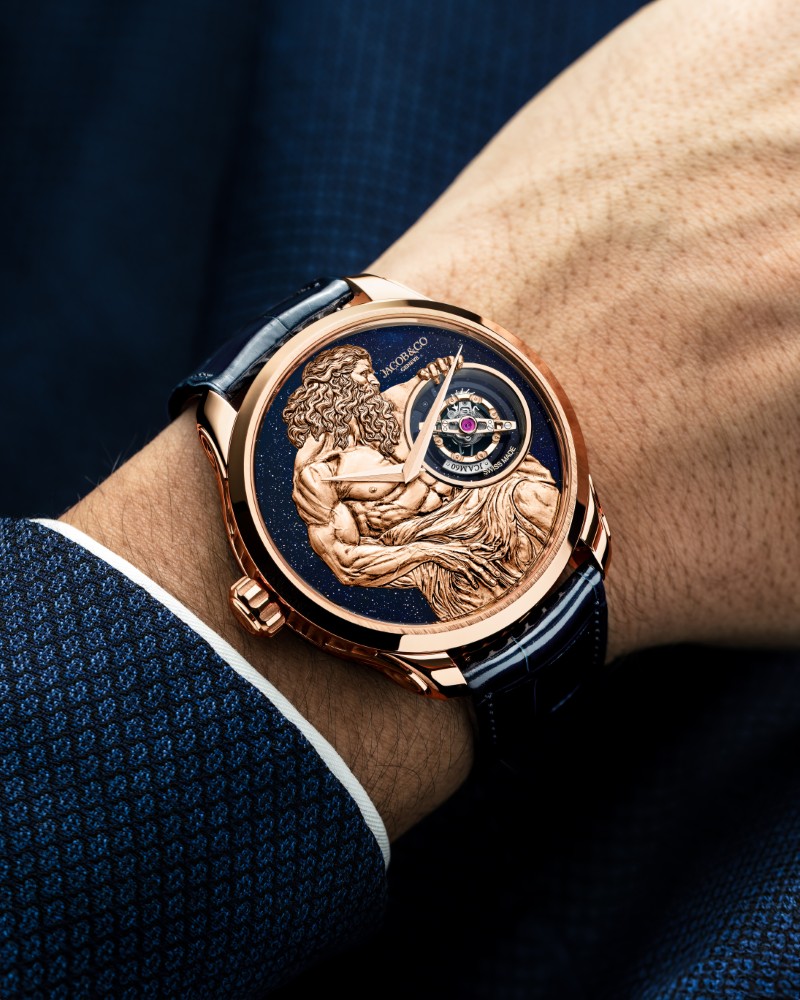
Yet the God of Time is not conceived as a technical abstraction, as its velocity is framed within a distinctly sculptural narrative. The dial is dominated by a three-dimensional rose gold figure of the Greek god of time, Chronos, rendered in high relief and hand-engraved over several days. At 37mm in length, the appliqué occupies much of the blue aventurine expanse, whose star-like inclusions reinforce the mythic atmosphere. Chronos appears to cradle the tourbillon, a visual allegory of time held in divine custody.
Time indication remains intentionally restrained: polished Dauphine hands sweep across the dial, their sharp geometry providing clarity against the richly textured backdrop. The hours and minutes are presented without conventional indices, allowing the sculptural composition and tourbillon aperture to dominate the visual hierarchy. The architectural metaphor extends to the 44.5mm rose gold case, where a fluted caseband and Ionic-inspired volutes evoke the column of a Greek temple. Measuring 18.25mm in height, the case possesses significant presence, yet its sculptural detailing tempers scale with proportion.
In recent decades, Jacob & Co. has cultivated a reputation for exploring the outer limits of the tourbillon form, from multi-axis constructions to rare constant-force implementations. With the God of Time, the maison adds another chapter to that catalogue: velocity as complication. It is a watch that asserts that technical extremity and visual drama need not exist in opposition. Here, mechanical acceleration and aesthetic mythology operate in tandem, each reinforcing the other.
Cartier’s Tressage demonstrates the ability to treat metal like silk
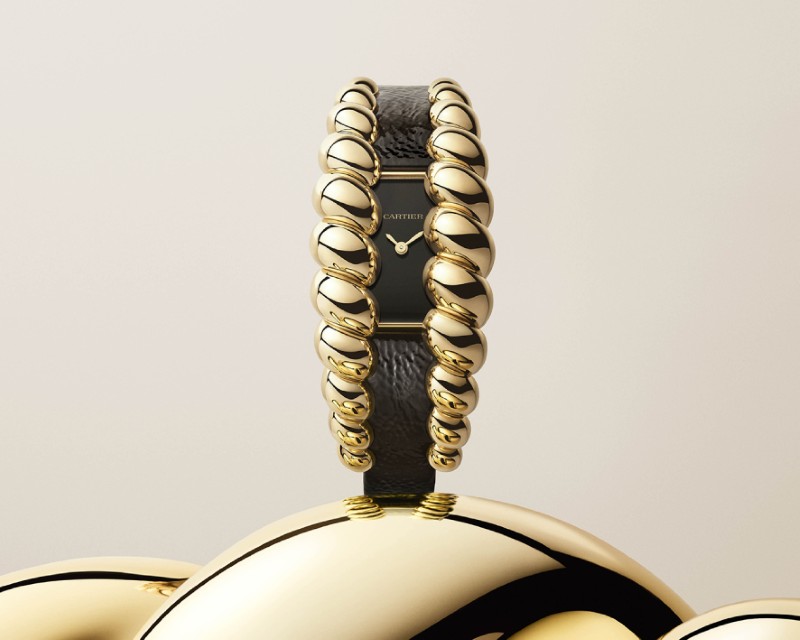
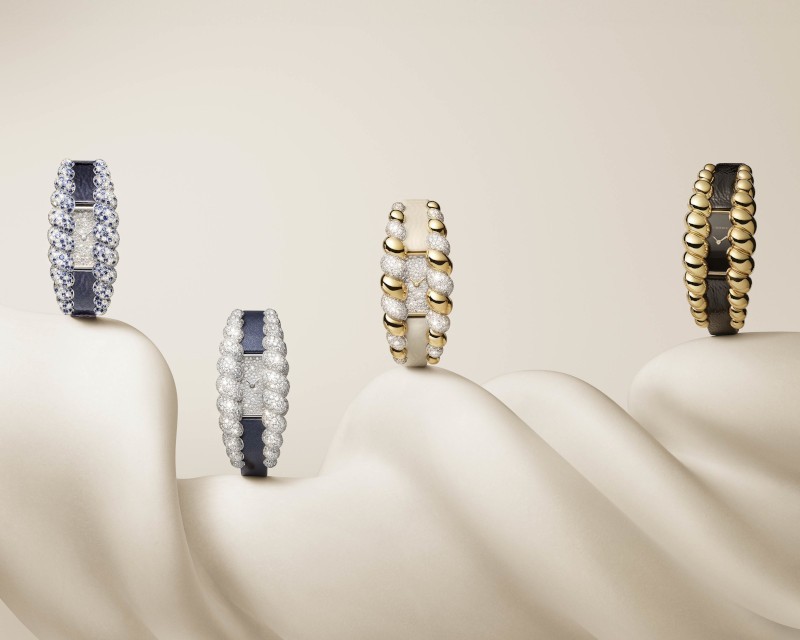
There is a particular kind of magic that happens at Cartier—an alchemy that transfigures the rigid into the fluid. To them, a watch is rarely just a timekeeper; it is a “watchmaking sculpture,” a term the maison uses to describe pieces that occupy that rare, atypical territory between high jewellery and horological precision. Its Tressage collection is a stunning inhabitant of this space—a series of four timepieces that beautifully tell the time while celebrating the very act of making and creation.
To understand the Tressage—taken from the French word for braiding—one must first understand the woman who made the maison roar: Jeanne Toussaint. Appointed Cartier’s first female Creative Director in 1933, Toussaint—famously nicknamed “La Panthère” by Louis Cartier—was a visionary who loathed the flat, abstract geometries of her era. She craved volume and obsessed over the tactile.
It was under her steady hand that Cartier moved toward a more three-dimensional, figurative style, one where gold was gadrooned, braided, and woven like silk. This year’s collection specifically channels the spirit of the Cartier Libre line, where the maison’s design studio is given free rein to dismantle house motifs and reassemble them through a contemporary, often radical, lens.
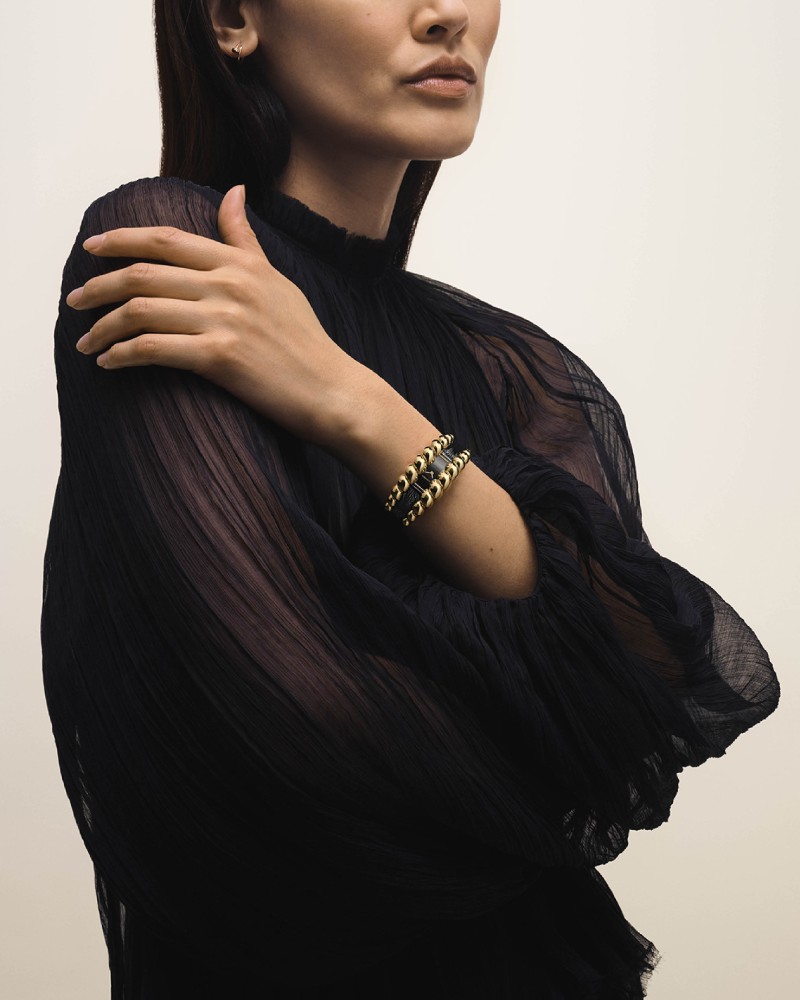
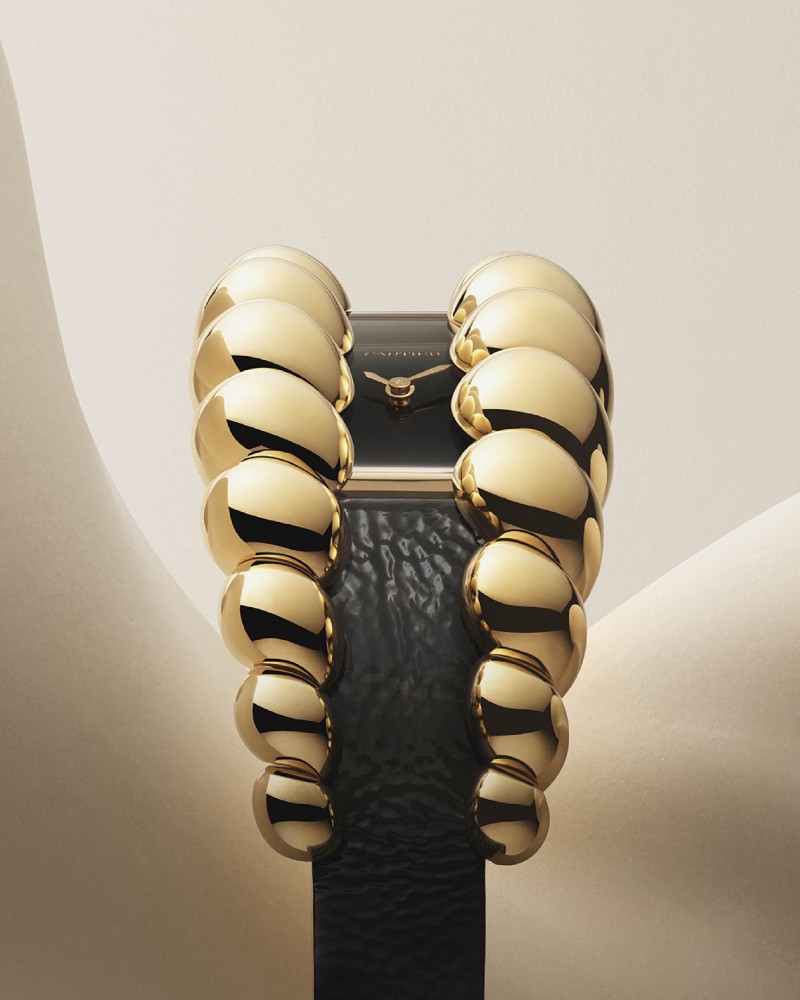
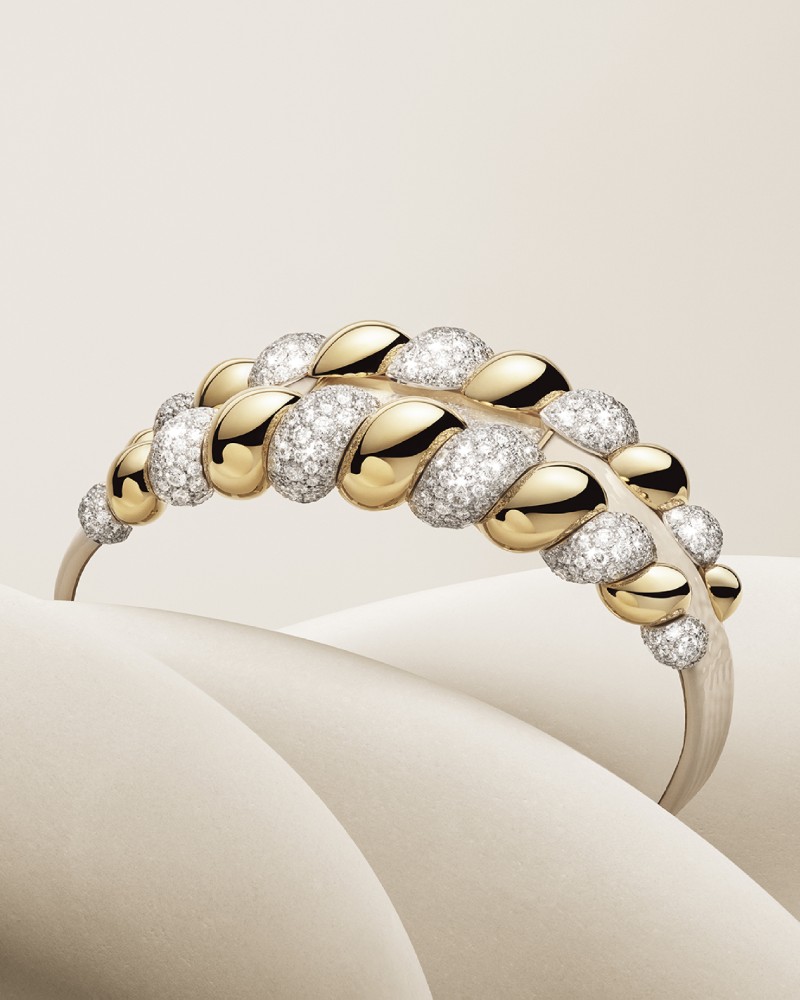
Toussaint’s legacy is a thumbprint on every piece of the Tressage collection. She had a unique ability to transform the hardest materials into something that conveyed a sense of softness—what Cartier calls “constraint and release.” The Tressage watch takes this concept and amplifies it. By enlarging and elongating the brancards, the vertical sidebars traditionally found on the iconic Tank, Cartier’s artisans have sculpted a voluptuous, twisted form that wraps around the wrist like a golden rope.
On the wrist, the ergonomics are surprising. Despite their substantial appearance— measuring 56.2 mm in length—the watches wear with remarkable lightness. The case is meticulously curved to match the natural arc of the human wrist, a design philosophy that stems directly from Cartier’s heritage as a jeweller. In the same way a high-jewellery necklace is engineered to move with the body, the Tressage is designed to be felt as much as seen. It is a “second skin” approach that ensures the watch never feels like an imposition, but rather an extension of the wearer’s own anatomy.
The collection is expressed through four distinct aesthetic lenses, each offering a different dialogue between metal and stone. For those who appreciate the stark, cinematic elegance of Art Deco, the first model is a revelation. Crafted in 18-carat yellow gold, it features smooth, polished gadroons that spiral around a minimalist black lacquered dial. There are no indices here, no diamonds to distract—just the raw, warm glow of gold against a void of deep black. Paired with a shiny black calfskin strap, it is a piece of graphic tension that feels both ancient and incredibly modern.
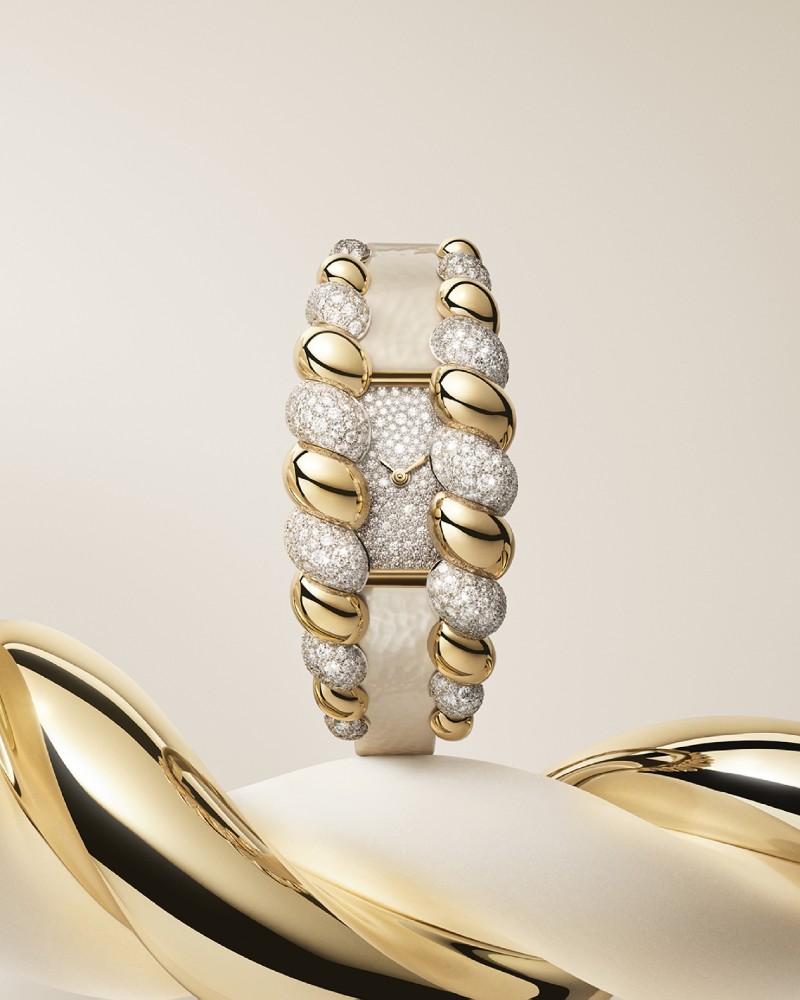
The second iteration introduces a more complex interplay of light. Here, Cartier mixes yellow gold with white gold, alternating smooth ropes of metal with bands of brilliant-cut diamonds. This model features a white gold dial finished with a snow-setting technique, where diamonds of varying diameters are placed so closely together they mimic the irregular, shimmering crust of fresh snow. With 466 diamonds totalling 6.3 carats on the case and buckle, it is a softer, more luminous take on the twisted silhouette.
If the previous models were studies in contrast, the third is a study in absolute brilliance. Fully rendered in white gold and entirely paved with 916 diamonds (totalling 12.2 carats), this version is a spectacle of high-jewellery craftsmanship. The braid here is formed entirely of light, with the snow-set dial blending seamlessly into the diamond-encrusted brancards. Paired with a navy blue calfskin strap, it evokes the cold, sharp elegance of a winter night, where every surface seems to vibrate with reflected light.
The apex of the collection is perhaps its most artistic. This final model splices a gradient of 330 sapphires (5.9 carats) among 570 diamonds (5.7 carats). The sapphires transition in hue as they spiral down the gadroons, creating a sense of movement and depth that feels almost organic—like a conical shell or a creature from the deep. The navy blue strap echoes the deep tones of the stones, creating a harmonious, monochromatic flow that feels like a modern tribute to Toussaint’s love for unexpected colour combinations.
Beyond the stones and the gold, there is a technical feat in the proportions. The Tressage watch sits 11.5 mm high, yet because of the deep curvature of the case back, it avoids the top-heavy feel common in larger jewellery watches. Each watch is powered by a high-precision Swiss quartz movement. While mechanical purists might look for something more cerebral, the use of quartz here is a tactical necessity—it allows the design team to push the radical, asymmetrical proportions of the braid without being hindered by the height or diameter of a mechanical movement.
Ultimately, the Tressage collection is a reminder of Cartier’s unique position in the world of luxury. Much like Jeanne Toussaint herself, the maison refuses to be categorised. It is, in many ways, proof that even in the precision-driven world of watchmaking, there is always room for the magician’s touch.
Cartier’s Latest Panthère Sharpen the Claws of an Icon
Some watches are designed to measure time. A rare few are conceived to shape it. The Panthère de Cartier belongs, indelibly, to the latter. Its presence on the wrist is not a passive act of time-telling. It is an active assertion of taste, a statement of intent, and a signature of a glamour that Cartier has mastered for more than a century.
The panther has served as the maison’s alter ego since the early 1900s, stalking its way across cigarette cases, vanity objects, brooches, jewellery, and ultimately, timepieces. It was Jeanne Toussaint, Cartier’s unforgettable director of style, who transformed the animal from a motif into an identity. Toussaint, nicknamed La Panthère herself, brought to the maison a mixture of precision, sensuality, and fearless elegance. She understood the panther not simply as an emblem of wild beauty but as a creature of ferocious modernity, whose gaze conveyed both assurance and mystery. Under her watchful influence, the panther became Cartier’s signature silhouette.
Cartier’s modern resurgence owes much to this early clarity of vision. While other maisons built their reputation solely on mechanical virtuosity or engineering bravado, Cartier distinguished itself through an added element of design excellence. It was understood that form and feeling could be as compelling as function. Today, as design and heritage reclaim their central role in watchmaking, Cartier stands once again at the forefront—a jeweller turned haute horloger whose strength lies in the coherence and unbreakable lineage of its vision.
The Panthère de Cartier watch, first born in 1983, marked the moment this great cat leapt fully into horology. It was unlike any other watch of its time—slender, supple, almost sinuous in its movement. With its perfectly articulated bracelet and softened rectangular case, it felt as though it had been sculpted into existence rather than engineered. The watch was an instant cultural phenomenon, worn by actors, musicians, bankers, and fashion icons with equal ease.
For a period, the icon slipped away, but its cult never truly faded. When Cartier relaunched it in 2017, it did not merely return; it reclaimed its place, proving it is one of the few designs in watchmaking that has never required reinvention, only reawakening. In 2025, Cartier pushes the feline further into its natural territory. The new Panthère models—high-jewellery, semi-pavé, and lacquer-set iterations—honour the icon, but also keenly sharpen its gaze.
This moment also marks the continuation of Cartier’s wider renaissance: an emphasis on their jewellery savoir-faire that shaped its earliest masterpieces. As collectors seek emotional connection, sculptural form, and a sense of cultural belonging, Cartier’s refusal to separate jewellery from horology has become its greatest advantage. These new models feel less like novelties and more like the natural evolution of a maison reclaiming its throne at the intersection of jewellery, time, and culture.
ORIGINS OF AN EMBLEM
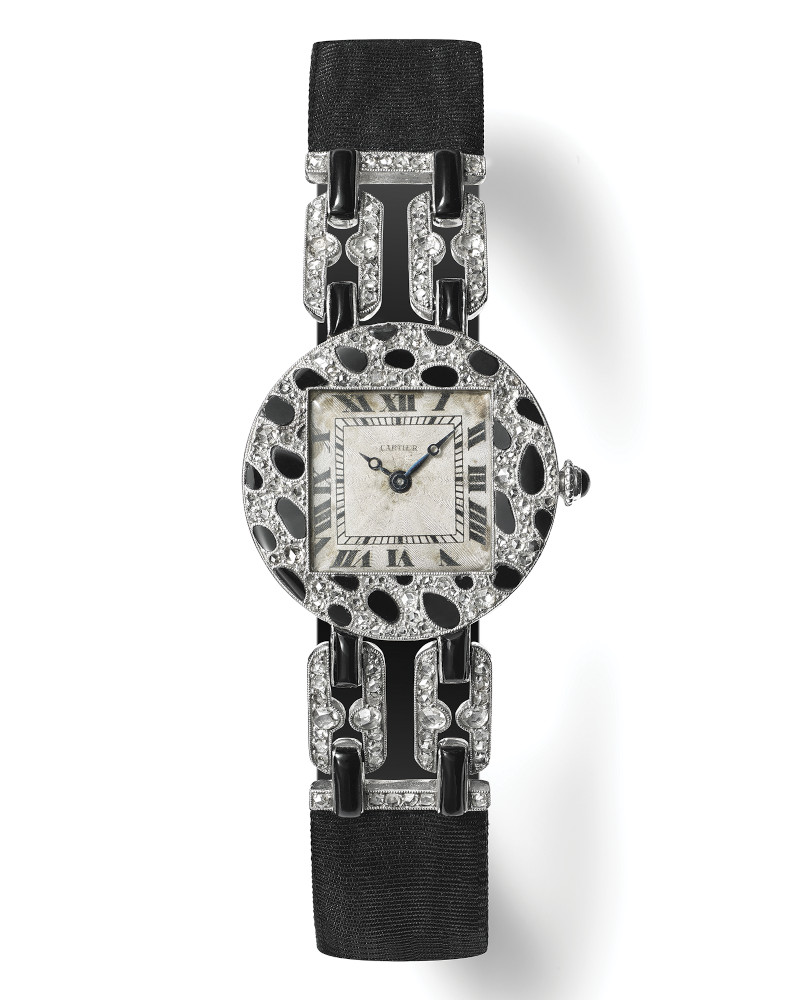
To understand why the Panthère remains so potent, one must look at the maison’s animalière heritage, a lineage that stretches through early 20th-century designs, across Toussaint’s reign, and into a modern era of artistic experimentation. The panther first appeared on a Cartier wristwatch in 1914, rendered in onyx and diamonds that mimicked fur. This early appearance was more than aesthetic playfulness; it signalled Cartier’s comfort with abstraction and its instinct for storytelling through geometry.
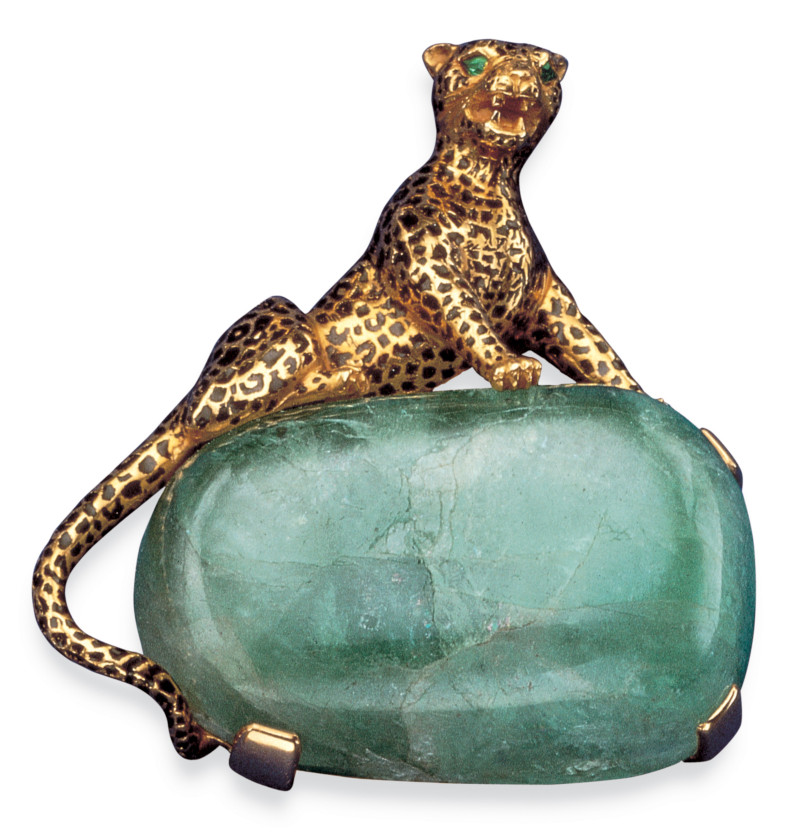
A Panthère brooch made by Cartier Paris in 1948 with Gold and black enamel on an emerald cabochon that weighed more than 116 carats. It was a special commission for the Duke of Windsor.
The Panthère de Cartier of 1983 inherited this legacy, yet it added something new: a kind of uncluttered urban elegance, a silhouette that felt at once architectural in its line and impossibly sensual on the skin. Its fluid bracelet, so silky it seemed to pour over the wrist, became its defining signature. Even before gender-fluid design entered the cultural vocabulary, the Panthère embodied that duality. It was not engineered for men or women, but crafted simply for those who liked its design.
The modern collector—more attuned to proportion, more comfortable with elegance, and more curious about jewellery craft—has brought fresh relevance to the Panthère. Cartier’s latest interpretation, the high-jewellery Panthère de Cartier, makes this connection explicit, drawing directly from archival jewels, animal motifs, and the maison’s own experiments with stripes, spots, and textures.
HIGH-JEWELLERY METAMORPHOSIS
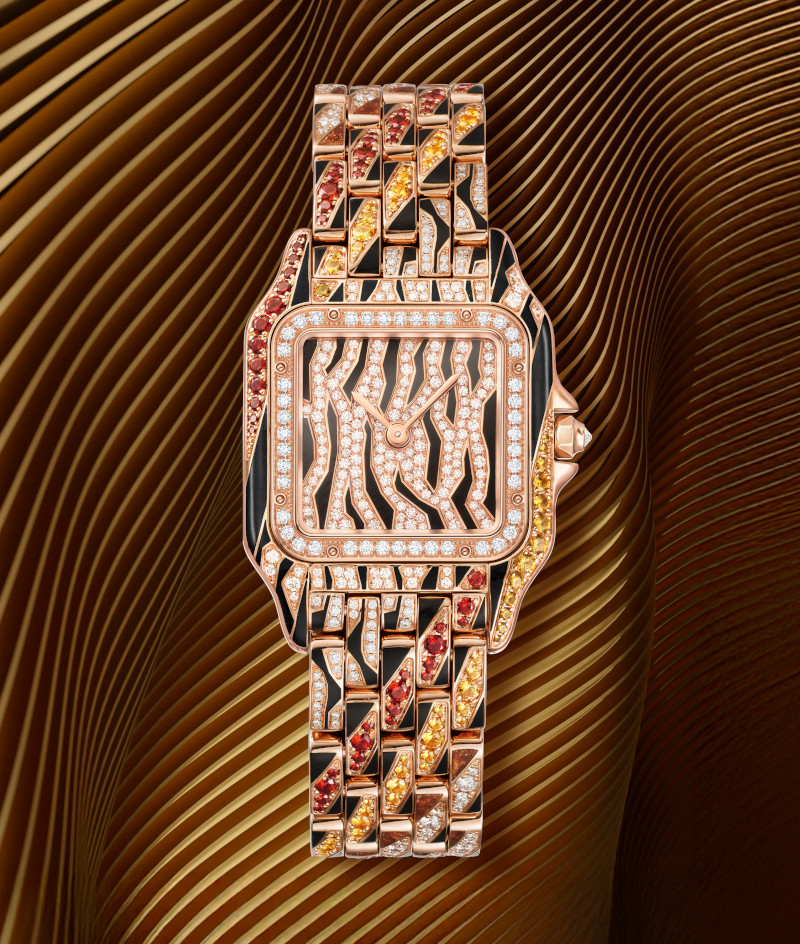
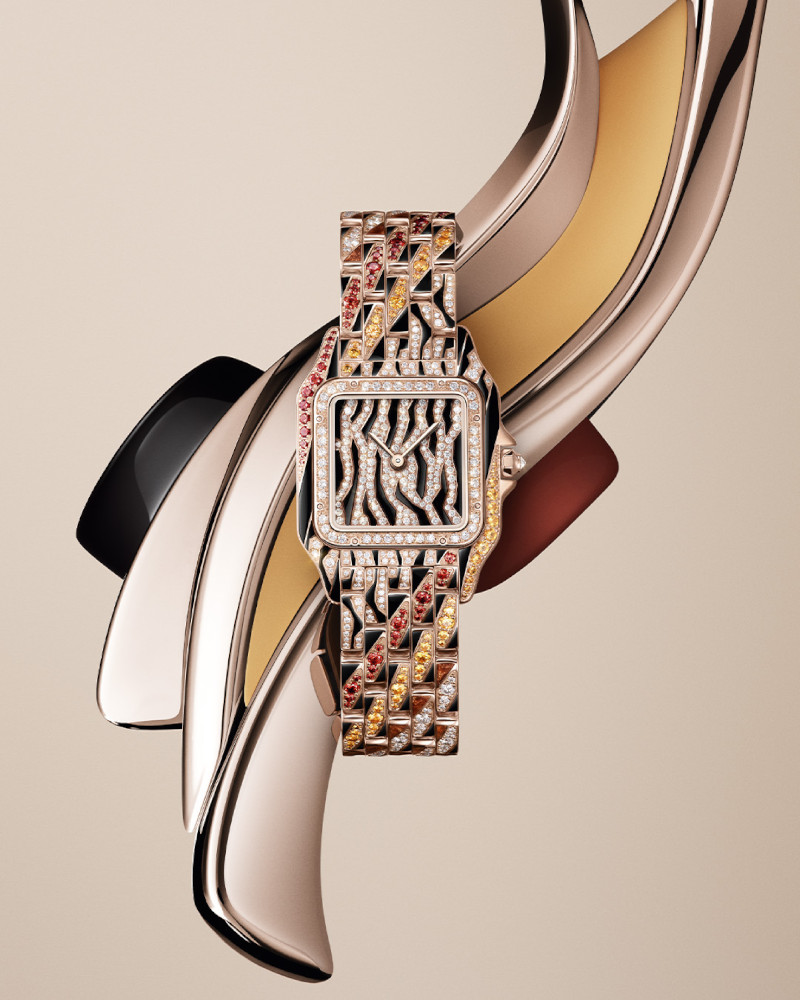
Unveiled at this year’s edition of the Watches and Wonders fair in Geneva to great fanfare, the latest Panthère de Cartier emerges as an intoxicating fusion of jewellery and horology. Cartier describes its pattern as existing somewhere between zebra and tiger, a hybrid coat that captures the essence of both without being beholden to either. This abstraction is characteristic of Cartier’s design philosophy, in which nature is never copied but interpreted, stylised, and refined into an idea.
Cartier's very first use of the panther-spot motif, found on a wristwatch from 1914 made with platinum, rose-cut diamonds, onyx and a moiré bracelet
L’Odyssée de Cartier, Parcours d’un style, bracelet, 2013
Pixelage necklace, Sixième Sens, 2022
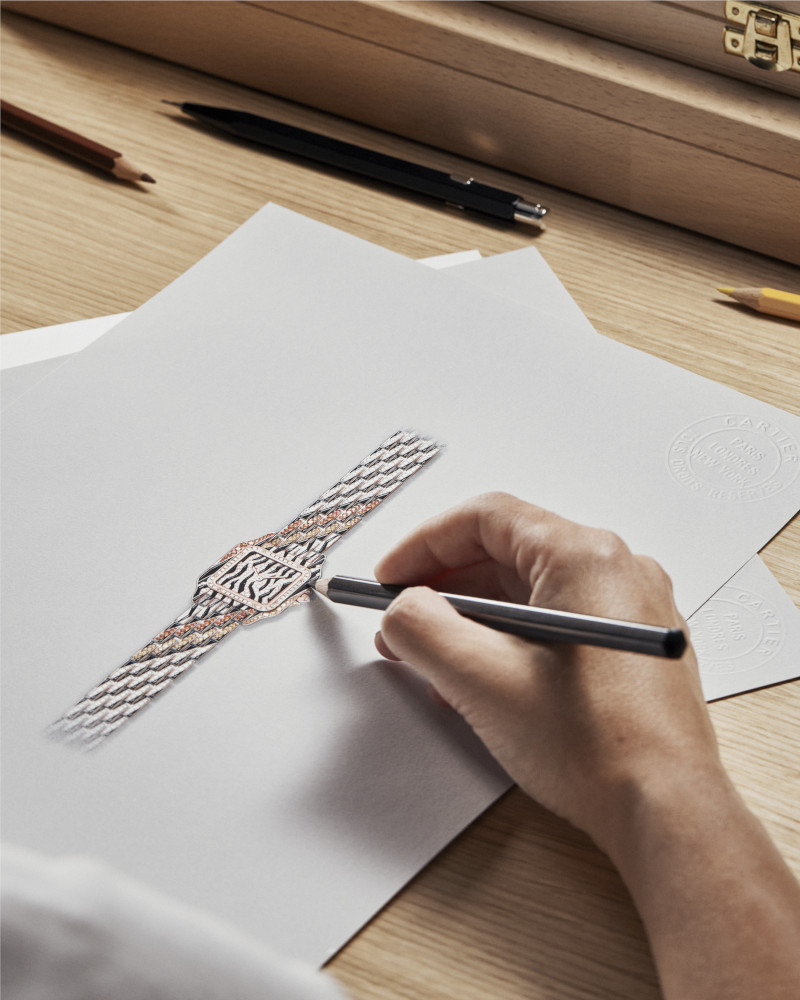
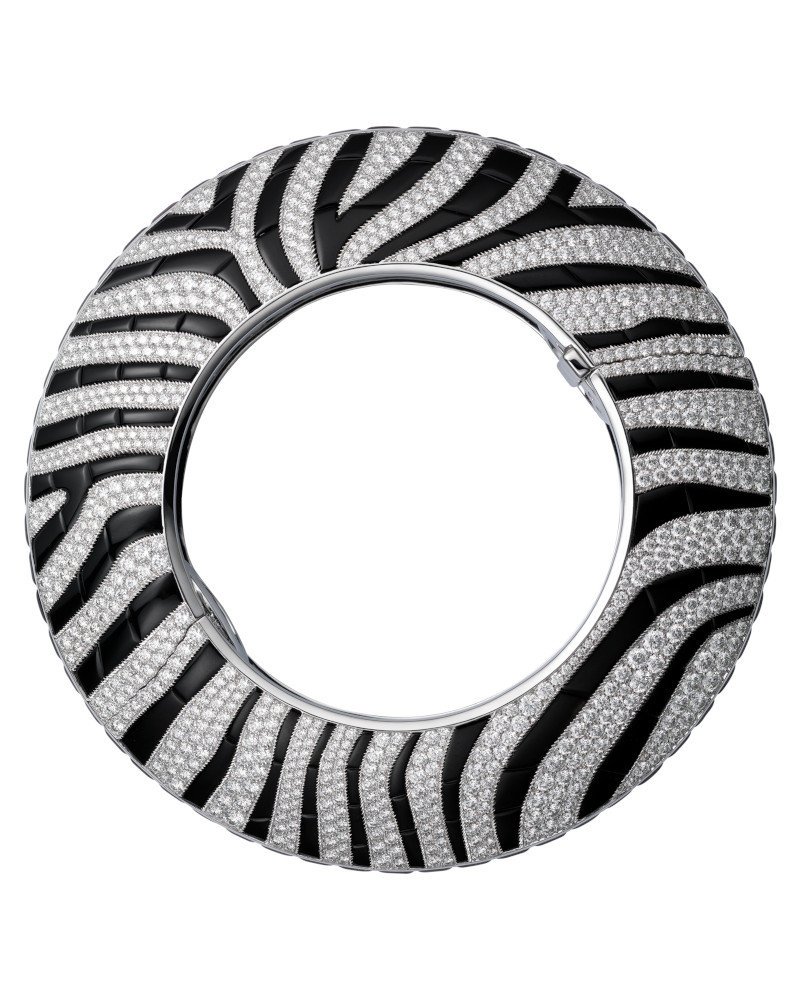
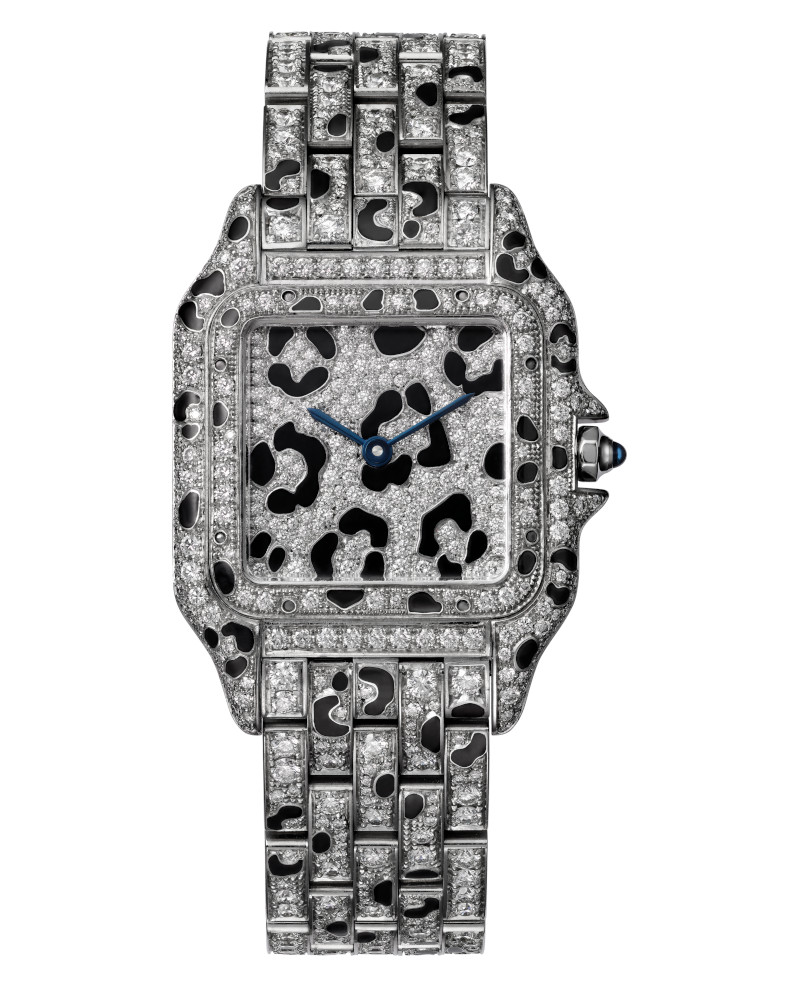
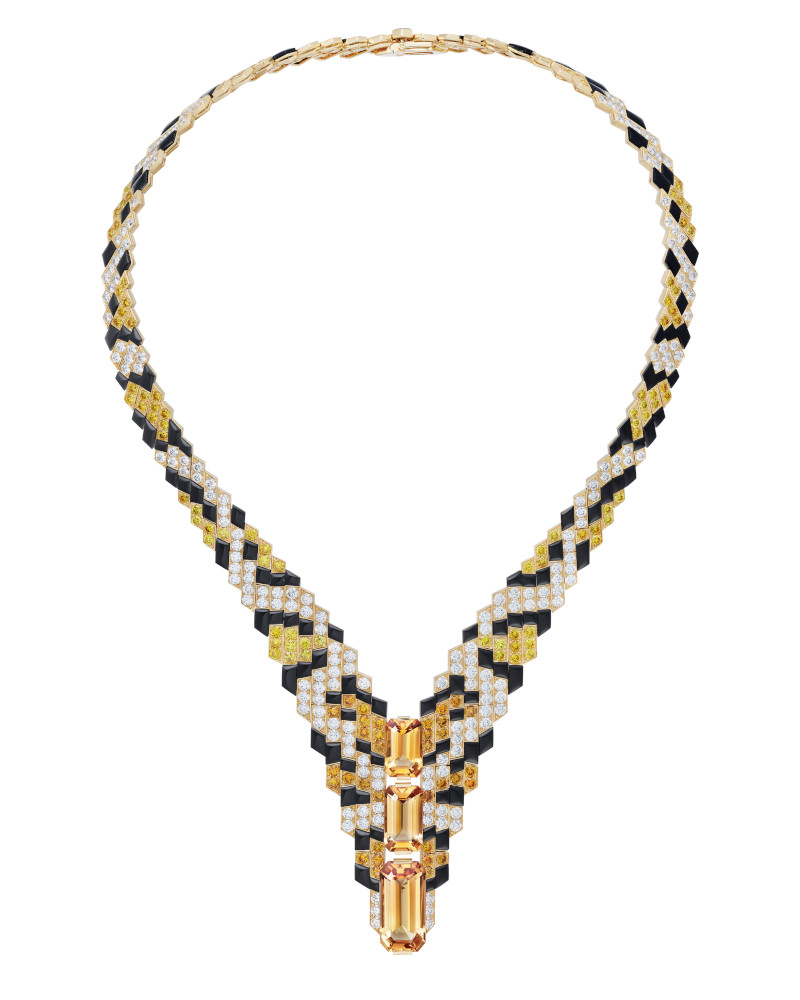
The maison’s own archives echo loudly in this new creation. Cartier’s animalière world has long celebrated fur, stripes, and the graphic tension between light and shadow. The hypnotic black-and-white lines of L’Odyssée de Cartier from 2013, the almost digital inflexions of the Pixelage necklace created in 2022, and the spotted Panthère watch of 2017 all form part of this rich and textured ancestry. This new Panthère does not break from its past, but it distils it.
The palette is abundant, a truly solar intensity that draws the eye. The dial’s black lacquer evokes the architectural precision of zebra stripes, while orange and yellow brilliant-cut spessartites bring the heat and intensity of tiger markings. The bracelet extends this chromatic story, combining black and golden-brown lacquer tones with diamonds and spessartites arranged in a vivid, sunlit progression. The effect is dazzling yet controlled, rich yet exquisitely balanced, like sunlight filtering through wild grass.
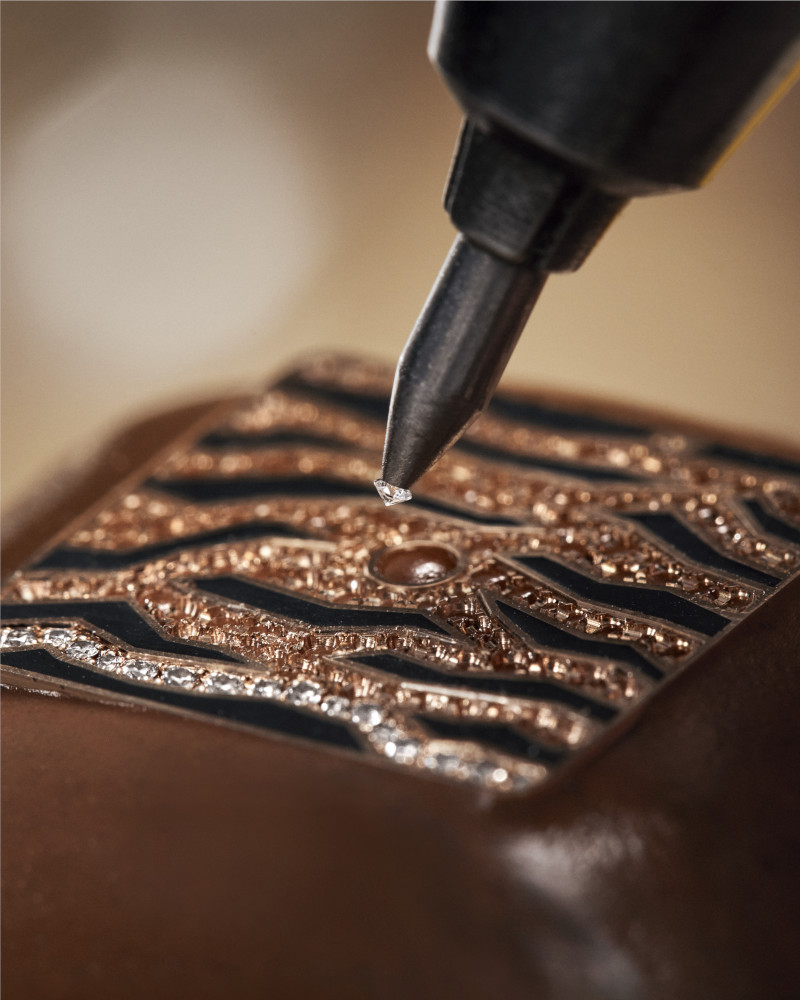
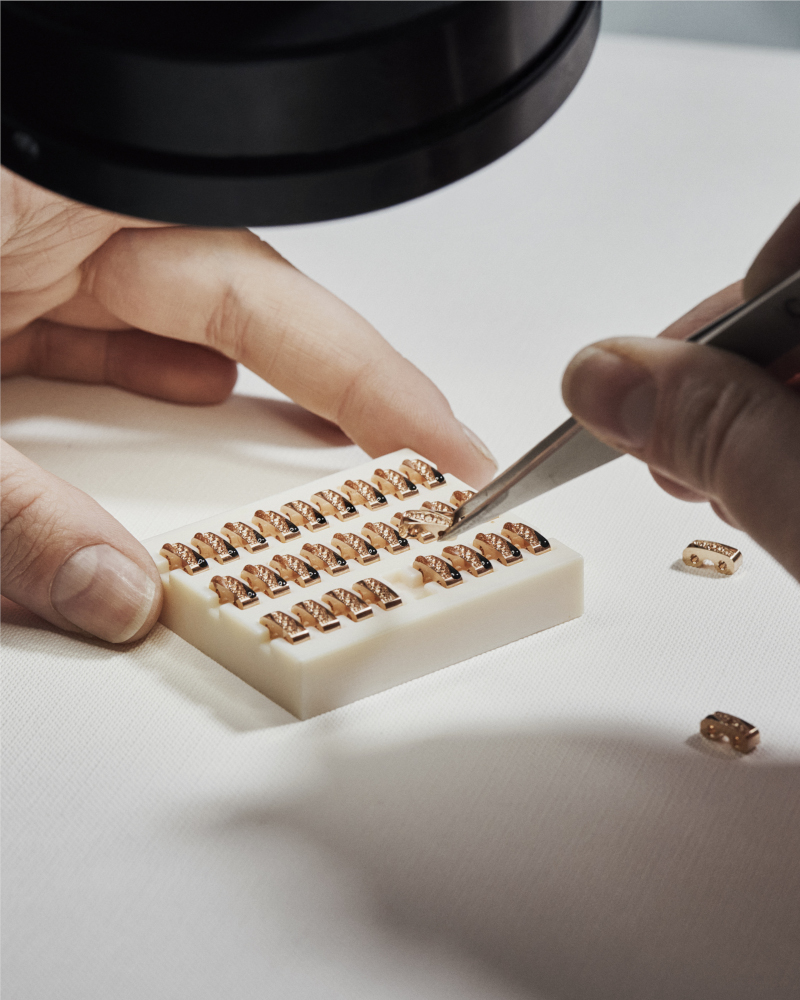
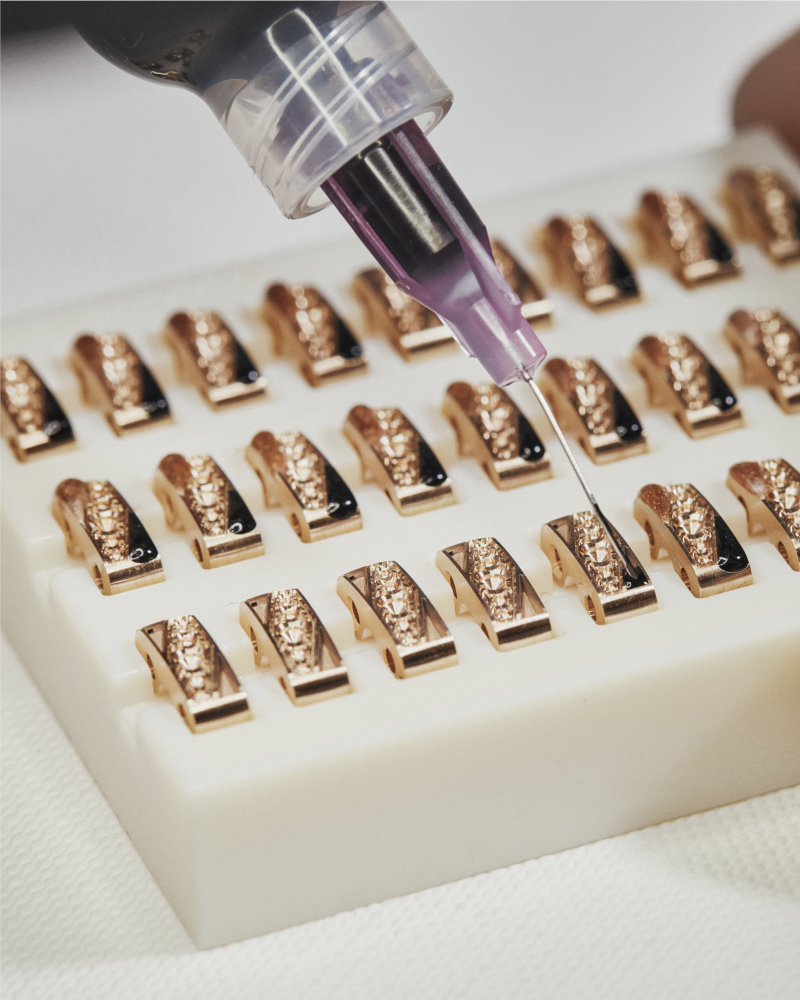
As with all Cartier creations, the real story lies in the craftsmanship. Cartier is foremost a jeweller, and the Panthère de Cartier confirms this identity with absolute clarity. The dial alone is a microcosm of métier d’art. Lacquer is applied by hand and fired at high temperatures within the Maison des Métiers d’Art to achieve its depth and lustre. Beneath the lacquer lies a snow-setting of 145 brilliant-cut diamonds, an artisanal technique in which stones of differing diameters are placed in seemingly organic arrangement — one that appears effortless but demands years of experience and unerring precision. The result is a dial that does not simply shimmer, but heaves with life.
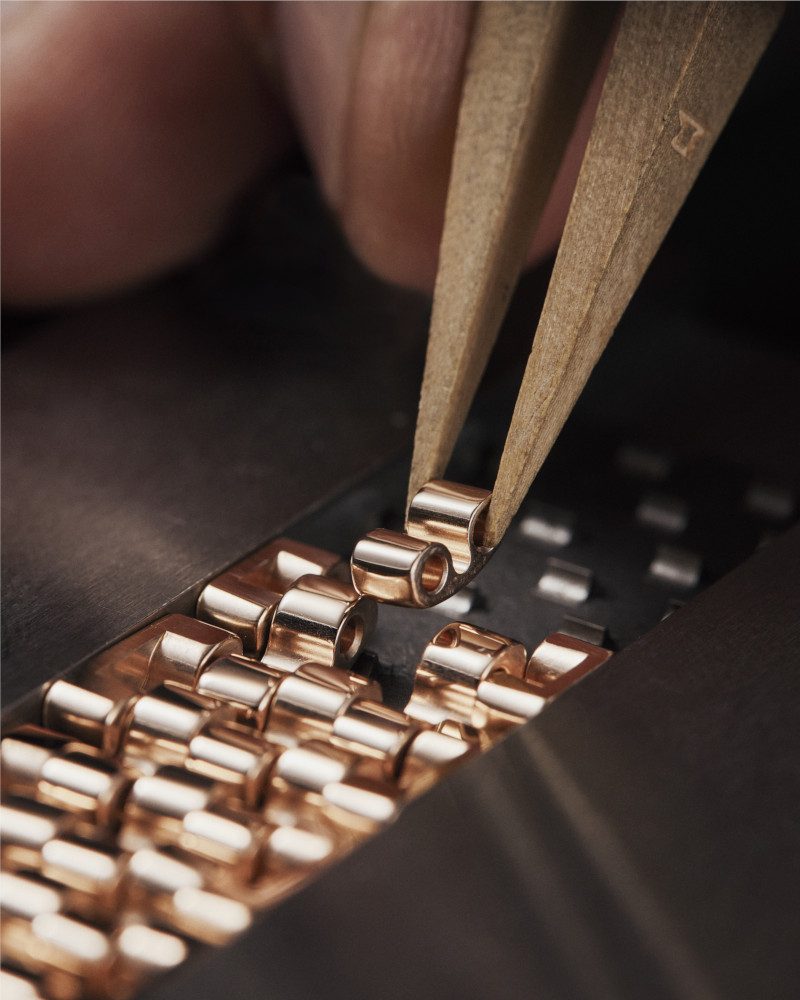
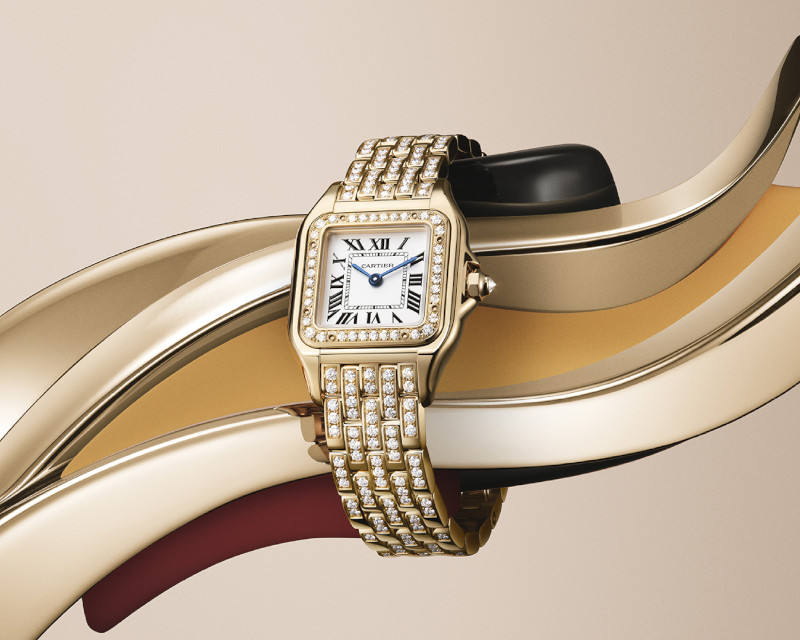
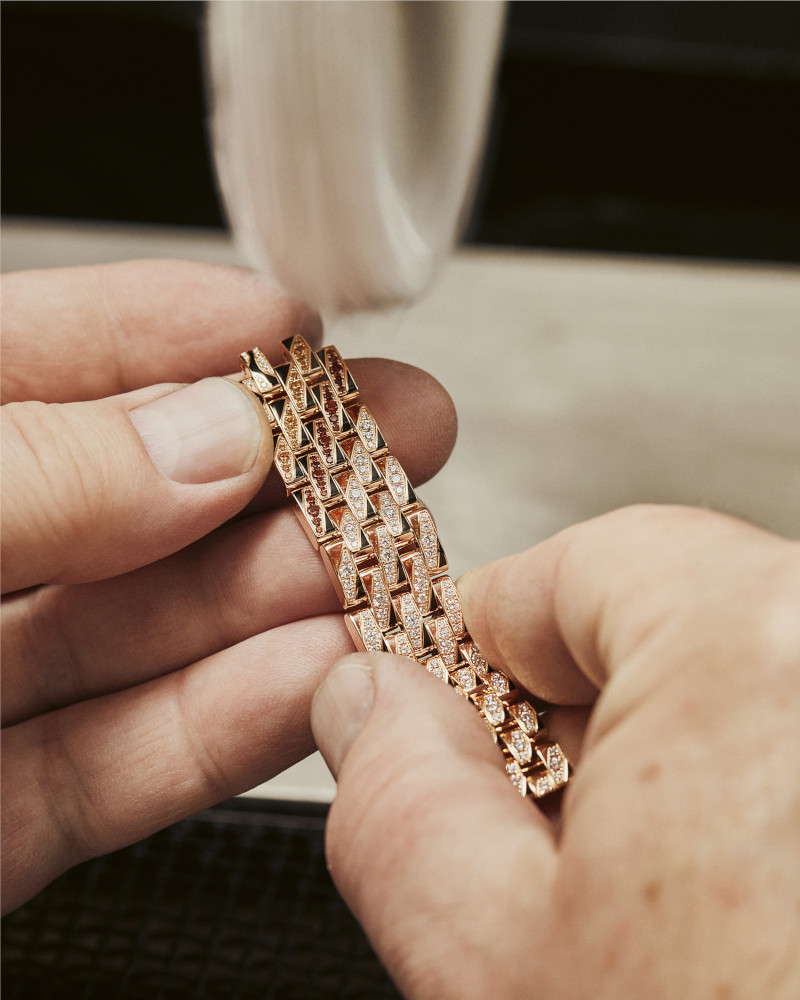
The bracelet is even more extraordinary. Entirely paved with 314 brilliant-cut diamonds and 86 brilliant-cut spessartites, each link is polished and set individually, a process that requires over 110 hours of work. This is not a bracelet constructed to resemble fabric; it is a bracelet that moves, flows, and yields like it. It drapes, flexes, and adapts to the body with a suppleness that only Cartier, with nearly two centuries of jewellery expertise, can achieve. The case and bracelet in rose gold are set with 398 brilliant-cut diamonds amounting to 3.36 carats, continuing the interplay of lacquer and gemstone. Measuring 36.5 by 26.7mm and just 6.8mm thick, the watch maintains the Panthère’s signature slimness, an essential characteristic of its personality.
Alongside the high-jewellery watch, Cartier presents a suite of semi-pavé Panthère watches in both rose and yellow gold. These variations, offered in multiple sizes, capture the essence of the line through a more understated elegance. Their bracelets feature soft gradients of diamonds flowing across the links, giving the sensation of movement even when the watch is still. The white dial, encircled by a diamond-set bezel, creates a visual contrast with the gold case, lending these models a fresh, modern luminosity. The blued-steel, sword-shaped hands provide a flash of Cartier classicism. Depending on the size, these semi-pavé Panthères are set with between 175 and 187 brilliant-cut diamonds.
They are refined, wearable, and distinctly Cartier. They are also a reminder of the maison’s mastery of proportion. Whether rendered in its most extravagant or most restrained form, the Panthère speaks the same language: elegance, rhythm, and feline poise.
AN ENGINE OF FINESSE
Part of the Panthère’s enduring refinement lies in the quartz engine that powers it—a deliberate choice that preserves the watch’s remarkable slimness and the uninterrupted fluidity of its bracelet. Cartier’s use of quartz should never be mistaken for compromise. Quartz movements serve a critical purpose within the industry. They are practical, reliable, discreet, and, above all, uniquely suited to watches where form, silhouette, and wearability take precedence.
Cartier has long understood this, which is why the maison has invested significantly in elevating the calibre itself. In 2018, the maison introduced a new generation of high-efficiency quartz movements with an autonomy of approximately eight years—double that of traditional quartz calibres. Achieving this required a complete reworking and resizing of the movement to reduce energy consumption, paired with a high-performance next-generation battery. This technology was engineered to reduce self-discharge by half and to offer five percent greater capacity, ensuring longevity without adding unnecessary bulk. Seen through this lens, Cartier’s approach reframes quartz entirely. Within the Panthère, it is not an economical solution but a design necessity, enabling the watch’s trademark thinness and allowing its architecture to remain pure, elegant, and unbroken.
ENDURING, UNLIMITED APPEAL
Perhaps the most revealing twist in the Panthère’s current chapter lies in the people who are wearing it. The modern man’s relationship with luxury has shifted; it is no longer defined by a need to project ruggedness at all times, but by an appreciation for refinement, nuance, and a personal sense of style. The gendering of jewellery has loosened its grip on culture. Today, the question is not whether something is “for him” or “for her”, but whether it is beautiful, whether it speaks to you, whether it feels right on your wrist.
This shift is written all over contemporary style. Rami Malek has long embraced Cartier’s smaller, elegant silhouettes, wearing Tanks and vintage-inspired pieces with quiet confidence. Timothée Chalamet, meanwhile, has helped redefine red-carpet jewellery entirely, pairing Cartier brooches, necklaces, and gem-set watches with a kind of effortless self-possession that resonates with a new generation. What they share is not a preference for femininity or masculinity, but an instinct for form, proportion, and design—values that Cartier has always championed.
It fits neatly with the maison’s broader jewellery philosophy. Cartier’s LOVE bracelets, Trinity rings, and Juste un Clou pieces are not marketed as gendered collections; they simply exist as expressions of design. The Panthère sits in exactly the same universe. When someone chooses a Panthère—gem-set or otherwise— they are simply recognising a piece of exceptional design and allowing it to become part of their visual language. The watch feels less like a departure from masculinity and more like an expansion of it, a sign that elegance and strength are not opposites but natural companions.
Smaller cases have become intellectually interesting again. Jewellery has lost its gender. And Cartier, with its heritage as a jeweller to royalty and style-makers alike, is perfectly positioned for this evolution. Icons survive because they possess a clarity that transcends era and trend, and the Panthère is one of those icons. Its bracelet remains one of the most fluid constructions in watchmaking. Its proportions, perfected in 1983, feel as contemporary today as they did at launch. Its personality—bold, feline, sculptural—has lost none of its power.
The 2025 Panthère collection illustrates why. Rather than reinvent the watch, Cartier has allowed it to prowl through the maison’s richest traditions: its animalière heritage, its mastery of lacquer and gem-setting, its instinct for proportion, and its refusal to separate jewellery from horology. This new model, with its solar chromatic palette and archival inspirations, may be the most sophisticated Panthère de Cartier to date.
What remains clear is that Cartier’s renaissance has not been incidental. It has come from embracing the very qualities that once set it apart: sculptural silhouettes, instinctive proportions, and a deep knowledge of how jewellery behaves on the body. In staying true to its jewellery-first identity, Cartier has reasserted itself not only as a watchmaker, but as a house whose designs shape cultural language itself. The Panthère has never relied on trends for relevance. Its authority comes from knowing itself, and it has always held that position with quiet conviction. While tastes rise and fall, the design endures—and inevitably, the times catch up to it. Today, as elegance resurfaces, as jewellery becomes a form of personal truth, and as collectors seek feeling as much as function, the Panthère stands right where it always has: at the crossroads of instinct and artistry.