A Century in Split Seconds: Patek Philippe’s Chronograph Legacy
Among the many emblematic complications in haute horlogerie, the split‐seconds chronograph has always held a heightened resonance. It is all at once analytical and poetic: a mechanism created to separate moments that unfold too quickly for the eye, yet dependent on a delicacy of construction that borders on the improbable. Patek Philippe has long treated the split‐seconds not as a technical novelty but as a demonstration of its deepest convictions about watchmaking. The Geneva firm’s finest rattrapante watches express a philosophy of clarity, restraint, and uncompromising craft. From the experimental wristwatch of 1923 to today’s Ref. 5370 split‐ seconds chronograph and the new quadruple complication Ref. 5308, the rattrapante has become one of the clearest through‐ lines in the manufacture’s story.

In the words that follow, we are about explore that very line. It begins with timepiece no. 124.824, sometimes considered the first split‐seconds chronograph made specifically for the wrist. It then traces the rise of the perpetual calendar chronograph with the Ref. 1518, and the parallel evolution of early split‐seconds wristwatches such as the references 1436 and 1563. From there, it moves through the present era of in-house chronograph design, the ultra-thin CHR 27-525 PS, the patent-laden CH 29-535 PS family, and the way these ideas reach maturity in the Ref. 5370 (read the Cover Watch story), Ref. 5204, Ref. 5373 and the Ref. 5308. The aim is to tell the story of the split-seconds chronograph through key references.
Ref. 5370R-001

1923: THE VERY FIRST WRIST-WORN RATTRAPANTE

When collectors and scholars discuss the 1923 origins of the Patek Philippe split-seconds wristwatch, they almost always begin with one number rather than a reference: 124.824. The movement within, cased in a 33mm yellow-gold “officer” style wristwatch with an enamel dial and a 60-minute counter, is widely regarded as Patek Philippe’s earliest split-seconds chronograph designed for the wrist.

Mechanically, the challenge of building a rattrapante has always been twofold. First, it doubles the functional burden on the chronograph train by adding a second central chronograph second hand and a split-seconds wheel that must be clamped and released on command. Second, it forces the watchmaker to manage energy and friction in a system that is already parasitic by nature, since the typical chronograph draws power from the going train as soon as it is engaged.

In a pocket watch, the split-seconds mechanism has room to breathe. Levers can be long and gently curved, clamps can be generous, and tolerances can be marginally more forgiving. In a 33mm wristwatch of the early 1920s, the constraints are brutal. The movement in no. 124.824 had to remain extremely thin while accommodating twin column wheels, a layered central chronograph staff, a split-seconds heart and clamp, and a rare 60-minute counter that required more complex chronograph gearing than the usual 30-minute register.


“The message is clear: from the outset, Patek Philippe saw the rattrapante as a field for long-term exploration rather than a passing technical display”

The watch uses a single-button system with the primary chronograph functions controlled through the crown and a separate split-seconds pusher above. The start, stop and reset of the main chronograph are governed by one column wheel, while the split-seconds lever and clamp are controlled by the second. The clamp must grip the split-seconds wheel with enough force to halt it instantly, yet release it without leaving marks on the teeth or disturbing the meshing with the heart cam. Achieving that behaviour in such a compact calibre at the time required tolerances that would have been demanding even in a much larger movement.

What makes 124.824 more than a historical curiosity is the way Patek Philippe subsequently treated it. Nearly a century later, when the manufacture introduced the Ref. 5959 in 2005, its calibre CHR 27-525 PS was explicitly based on the architecture of the 1923 movement, scaled and updated but recognisably descended from the same idea. The message is clear: from the outset, Patek Philippe saw the rattrapante as a field for long-term exploration rather than a passing technical display.

1518: THE PERPETUAL CALENDAR CHRONOGRAPH AS A PATEK PHILIPPE LANGUAGE

If the 1923 wristwatch established Patek Philippe’s ambition in split-seconds chronographs, the Ref. 1518 defined another of the manufacture’s enduring signatures: the serially produced perpetual calendar chronograph. Approximately 281 examples of Ref. 1518 were produced, with the majority encased in yellow gold, while approximately 20% were cased in pink gold. Scholarship has shown that during the reference’s 14-year production run, a total of only four are publicly known to have been completed and exist today in stainless steel. The earliest instance of this quartet was offered by Phillips recently at its Watches: Decade One (2015–2025) sale on November 8 in Geneva, where, this rarer- than-hen’s-teeth of a timepiece, fetched an unfathomable CHF 14,190,000.

Launched in 1941, Ref. 1518 is widely recognised as the first wristwatch to combine a chronograph with a perpetual calendar in regular production. Its movement was based on a Valjoux 23 chronograph ébauche that Patek Philippe reworked extensively, along with a Victorin Piguet perpetual calendar module, and elevated the finishing to a level expected of a Genevois grand complication.

The watch’s true achievement, however, lies as much on the dial as in the calibre. The 1518 established a visual and functional template that Patek Philippe would revisit for decades: twin chronograph registers at three and nine o’clock, a moonphase and date at six, and twin windows for day and month at twelve.

The calendar works are built around a 48-month cam and a set of levers and jumpers that accumulate energy over the course of the day and release it in an instantaneous change at midnight. For the wearer, the effect is a clean, legible display that hides the complexity of the underlying mechanism.

This reference set the rhythm for an unbroken chain of perpetual calendar chronographs: the 2499, 3970, 5970 and, in the fully in-house era, the 5270 and 5204. Within this family, the 5204 will later become particularly important, because it brings the split-seconds mechanism back into a genre that the 1518 first defined.
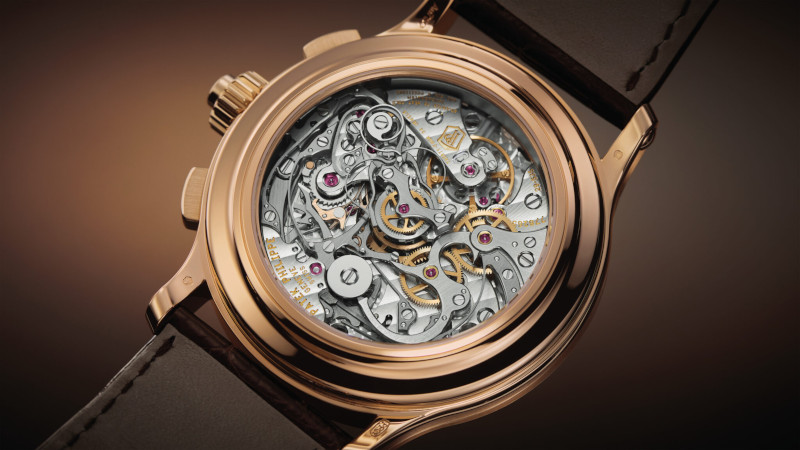
Ref. 5370R-001

EARLY WRIST-WORN RATTRAPANTES: 1436, 1563 AND THE IDEA OF A SERIALLY PRODUCED SPLIT-SECOND CHRONOGRAPH

While the 1518 and its successors pursued the marriage of calendar and chronograph, Patek Philippe also continued to refine the pure split-seconds wristwatch in parallel. But before the split- seconds chronograph became a recognisable Patek Philippe speciality, it appeared in several experimental forms. The earliest wrist expression of this ambition can be traced to Ref. 130, the manufacture’s first serially produced chronograph. While the standard Ref. 130 was a two-pusher, twin-register chronograph powered by Patek Philippe’s reworked Valjoux 23 (calibre 13‐130), a rare few 130s are known to exist in a split‐seconds configuration. These watches, however, did not establish a true lineage.
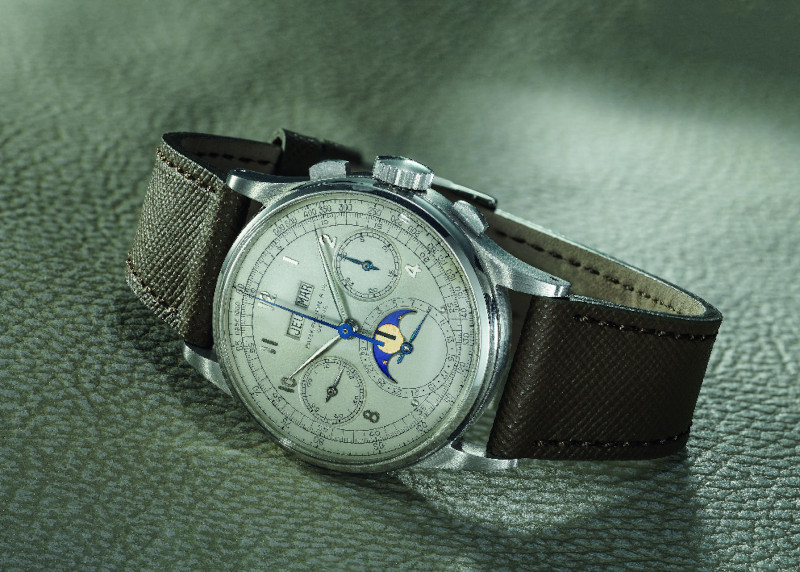
Ref. 1518 in steel from the Phillips auction in Geneva in November

That true lineage begins with the Ref. 1436, introduced around 1938 and generally considered as Patek Philippe’s first series‐produced split‐seconds chronograph wristwatch. Using a 13‐ligne rattrapante movement derived from the 13‐130 architecture, the 1436 brought the complication into commercial production with approximately 140 pieces created over three decades. Early examples used a system in which the crown itself controlled splitting and reuniting the chronograph seconds hands. Later executions adopted a more robust solution: a co‐axial pusher integrated into the crown, offering crisper engagement and improved reliability.

Housed in what is essentially the Ref. 130 case, Ref. 1436 refined the mechanical logic first seen in the 1923 prototype into something suitable for regular use – and regular production. Where Ref. 1436 was classical, Ref. 1563 represented a rare and energetic variation of the theme. Produced in only a tiny handful of examples – available scholarship cites just three known – Ref. 1563 is effectively a split‐seconds version of the Ref. 1463 “Tasti Tondi”, Patek Philippe’s first water‐resistant chronograph.

Seen together, references 130, 1436 and 1563 trace the earliest contours of Patek Philippe’s split‐seconds identity. Ref. 130 rattrapante reveals the manufacture’s early ambitions; Ref. 1436 establishes the complication as a coherent catalogue reference; and Ref. 1563 shows that the mechanism could inhabit not only elegant mid‐century dress cases but also the more muscular architecture of the “Tasti Tondi”. These watches form the pre‐war and mid‐century backbone of the rattrapante story, an essential foundation for understanding the technical and aesthetic decisions that shape much later references such as 5004, 5204, 5370 and ultimately the 5308.
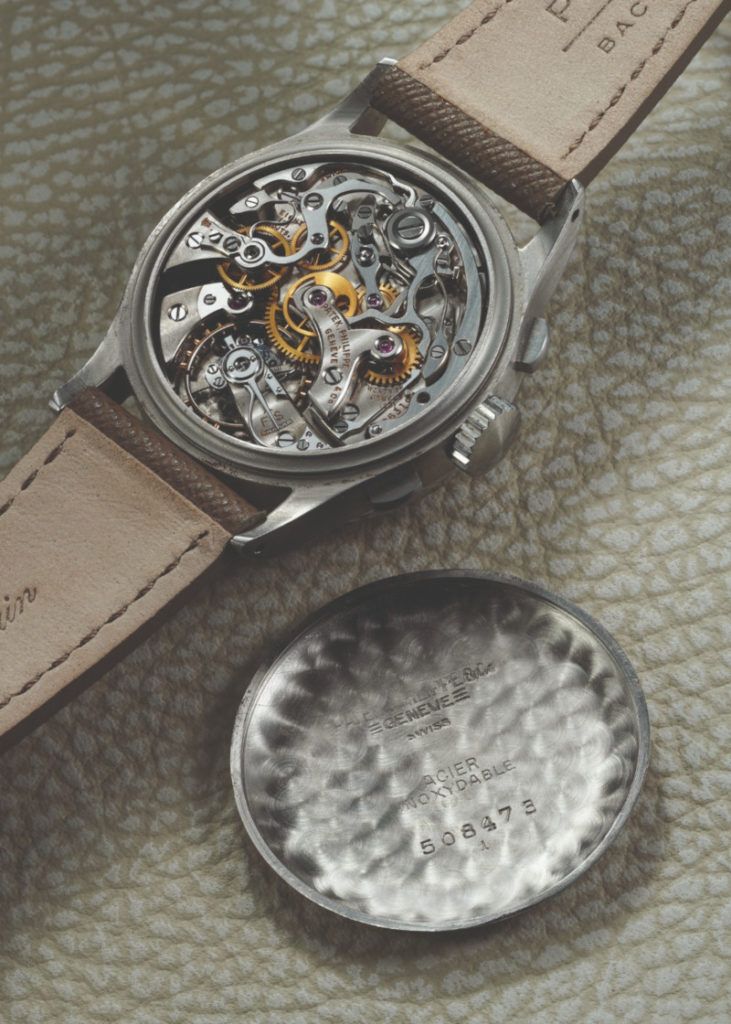
Ref. 1518 in steel from the Phillips auction in Geneva in November

REF. 5004 — THE LAST GREAT LEMANIA‐BASED RATTRAPANTE

Introduced in 1996, Ref. 5004 was the most mechanically ambitious wristwatch Patek Philippe had ever produced. Built on the blueprint of CH 27‐70 Q, Ref. 5004 added a full split‐seconds mechanism and perpetual calendar to an already dense chronograph calibre. The resulting movement – often cited by watchmakers as one of the most challenging Patek Philippe ever assembled – revealed both the brilliance and the constraints of the Lemania base.

The key innovation was the now‐famous “octopus” isolator mechanism, developed to address the amplitude drop that occurs when a split‐seconds hand is clamped. Earlier rattrapantes, including the 1436, 1563 and even some pre‐production 5004 prototypes, suffered from noticeable drag when the rattrapante wheel halted. The isolator in Ref. 5004 (a multi‐armed, spring‐loaded component that sits atop the split‐seconds column wheel, easily recognisable) disengages the split‐seconds wheel at the moment of clamping. This prevents parasitic load on the chronograph train and stabilises amplitude.

The system worked, but it was extremely complex to adjust. The isolator arms required careful hand‐tensioning, and the Lemania base, which was designed long before Patek Philippe envisioned such a mechanism, did not offer ideal geometry for integration. As a result, Ref. 5004 required intensive regulation to achieve consistent rattrapante performance.

Yet this reference occupies a vital position in this lineage. It represents the boundary of what could reasonably be achieved on the Lemania platform and directly informed the requirements for the next era of Patek Philippe chronographs: lower friction, optimised tooth geometry, a more compact rattrapante layer and an isolator that no longer required the elaborate “octopus”.

“The key innovation was the now‐famous “octopus” isolator mechanism, developed to address the amplitude drop that occurs when a split‐seconds hand
is clamped”

THE FIRST FULLY IN‐HOUSE CHRONOGRAPHS — CHR 27‐525 PS

By the early 2000s, Patek Philippe moved decisively towards full independence in chronograph construction. The first milestone was the CHR 27‐525 PS of 2005, the manufacture’s thinnest rattrapante chronograph at just 5.25mm. As mentioned earlier, its architecture deliberately referenced the 1923 wristwatch, with elegantly shaped bridges, classical column‐wheel control and exposed steelwork finished to a high polish.

Just five years later, Patek Philippe added an instantaneous perpetual calendar, creating the CHR 27‐525 PS Q – only 7.3mm high. Used in references such as the 5951, 5372 and now the 5373, it demonstrated that ultra‐thin construction and a full rattrapante could coexist without sacrificing reliability. These calibres prove that Patek Philippe’s interest in split‐seconds chronographs is not only historic but ongoing.

CH 29‐535 PS: PATENTS, TOOTH PROFILES AND THE PRESENT CHRONOGRAPH GRAMMAR

If the CHR 27‐525 PS family represents one branch of Patek Philippe’s rattrapante thinking, the CH 29‐535 PS family represents another. Introduced in 2009, the CH 29‐535 PS was the manufacture’s first fully in‐house, manually wound chronograph calibre without additional complications. It is a traditional column‐wheel, horizontal‐clutch movement in broad conceptual terms, but its details show how carefully Patek Philippe studied the weaknesses of classical chronographs.

The calibre incorporates six patented innovations. The first is an optimised tooth profile for both the chronograph wheel and its driving wheel, designed to suppress hand quiver when the chronograph starts, reduce backlash and increase efficiency. The second uses an eccentric cap on the column wheel to allow precise adjustment of the meshing depth between the clutch and chronograph wheels, turning what was once a decorative cap into an active regulating element. The third synchronises the clutch and brake levers directly via a finger on the clutch lever, rather than relying on separate column‐wheel contacts, which makes timing their actions more precise and simplifies future adjustment.

The fourth patent concerns a slotted minute‐counter cam that allows the minute hand to jump cleanly while minimising the energy impact on the train. The fifth introduces self‐setting return‐to-zero hammers that automatically align themselves to the heart cams, improving reliability over time. The sixth pivots the reset hammers between jewel bearings on a common axis, each with its own spring, enhancing both alignment and long-term stability.

Beyond the patents, the CH 29-535 PS is distinguished by its architecture: broad, gracefully shaped bridges, a large four- armed Gyromax balance beating at 4 Hz, and an instantaneous 30-minute counter that jumps in a fraction of a second. It has become the base calibre for a family of movements, including the CH 29-535 PS Q with perpetual calendar and, crucially for our story, the CHR 29-535 PS and CHR 29-535 PS Q, which add the split-seconds function.

These CH 29-535-derived calibres are the mechanical language through which Patek Philippe expresses its current chronograph thinking. The Ref. 5370 and Ref. 5204 are two of the clearest sentences in that language; as usual with the cover story, see the Cover Watch segment for details about Ref. 5370.
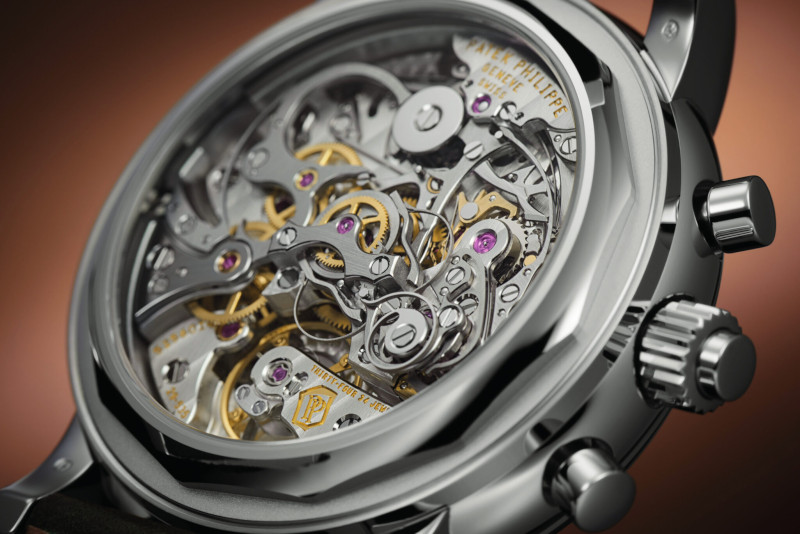
Ref. 5204G-001

REF. 5204: THE PERPETUAL CALENDAR SPLIT-SECONDS, RE-WRITTEN IN-HOUSE

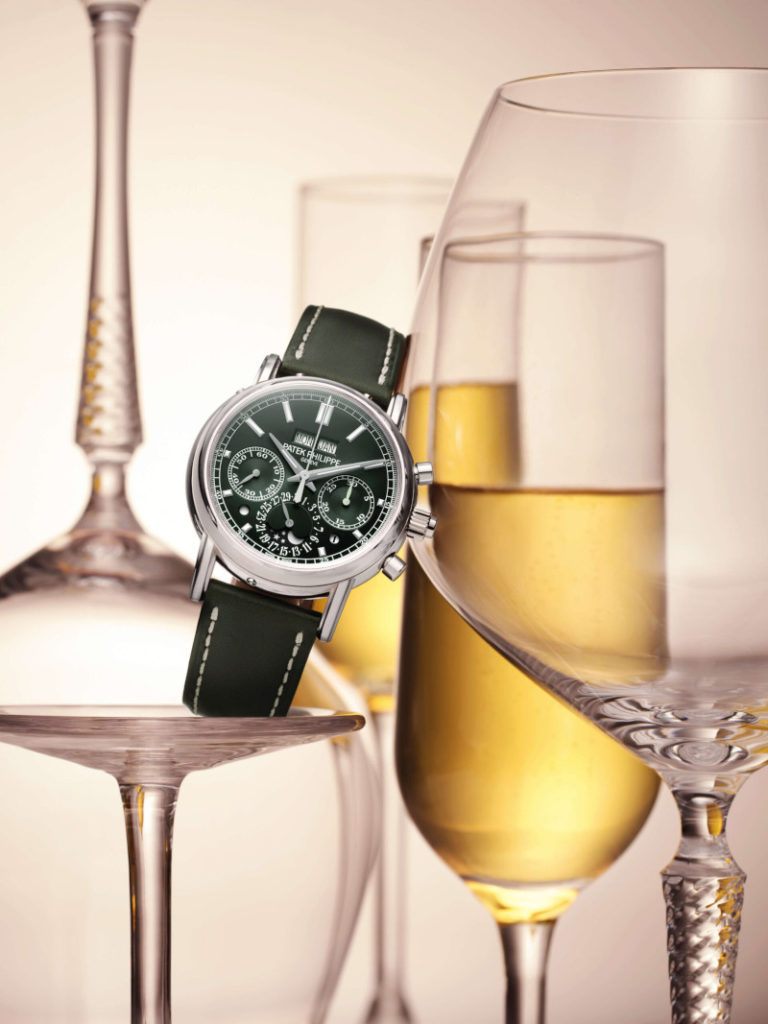
If Ref. 5370 is Patek Philippe’s purest contemporary expression of the split-seconds chronograph, Ref. 5204 is its most articulate. It is the point where the perpetual calendar chronograph lineage that began with the 1518 intersects with the in-house rattrapante vocabulary of the CH 29-535 PS.

Launched originally in platinum and offered in white gold since 2022 as the 5204G-001, the watch combines a split- seconds chronograph with a full perpetual calendar, moonphase display, day–night indicator and leap-year indication. The movement is the CHR 29-535 PS Q, which takes the base CH 29- 535 PS and adds both the rattrapante mechanism and a perpetual calendar module.

The chronograph side benefits from all six patents of the base calibre. The split-seconds side gains two additional technical advances: an improved isolator for the rattrapante lever and a mechanism that reduces alignment error between the chronograph and split-seconds hands when they are meant to sit directly on top of one another. In the technical notes for Ref. 5204, Patek Philippe explains that the new split-seconds lever features twin flat contact surfaces which mate with corresponding flats on the heart cam recess, improving hand superposition accuracy by roughly three quarters compared with the previous generation.

The perpetual calendar is of the instantaneous-jump type. Energy is accumulated by a cam and spring system over the course of the day; at midnight, that energy is released in a single, coordinated action that advances the day, date, month, leap-year and day–night indications together. The date is displayed by hand, while the other indications appear in apertures. The moonphase display is calibrated for an error of one day in 122 years.

For the wearer, Ref. 5204 is the rational bridge between Ref. 1518 and 21st-century Patek Philippe. It applies the visual grammar established in 1941 to an entirely in-house movement with contemporary chronograph architecture and a split-seconds system that reflects three decades of rattrapante refinement since Ref. 5004. It is also the watch that helps contextualise Ref. 5308G (see below). Where Ref. 5204 answers the question “How far can we take a traditional perpetual calendar split- seconds chronograph in a manually wound format?”, Ref. 5308 asks a slightly different one: “How many of Patek Philippe’s most demanding complications can be made to coexist in an automatic wristwatch without compromise?”
Ref. 5204G-001

REF. 5373P: THE LEFT-HANDED DETOUR

Before we reach the 5308G, one more split-seconds chronograph deserves mention, because it illustrates Patek Philippe’s willingness to re-think ergonomics even at the highest level of complication.

The Ref. 5373P-001 is a split-seconds monopusher chronograph with perpetual calendar, designed with its crown and pusher set on the left of its case. Inspired by the earlier 5372P, it rotates the crown and chronograph monopusher to nine o’clock and the split-seconds pusher to eight o’clock. The dial indications are turned through 180 degrees so that the date sits at 12 o’clock, seconds at 3, moonphase at 6 and 60-minute counter at 9.

Inside, the calibre is the CHR 27-525 PS Q, the ultra-thin split-seconds chronograph with perpetual calendar introduced in 2010 and now reserved exclusively for this reference. At 27.3mm in diameter and 7.3mm thick, it remains Patek Philippe’s thinnest movement combining these functions. The architecture relies on twin column wheels with polished caps, a 60-minute counter rather than the more common 30-minute register, a Gyromax balance at 3Hz and a perpetual calendar module that adds only 2.05mm in height to the base chronograph.

As a watch, Ref. 5373P is more extroverted and sporty than references 5370 or 5204, with its charcoal dial, red chronograph hands and calfskin strap embossed to resemble technical fabric. Mechanically, however, it and Ref. 5370 are essentially two sides of the same coin: one ultra-thin and tightly packaged, the other more expansive and demonstrative in its layout. Together, they underscore the breadth of Patek Philippe’s current split-seconds capabilities.
Ref. 5308G-001

REF. 5308: THE QUADRUPLE COMPLICATION AS MECHANICAL SYNTHESIS

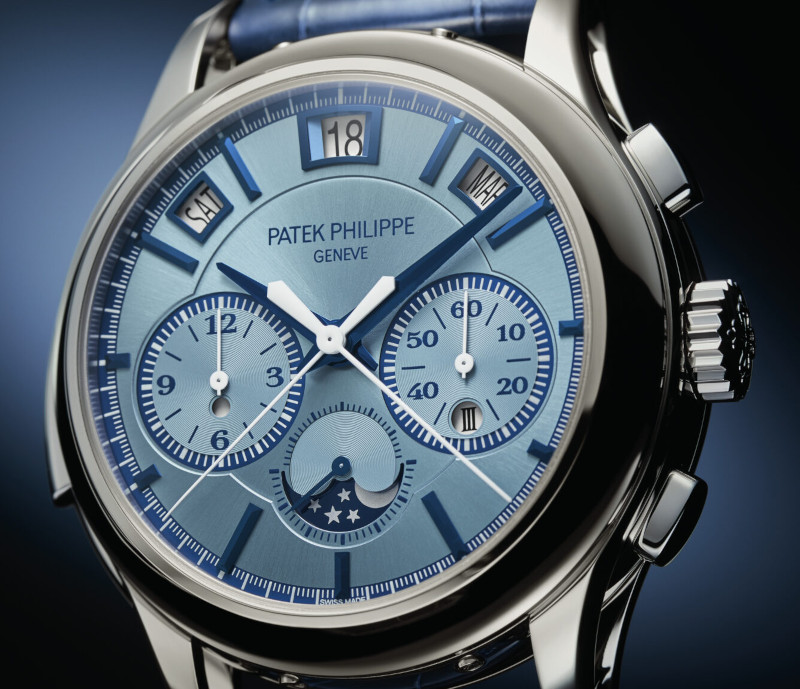
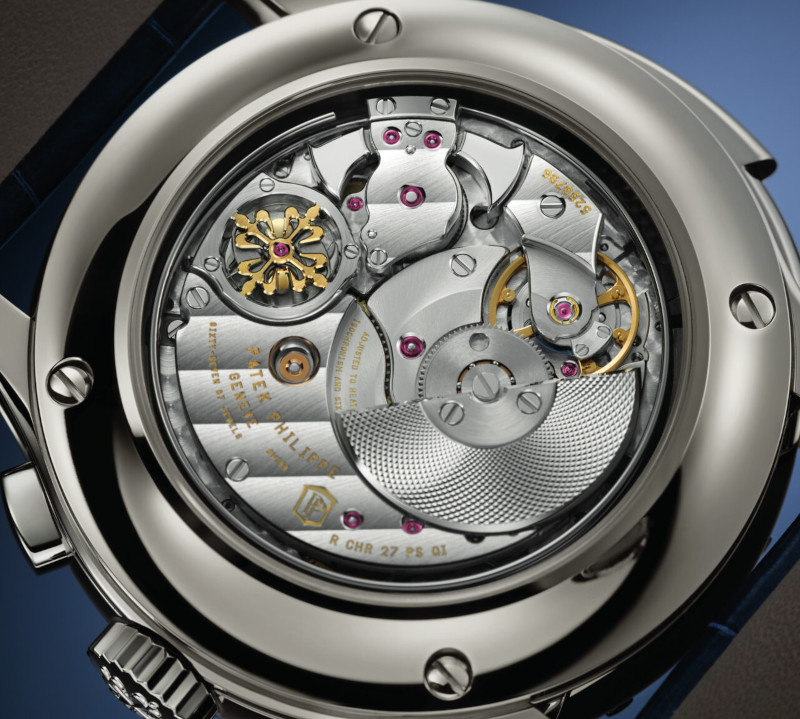
Ref. 5308G-001, introduced for Watches and Wonders Geneva 2025, is where these threads are drawn together. Officially described as a “quadruple complication”, it combines a minute repeater, a split-seconds monopusher chronograph and an instantaneous perpetual calendar. It is self-winding with a platinum micro-rotor.

The movement, calibre R CHR 27 PS QI, descends from the R 27 PS QI of Ref. 5208 but adds a full split-seconds chronograph on top of the minute repeater and instantaneous perpetual calendar. It measures 32mm in diameter and is 12.28mm thick, contains 799 components and is wound by the aforementioned recessed micro-rotor. The micro-rotor architecture keeps the overall height within wearable bounds and leaves a generous view of the movement through the display back.

From a technical perspective, the key achievement of Ref. 5308 is not simply that these four complications coexist, but that they do so in a way that preserves the integrity of each. Three areas in particular deserve closer attention: acoustic isolation and power management for the repeater; friction control and isolator design for the split-seconds chronograph; and energy storage and release for the instantaneous perpetual calendar.

The minute repeater is driven by a separate barrel and gear train dedicated to the chiming work. When the slide is actuated, the strike train draws power from this barrel to drive the racks, snails and hammers that sound the hours, quarters and minutes on two classic gongs. To maintain consistent volume and tempo, the calibre uses a centrifugal governor with aerodynamically shaped blades that regulate speed while producing minimal mechanical noise of their own. The construction ensures that neither the going train nor the chronograph train interferes with the flow of power to the repeater while it is in action, which is crucial for both acoustic purity and rate stability.

The split-seconds chronograph in Ref. 5308 is monopusher in layout but fully fledged in function. Start, stop and reset are controlled by a single pusher at 2 o’clock; the split- seconds function is activated by a second pusher at 4 o’clock. The movement uses twin column wheels to coordinate the chronograph and rattrapante functions and an isolator system to prevent the clamped split-seconds wheel from loading the chronograph train. The steelwork is finished to the same standard as the CHR 29-535 family – even where a lot of these elements are not even visible from the caseback – with black-polished column-wheel caps, straight-grained levers, rounded and bevelled edges and mirror- finished hammers.

The perpetual calendar is of the instantaneous jumping type, with day, date and month displayed in a broad arc of apertures across the upper half of the dial, complemented by leap- year and day–night indications. Patek Philippe has engineered the system so that the three main calendar discs jump in roughly 30 milliseconds, regardless of whether the month has 28, 29, 30 or 31 days. Two opposed jumper springs of equal strength act on the date, balancing each other so that the force required to advance the disc remains essentially constant from month to month. This stabilises amplitude at the precise moment of switching, which is particularly important in a watch where other energy-hungry complications are present.

On the dial side, the 5308G wears its complexity with some restraint. The ice-blue sunburst dial, with its faceted baton markers and arched calendar windows, reads more like a contemporary Patek Philippe perpetual calendar at first glance than a four- complication statement piece. Only on closer inspection do the extra pushers, repeater slide and twin chronograph registers give the game away.

In the context of Patek Philippe’s split-seconds story, Ref. 5308 occupies a very specific place. It is not a laboratory prototype or a one-off special order, but a catalogued watch that distils much of the brand’s accumulated knowledge into a single reference. It is, in effect, the grand synthesis to which the 1923 wristwatch, the CHR 27-525 PS, the CH 29-535 PS and Ref. 5204 have all contributed.
Ref. 5308G-001

REF. 5370 AS LENS, REF. 5308 AS HORIZON

Taken together, these watches describe a century of thought about how to measure the shortest intervals of time, and how to reconcile that task with other demanding complications.

The 1923 no. 124.824 shows Patek Philippe grappling with the basic question of how to fit a split-seconds chronograph into a wristwatch at all, and doing so with such success that its architecture can be revived a hundred years later. The early wrist- worn rattrapantes, references 130, 1436 and 1563, demonstrate that the manufacture was prepared to let the complication live in real and wearable cases. Ref. 1518 establishes a second, parallel line of enquiry by combining chronograph and perpetual calendar in a serially produced watch, a line that runs unbroken through references 2499, 3970 and 5970 to the fully in-house references 5270 and 5204.

The CHR 27-525 PS family and the CH 29-535 PS family mark the decisive move to in-house chronograph calibres, each embodying a different approach to thinness, layout and complication load. Their patents and refinements, from optimised tooth profiles to improved isolators, are the invisible scaffolding beneath the graceful sweep of the chronograph hand.

Ref. 5370 stands at the centre of this constellation. It is the watch that best allows a collector to see, via one open caseback, what Patek Philippe currently thinks a split-seconds chronograph should be. Ref. 5204 shows how those ideas can be integrated into the long-standing Patek Philippe language of perpetual calendar chronographs. Ref. 5373 demonstrates that even in this rarefied field, ergonomics and playfulness still have a place.

The Ref. 5308G-001, finally, is the horizon. It gathers minute repeater, split-seconds chronograph, instantaneous perpetual calendar and micro-rotor automatic winding into a single, precisely choreographed whole. In doing so, it turns the split-seconds chronograph from the protagonist into one of several lead players. The rattrapante is no longer an isolated display of virtuosity, but part of a broader composition about how far a wristwatch can go while remaining, just about, wearable.

In that sense, the story that begins with a unique 33mm gold watch made in 1923 now continues in a white gold watch that represents one of the most mechanically ambitious Patek Philippe wristwatches ever placed into regular production. Between them stands Ref. 5370, the contemporary rattrapante that makes clear why this complication continues to fascinate watchmakers and collectors alike: because it is, quite simply, one of the most eloquent ways to measure a human moment.

PHOTOGRAPHY CHING@GREENPLASTICSOLDIERS
STYLING AND ART DIRECTION AUDREY CHAN
ADDITIONAL WATCH IMAGES COURTESY OF PATEK PHILIPPE AND PHILLIPS
The Watchmaker’s Canvas

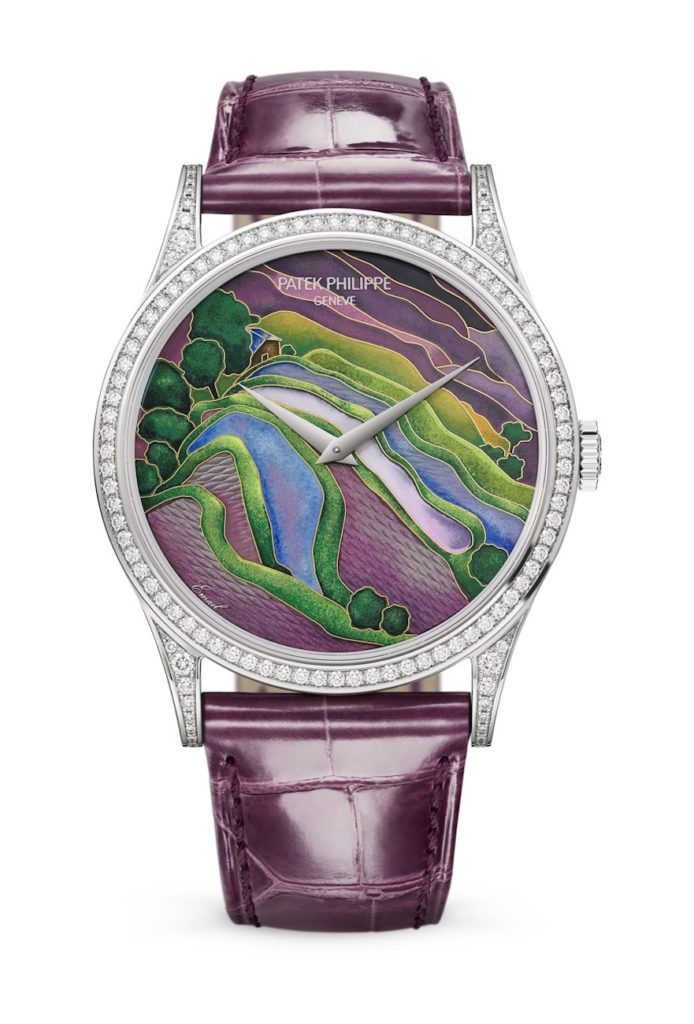
In the rarified world of haute horlogerie, where decimal tolerances speak of engineering precision and tourbillons pirouette with celestial grace, there lies a surface no thicker than a coin but deeper than a sonnet: the watch dial. While movements often garner the loudest applause, it is on the dial that imagination, identity, and artistry converge.

Dial artistry is not mere ornamentation; it is a deliberate canvas, a miniature theatre of craftsmanship. It serves not only to inform, but to seduce, provoke and sometimes to play. Today, traditional techniques like cloisonne enamel, miniature painting and guilloche coexist with contemporary innovations such as laser engraving, 3D printing and even augmented reality.

These hybrid approaches allow artisans to experiment with depth, interactivity and narrative in ways previously unimaginable — pushing the dial into new realms of artistic and sensory experience. In the following paragraph, we will turn our attention to eight extraordinary maisons whose work exemplifies wonderful possibilities of creative expression on the faces of timepieces.

Patek Philippe

Let us begin at the summit—with Patek Philippe, a maison that has long held a religious devotion to metiers d’art. Here, dial artistry is not a trend, but a calling, rooted in an ethos that prizes time-honoured techniques as deeply as it does innovation. The 2025 Rare Handcrafts collection continues this tradition with remarkable pieces like the Golden Ellipse Ref. 5738/50J-011 “Yellow-Crested Cockatoo”, featuring a cloisonne enamel dial enhanced by a miniature painting that brings the vibrant bird to life in exquisite detail. It is not simply decorative—it is narrative.

Equally mesmerizing is the Calatrava Ref. 5077/100R-071 “White Swan,” whose dial is crafted from rare species of wood marquetry and finished with delicate gold leaf. Each thin slice of wood is chosen for its grain, tone, and pliability, then hand-cut and assembled like a jigsaw puzzle of tone and texture. This level of detail—sometimes involving over 200 pieces per dial—requires not just skill but patience bordering on the monastic. The result is not merely visual, but tactile, drawing the eye into its layered intricacies with each glance.

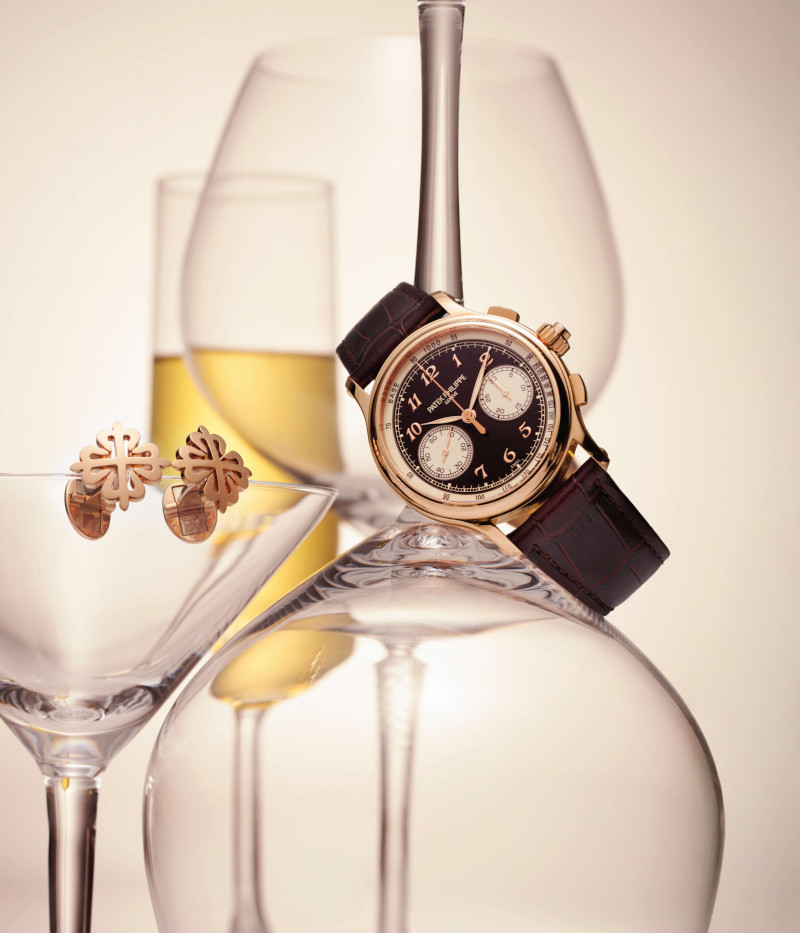
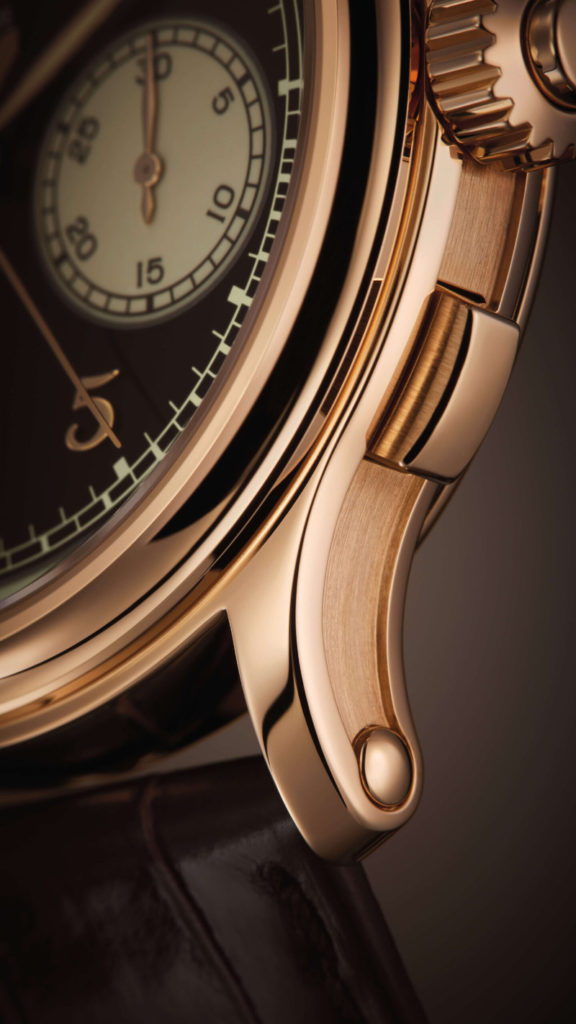
Yet, Patek Philippe’s dial artistry extends far beyond métiers d’art alone, blending seamlessly with high complications. In the Ref. 5370R-001 Split-Seconds Chronograph, introduced in 2025, design and engineering unite harmoniously. The brown Grand Feu enamel dial, with beige champlevé enamel subdials and a tachymeter scale, showcases Patek’ Philippe’s ability to balance technical sophistication with aesthetic refinement. Here, symmetry, legibility, and elegance are not mere preferences; they are obligations. The dial becomes a stage where every complication plays its part in balance and proportion, where function enhances form rather than burdens it.

Van Cleef & Arpels

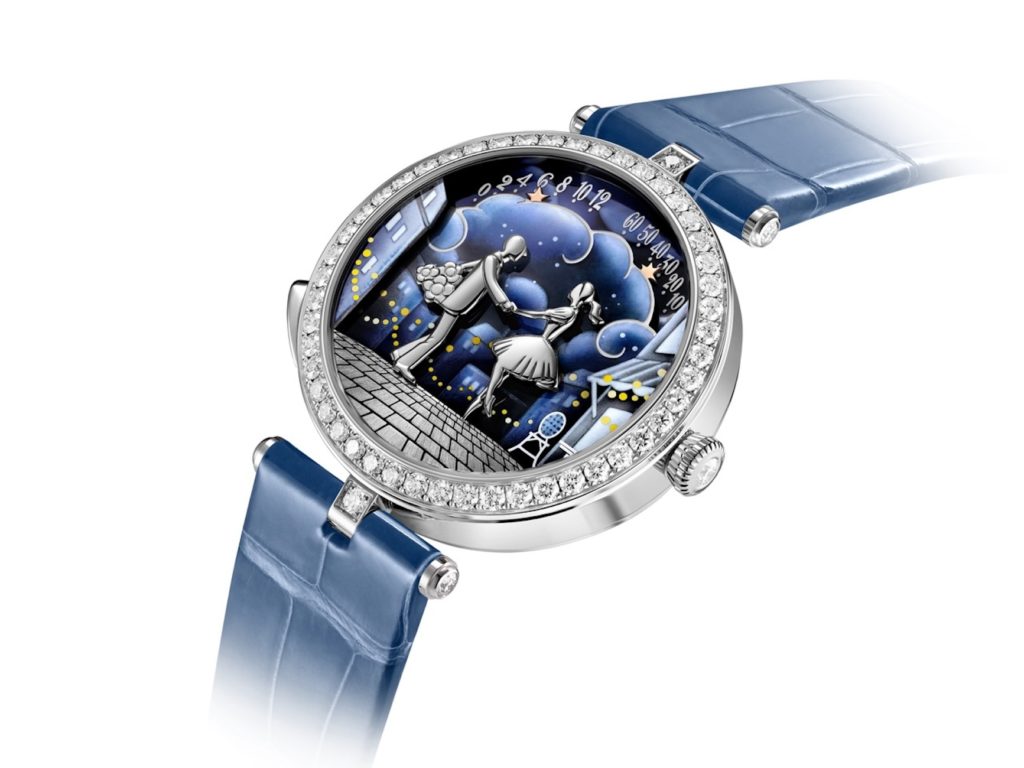
Next, we move to a maison where time is measured not in seconds, but in stories: Van Cleef & Arpels. Few watchmakers elevate narrative like this one, and their 2025 presentation at Watches & Wonders reaffirmed their mastery of emotional storytelling through mechanical ingenuity. The Lady Arpels Bal des Amoureux Automate, a sublime expression of the maison’s Poetic Complications, features a romantic scene in white gold, adorned with diamonds and miniature sculpture. At noon and midnight, an automaton mechanism animates the scene, bringing the lovers to life as they glide toward each other for a tender kiss.

The dial’s intricate design incorporates five planes for added depth, with grisaille enamelling evoking a starlit night and delicate brushwork capturing folds of fabric and expressions of longing. Time is told by two stars set in motion via a double retrograde system, blending technical sophistication with poetic artistry. Here, mechanics are not concealed, they are staged, choreographed, and emotionally resonant. The timepiece is, in fact, a continuation of the animation depicted on the dial of the Lady Arpels Pont des Amoureux, which was first introduced in 2010.

Alongside this, the maison’s Extraordinary Dials series continues to showcase its virtuosity in métiers d’art. Previous years have featured butterflies in miniature mosaic and dreamy zodiac scenes in plique-à-jour enamel. Even in the restrained elegance of the Pierre Arpels collection, where minimalism reigns, the dial remains a sacred space, empty not from absence, but from intention. It is designed as a pause, the white space of a poem, the silence between notes in a sonata.

Chanel

From fairy tales to fashion rebels, Chanel brings its haute couture swagger to the dial with irrepressible confidence. The house’s design language—bold yet elegant, masculine but never without grace—finds its gorological counterpoint in models like the Boy.Friend.Originally conceived as a study in masculine lines for a feminine wrist, it has now become a playground for dial experimentation.

A standout is the 2024 piece unique created for the TimeForArt auction: a Pop Art-style portrait of Gabrielle Chanel herself, clad in pearls, layered necklaces and bold cuffs, framed within a bezel of 38-baguette-cut diamonds. Crafted in Grand Feu Studio, the image is built up using twelve individual cliches, dimensionality, with texture, wit and irreverent charm.

In 2025, Chanel continues this exploration with Boy.Friend Coco Art Watch, a reissue of the 2024 piece, unique as a limited edition of 20 pieces, this time framed with a bezel of 38 baguette-cut pink sapphires. Chanel also introduced the Boy.Friend Blush at Watches & Wonders 2025. This limited-edition timepiece features a coral lacquer dial adorned with a stylised portrait of Gabrielle Chanel, paired with a pink strap and a black stainless-steel case.

The contrasting hues, slightly off-killer symmetry and expressive line work echo Chanel’s radical take on femininity. Chanel’s dial experimentation is neither nostalgic nor tech-forward: it is artistic expression in the medium of time; fashion rendered in horological form.

Hermès

Dial artistry often speaks most potently when it whispers, and few speak this dialect more fluently than Hermès. Revered for its leather and scarves, the maison has now turned its horological eye inward, and upward. The Arceau collection, long celebrated for its asymmetrical stirrup-shaped lugs and narrative-driven dials, epitomizes this approach.

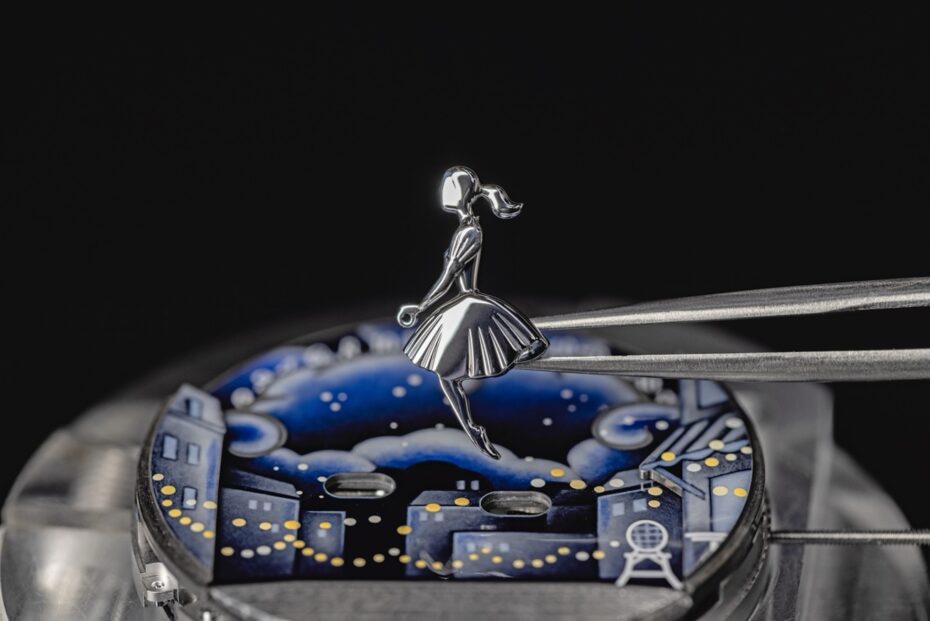
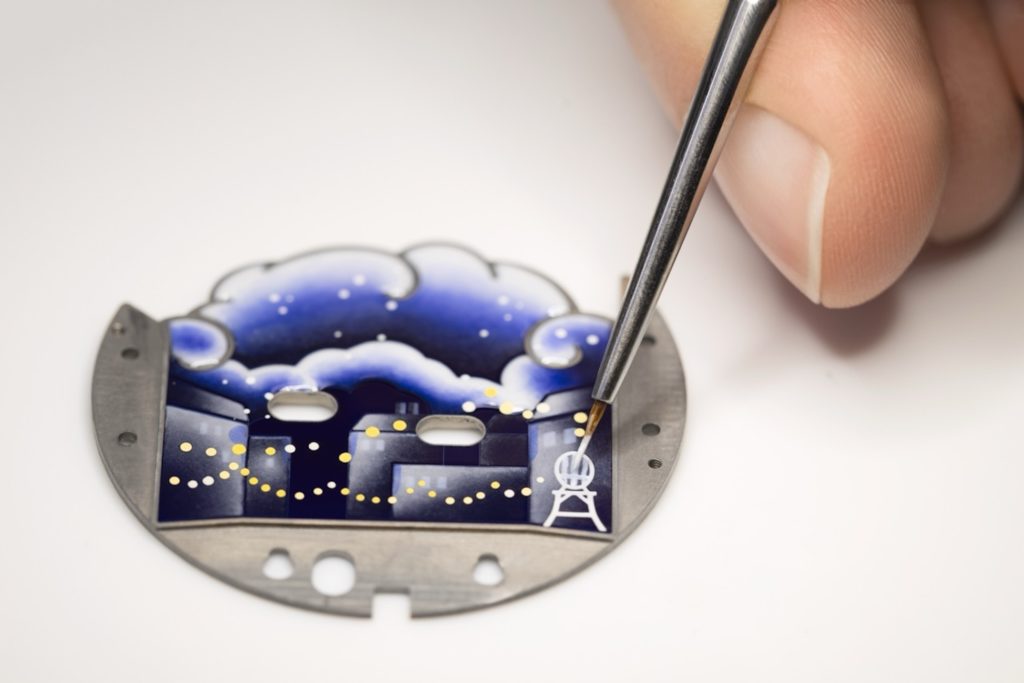
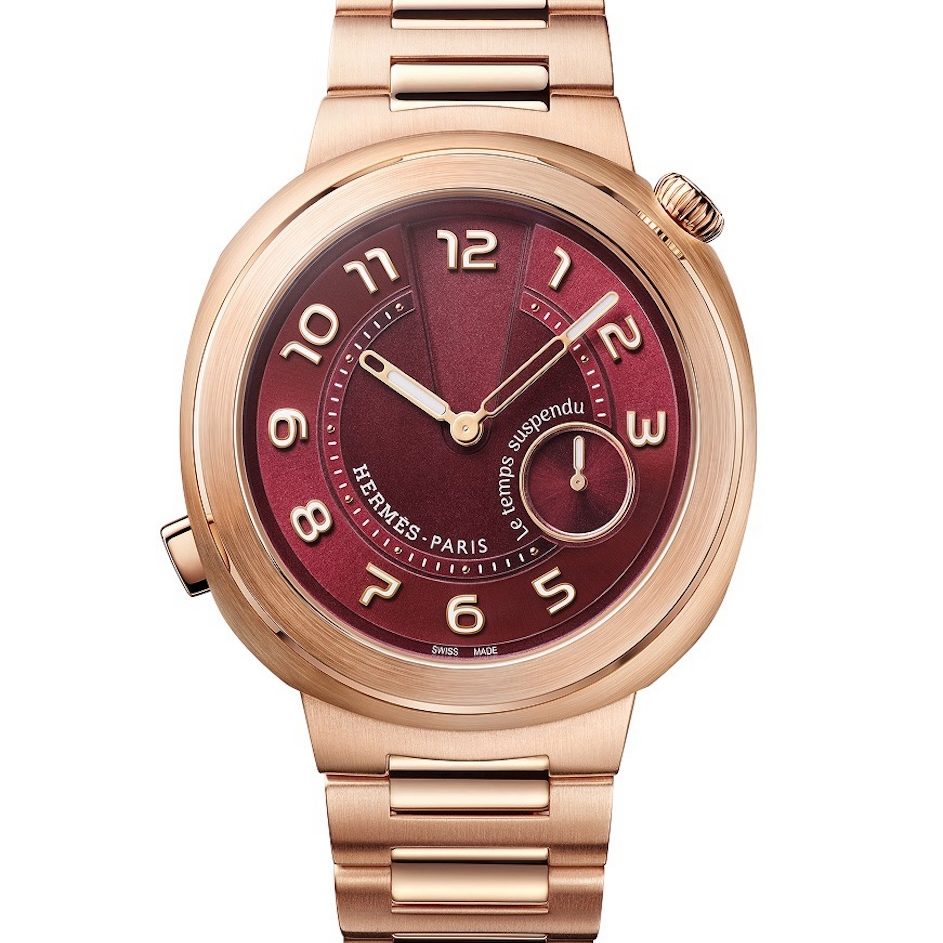
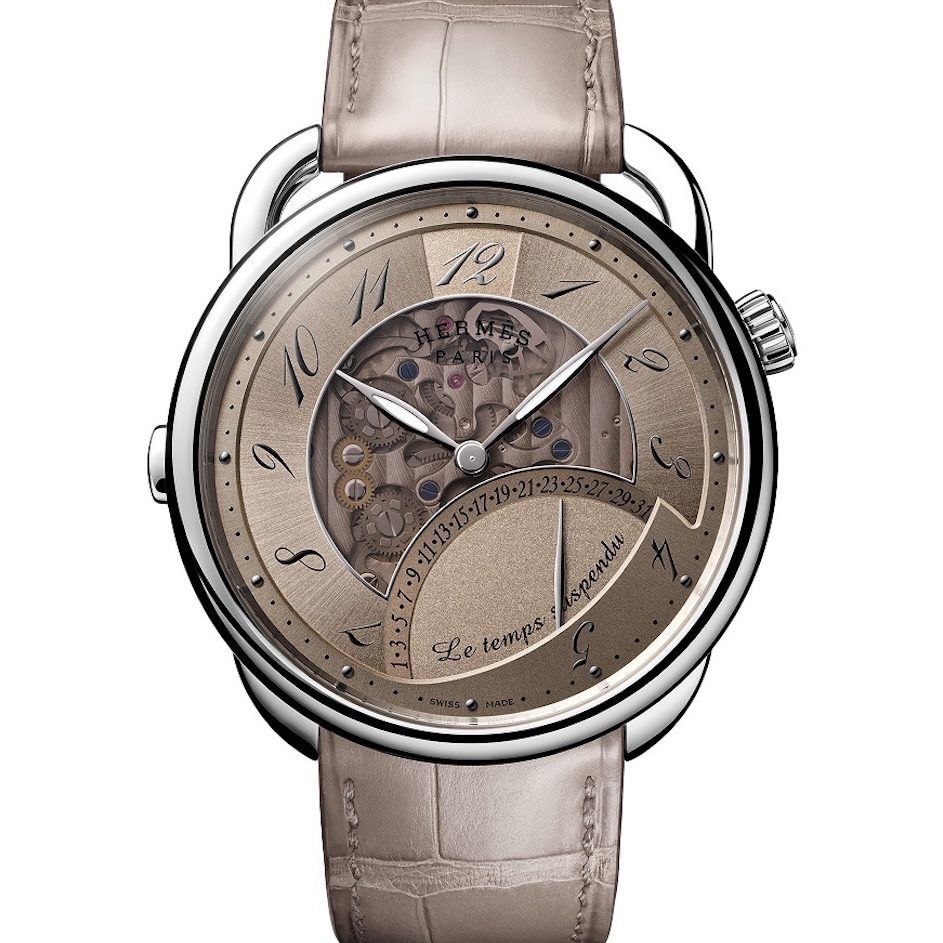
The Arceau Le Temps Suspendu, returning in 2025, invites you to pause time itself, literally. At the press of a pusher, the hands retreat, leaving time to quietly continue inside while refraining from declaring it. The dial becomes an existential pause, a philosophical gesture cloaked in horological mastery. It is a reminder that time, like language, can be withheld, held in suspense, or gently subverted.

Then, there’s the Arceau Rocabar de Rire, which replaces solemnity with mirth. A horse crafted from horsehair marquetry, engraving, and miniature painting sits on the dial, with the punchline arriving when the horse sticks out its tongue at the press of a pusher. It is playful, delightful, and exquisitely made. It reminds us that technical mastery and a sense of humor are not mutually exclusive.

Hermès has long embraced playfulness with discipline. Even in pieces like the Arceau Millefiori—where the dial is a slab of colored glass crafted in the Cristalleries de Saint-Louis—or the lacquered scenes inspired by its scarf designs, the maison demonstrates that dial artistry can be both poetic and whimsical, a quiet rebellion dressed in elegance.

Longines

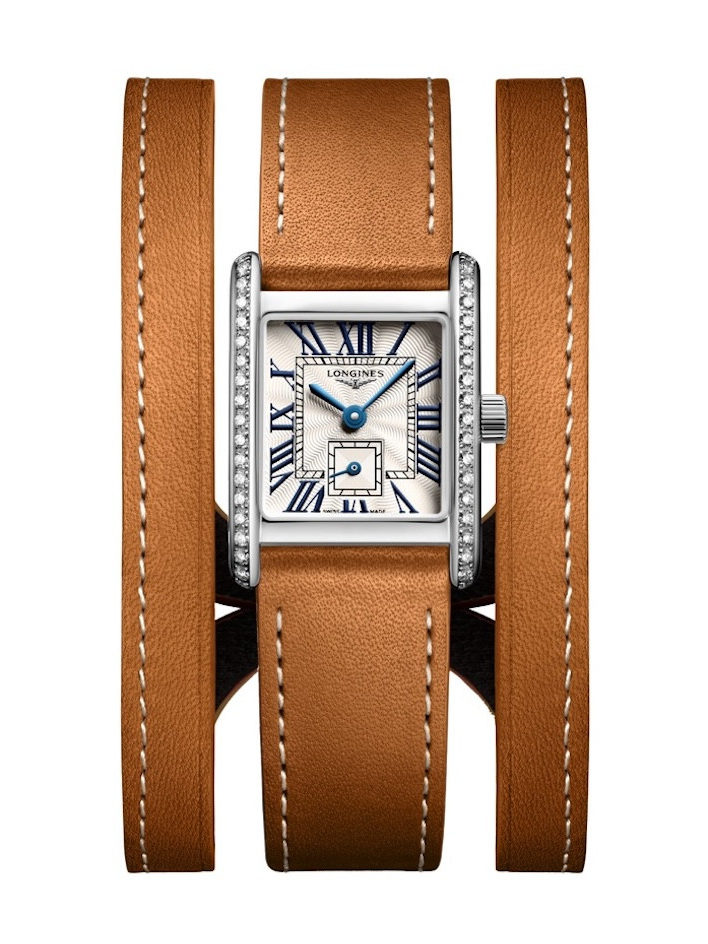
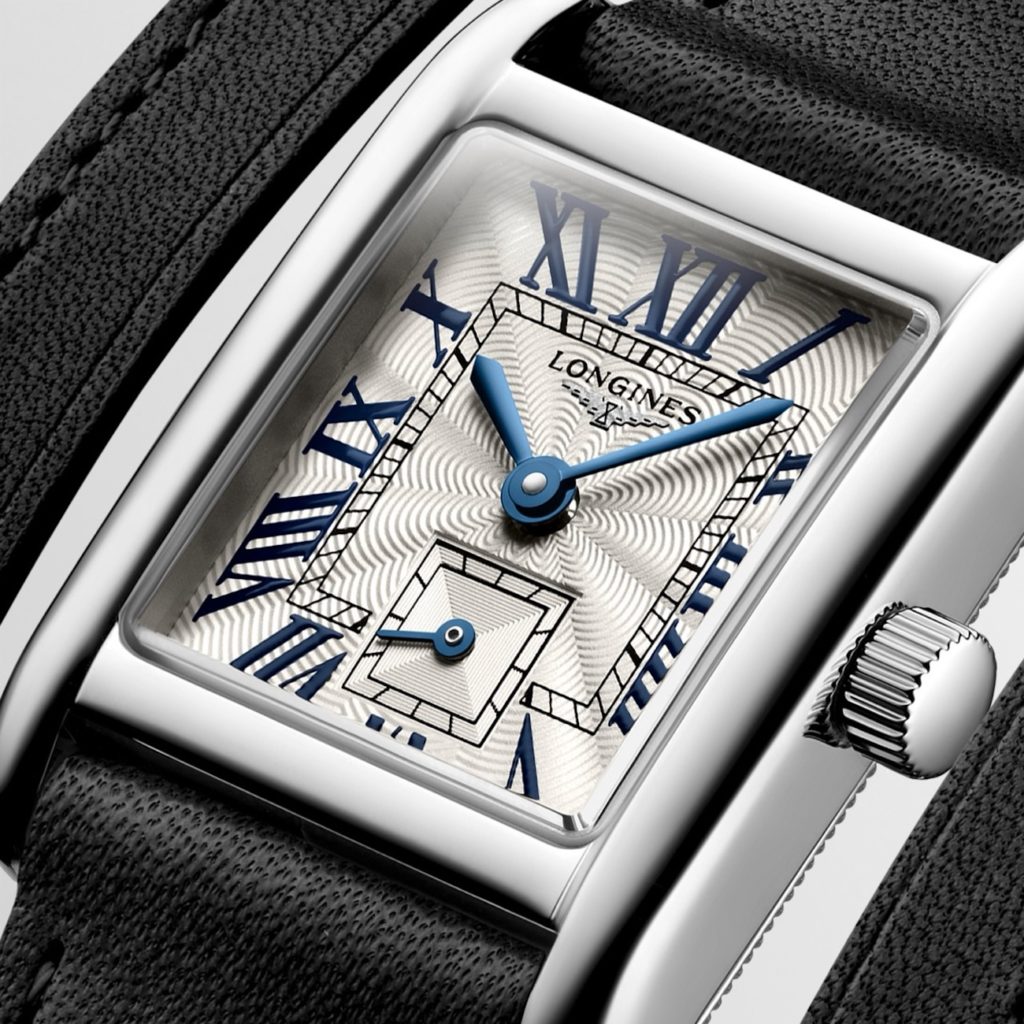
Longines proves that artistry needn’t always be ornate. Take for instance, the brand’s famed sector dials, which are studies in proportion and clarity, designs that whisper rather than shout, yet command attention with their perfect geometry. In these dials, symmetry reigns: concentric circles, crisp crosshairs, and evenly spaced markers create a visual rhythm that recalls interwar modernism and mid-century minimalism.

Contemporary releases like the Heritage Classic Sector Dial and the rectangular DolceVita Sector Dial have garnered praise not for their complexity but for their restraint. The spacing of elements, the serif typefaces, the muted palettes, all recall a time when utility and beauty were not in conflict but in conversation.

This restrained elegance permeates the broader catalogue. From the balanced typography of the Master Collection to the disciplined legibility of the Spirit line, and even in the sportier HydroConquest models, Longines consistently favours proportion over embellishment. It is a quiet, deliberate aesthetic, one that values design discipline as a form of artistry. The dial becomes a diagram of clarity, a design of timeless relevance.

Bvlgari

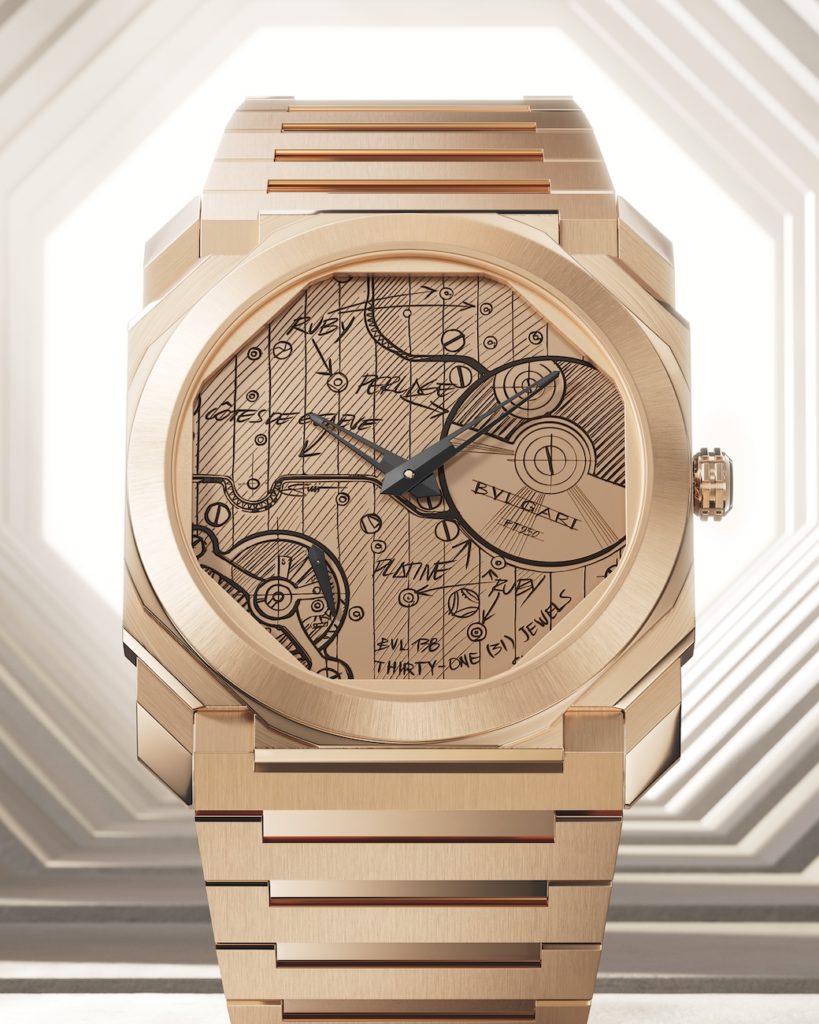
Bvlgari, master of Roman sensuality, offers a different proposition altogether. Its approach to dial artistry is all at once conceptual and sensual, merging engineering and aesthetic daring. In celebration of its 140th anniversary, the brand unveiled the Octo Finissimo Automatic Sketch Dial, a limited edition that places the movement front and centre on the dial.

The face features a hand-drawn illustration of the ultra-thin calibre BVL 138, complete with its micro-rotor and intricate finishing details. This layered, expressive depiction blends mechanical complexity with artistic imagination. Made available in 280 pieces in stainless steel and 70 in 18k rose gold, the timepiece underscores Bvlgari’s commitment to challenging horological conventions with elegant disregard.

This sketch-style approach first emerged in 2022, when Bvlgari’s creative director, Fabrizio Buonamassa Stigliani, printed his original design drawings directly onto the dial. By elevating what is normally a backstage process into the star of the show, Bvlgari upends the hierarchy of watch design. It is meta, mechanical, and unmistakably Roman in its flair. This approach offers a rare glimpse into the design process and celebrates the generative power of sketching—the first line before anything else exists, now frozen forever on the dial.

H. Moser & Cie

Meanwhile, in Schaffhausen, H. Moser & Cie dares to scribble all over tradition—challenging the codes of classic watchmaking like none before. Nowhere is this more apparent than in the Endeavour Perpetual Calendar Tutorial. This limited edition takes the brand’s revered perpetual calendar and overlays it with scribbled annotations, doodles, and playful reminders as if written by a mischievous watchmaker.

With cheeky notes like “Watch out for very rare 29th” next to the month of February, the dial transforms into living breathing user manual. And yet, the mechanism beneath remains uncompromising: instantaneous date change, manual override, and minimalist architecture all powered by the HMC 800 calibre. Moser’s point is clear: serious watchmaking doesn’t have to take itself too seriously.

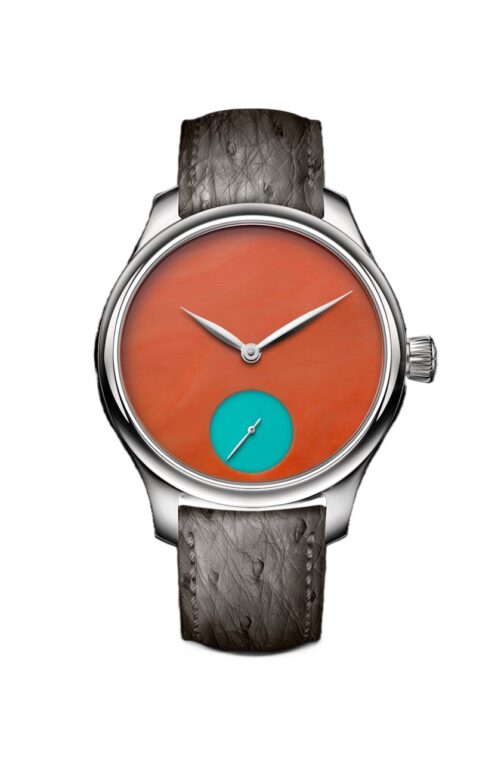
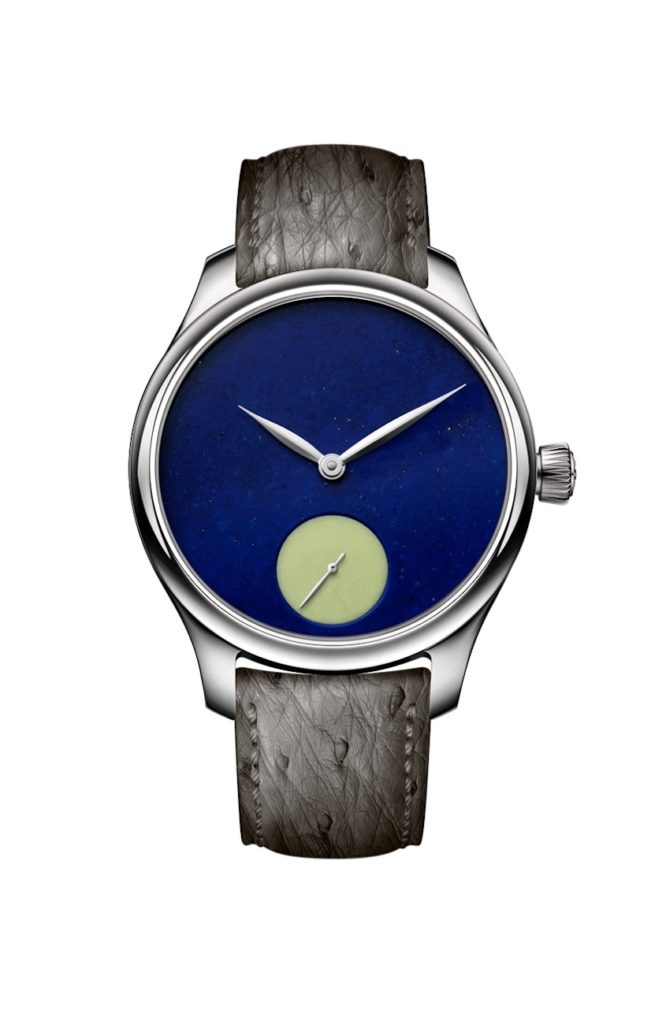
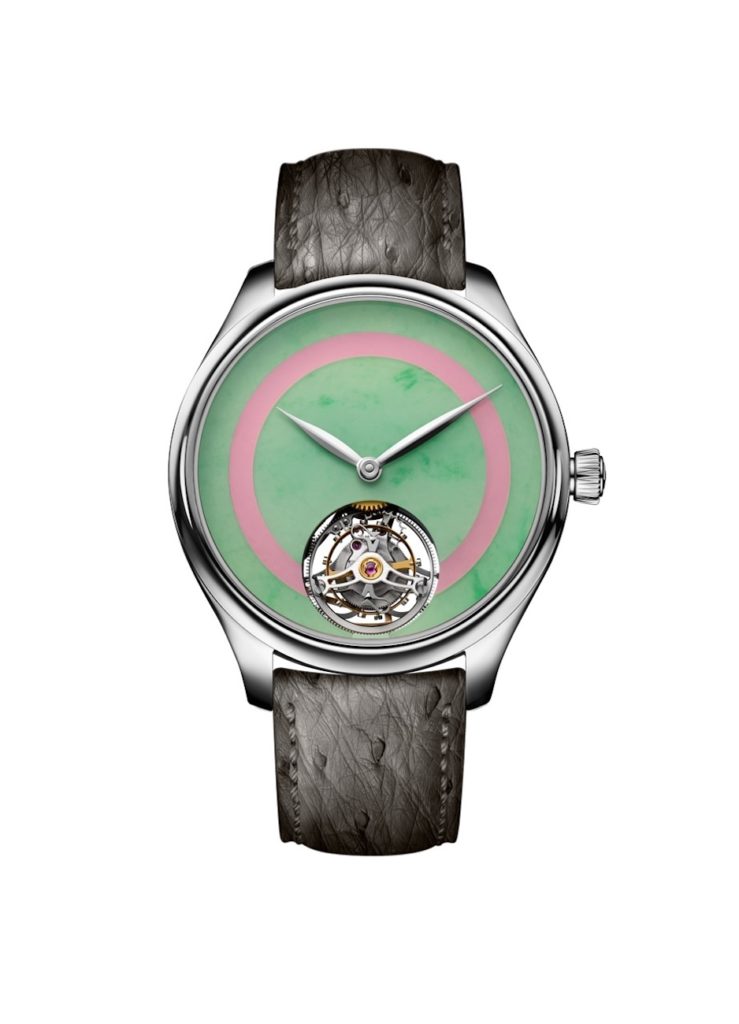
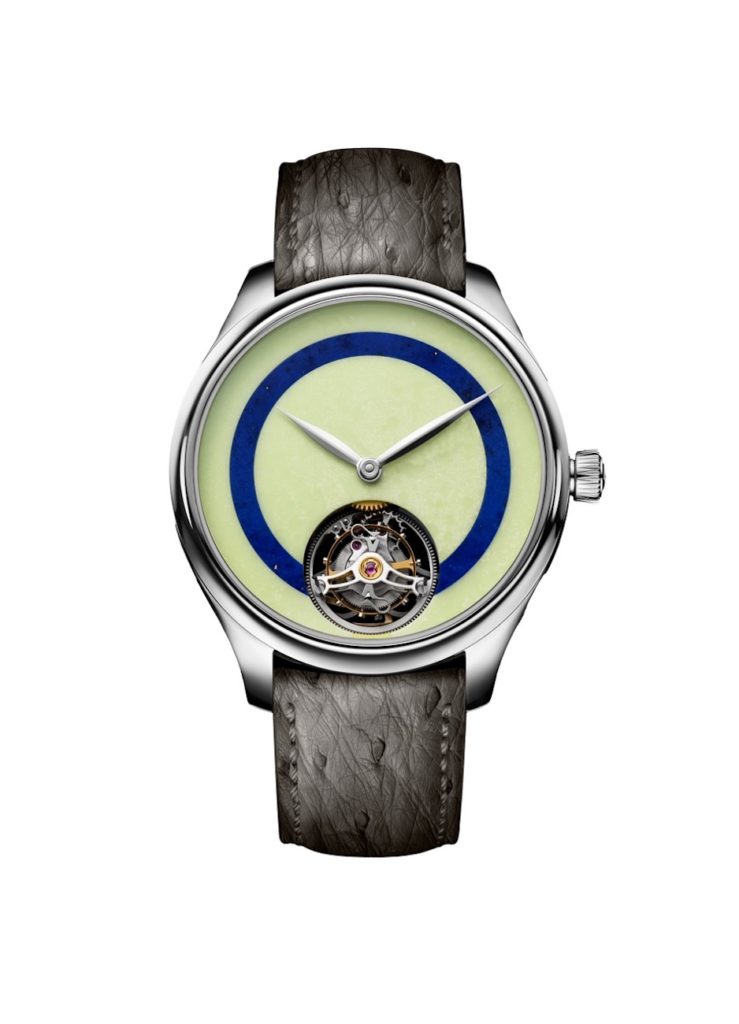
This spirit of rebellion is also reflected in Moser’s 2025 Pop Collection: a riot of colour and natural materials that reimagines the Endeavour line. Dials crafted from turquoise, coral, jade, and lapis lazuli present a vivid, almost surreal intensity. Each stone dial is unique, offering an artistic expression of nature’s imperfections, while still maintaining Moser’s commitment to technical integrity. Here, nature becomes the artist, and the dial the medium.

Mido

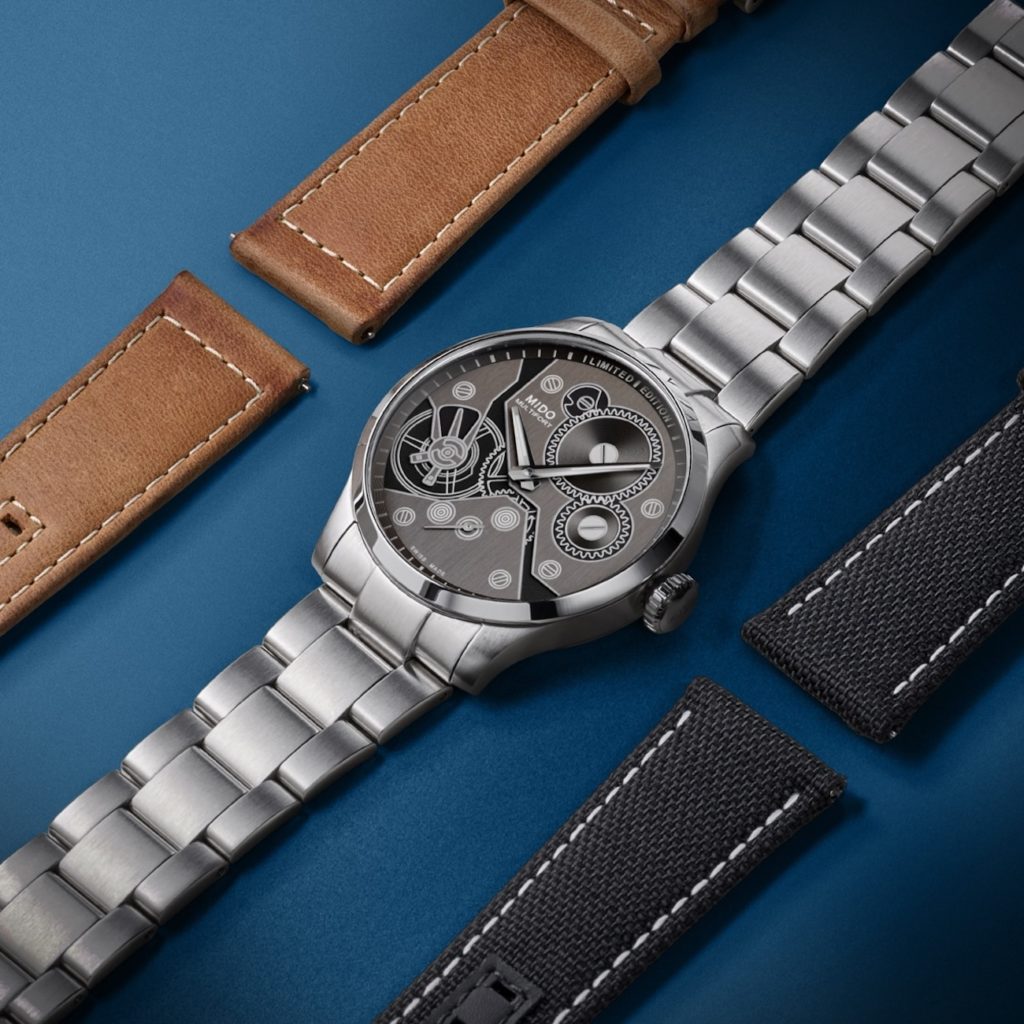
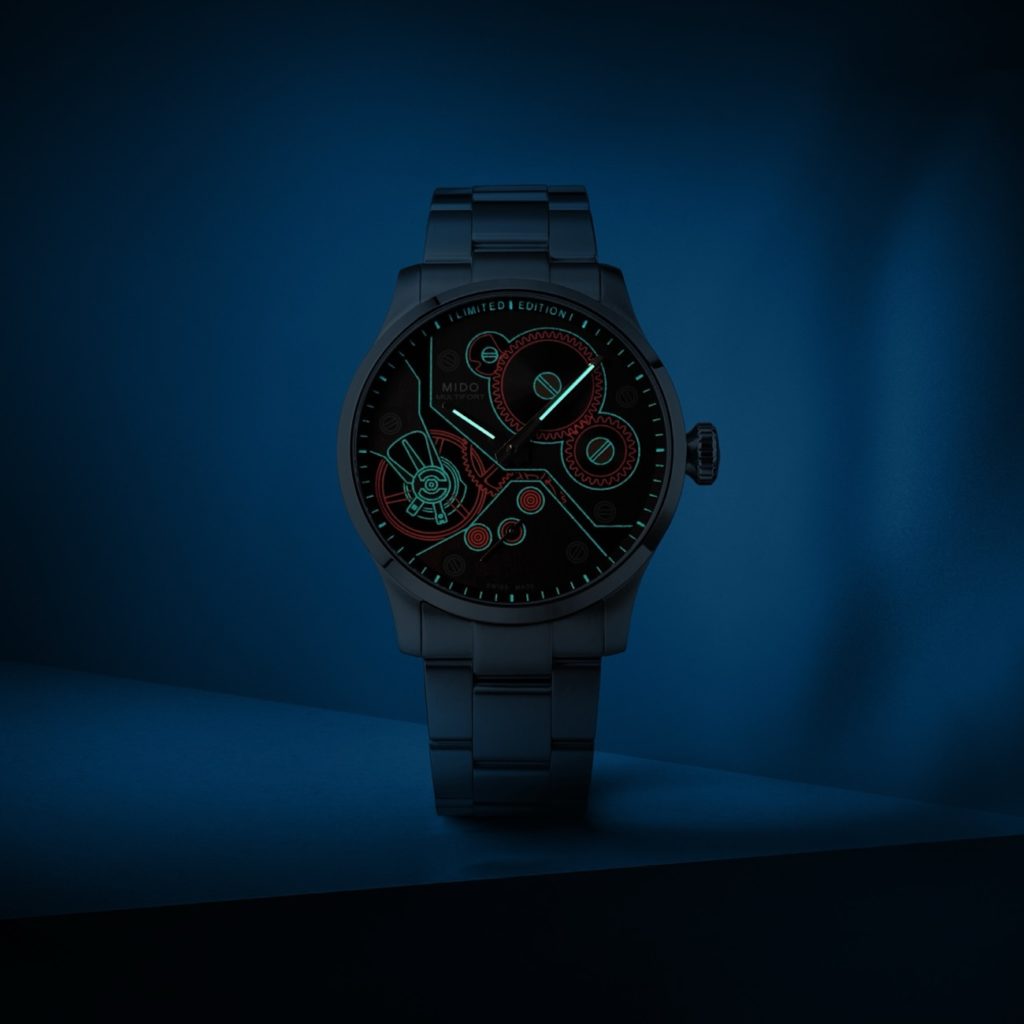
Mido, the quiet achiever of Swiss watchmaking, is carving out a unique space by reimagining mechanical design with artistic clarity. While the brand favours architectural rigor over ornamentation, its recent foray into dial artistry has been both clever and refreshing. The Multifort Mechanical, introduced in 2024, features a printed illustration of the movement across its dial.

Mido cheekily turns the mechanics inside out, placing a schematic drawing of the calibre front and centre, treated with luminescent material for a glow-in-the-dark effect. The result is cerebral yet charming, a visual homage to the machine within, rendered with graphic finesse.

And in other lines, such as the Ocean Star Decompression Timer or Commander Gradient, Mido balances colour, transparency, and playful geometry with surprising dexterity. It is not showy but assured. It proves that even in the affordable segment, dial artistry can sing with both intelligence and integrity. The art is democratic, the detail precise, the joy unmistakable.

In a world where time is often reduced to a mechanical abstraction, these eight maisons demonstrate the elevation of the dial to its rightful place as an art form. Each dial considered above represents not merely a functional surface, but a synthesis of heritage and experimentation—a miniature gallery where history, philosophy, and innovation converge. Whether it’s the precision of wood marquetry, the storytelling of automata, or the unexpected poetry of laser etching or graphic schematics, the dial has become a space where the past and future of watchmaking hold a quiet, exquisite dialogue. These timepieces remind us that a watch does more than tell time; it frames it, questions it, decorates it—and, most importantly, reimagines it.

Jack Heuer's Vision: The Enduring Appeal of the TAG Heuer Carrera

TAG Heuer Carrera Chronograph Tourbillon

While not every story about TAG Heuer begins with a specific human being, this one does. This is particularly true of our cover star this issue, and also of the broader collection it belongs to. You cannot quite begin to learn about the Carrera’s origins without first learning a little about the man responsible for having dreamed it up: Jack Heuer. Jack, whom this story addresses mostly by his first name to avoid confusion with the Heuer brand, is the great-grandson of Edouard Heuer who, in 1860, founded the watchmaking endeavour that stands today as TAG Heuer. He was born on November 19, 1932, in Bern, Switzerland. Jack describes in his autobiography: The Times of my Life - An Autobiography by Jack Heuer, that he had a “very happy and privileged childhood.” Jack Heuer was already comfortable navigating life in English, French and his father’s specific Swiss German dialect, at a young age. He was no stranger to the outdoors thanks to his father’s influence and, apparently, he was quite a talented skier who was allowed to go the more difficult slopes alongside kids who were significantly older than him.

Jack made his first contribution to the family business at the tender age of 15, when the resourceful teenager managed to employ the help of his physics teacher at school, Dr. Heinz Schilt, to create the Heuer company’s first tide watch, the Solunar, and later the Mareograph-Seafarer; and thus a connection with the TAG Heuer Carrera Chronograph Skipper (opposite) emerges, if only thematically.

Later in his life, for his university education, Jack went to the Federal Institute of Technology, in Zurich. It was here that Jack developed an interest and love for modern design. He writes that he loved the works of furniture designers Le Corbusier and Charles Eames, and architects such as Eero Saarinen and Oscar Niemeyer. Jack shares further that as a student, he even saved enough to buy himself an Eames lounge chair, which he confesses, looked oddly out of place in his student accommodation.

Jack Heuer joined the family watchmaking business, formally on January 1, 1958. In a few short years, he had delved into various aspects of the business, both at home and overseas, and the time had soon come for him to design his first watch… Hot on the heels of the launch of the beloved Autavia, in 1962, Jack was invited by the Sports Car Club of America to attend the 12 Hours Race at Sebring in Florida. The invite was the result of his loaning the race a handful of Heuer pocket watch chronographs with spilt seconds. And thus, the performance motoring story flagged off.

The Sebring race was the place to be during those years for anyone with serious interest in endurance racing. The race is known to have had notable participants from both the professional and amateur circuits including German racer, Jochen Rindt, the Mexican racing brothers, Pedro and Ricardo Rodriguez, and even the one and only, Paul Newman. While he was there, Jack writes that he spent the bulk of his time at the Ferrari pits. He spent so much time there that he managed to get well acquainted with the team’s drivers, the Rodriguez brothers and even their parents.

Designing the Carrera

Jack Heuer writes, recounting the conversation he had with the Rodriguez parents, “They told me that they were lucky that their boys were so young — Pedro was then 21 and Ricardo 19 — because if they had been born a few years earlier they would certainly have participated in the dangerous race across Mexico known as the Carrera Panamericana Mexico. At the time it was considered to be the most dangerous sports car race in the world and over a period of five years had claimed over 30 victims. It was called off in 1955 because of safety concerns, a decision no doubt reinforced by the disaster at Le Mans the same year.”

It was the first time Jack had encountered the word Carrera, which immediately left a deep impression on him. He writes, “I loved not only its sexy sound but also its multiple meanings, which include road, race course and career. All very much Heuer territory! So as soon as I got back to Switzerland I rushed to register the name under Heuer Carrera.”

Read more: Quartz Watches: What They are and How They Work

TAG Heuer Carrera Chronograph Skipper

Jack set out to make the Heuer Carrera a watch of its time, taking inspiration from the designers he admired. For this he shares, “I wanted a dial that had a clear, clean design, and a new technical invention came to my aid. A manufacturer of plastic watch crystals had invented a steel tension ring that fitted inside the crystal and kept it under tension against the surrounding steel case, thereby greatly increasing the degree of water resistance. I decided to use the inside bevel of this tension ring to carry the markings measuring one-fifths of a second. In other words, the flat dial surface no longer had to carry these markings — they had now been shifted off onto the tension ring — and this was the secret behind the fresh, clean and uncluttered appearance of my first ‘Carrera.’”

Jack designed the dial of the Heuer Carrera, first and foremost, with legibility in mind. He limited the text on the dial to a bare minimum, essentially just incorporating the word Carrera printed above the Heuer shield at 12 o’clock and a fine print of the word “Swiss” at 6 o’clock. Jack added to the watch’s legibility by opting for black text on an otherwise monochromatic dial. He proportioned the subdials with great care, ensuring superb balance. But of course, it was the steel tension ring that fitted inside the crystal and accommodated the 1/5th seconds scale that ultimately gave the first Heuer Carrera its sense of expansiveness.

The Heuer Carrera was launched in 1963 as the reference 2447, targeted primarily at motor racers. Measuring 36mm, initially the watch had three subdials — 30-minute and 12-hour totalizer, along with a running seconds — and was powered by the Valjoux 72 chronograph movement. It did not take long, however, for the watch to evolve. Practicality required that for watch buyers with the need for specialized chronograph scales, the Heuer Carrera had to accommodate a variety of alternative scales on its dial. These scales couldn’t be confined to the aforementioned steel tension ring. So the Carrera’s dial too had to consider different outlooks.

In 1965 specifically, Jack Heuer launched the reference 3147 Carrera Date, or “Dato” as it is better known among collectors. The Landeron 189 movement in the watch allowed for a running seconds display at 9 o’clock, a 45-minute totalizer at 3 o’clock and, oddly, a date window at 12 o’clock; when the chronograph was zeroed, the large second hand would obscure the date. This was rapidly rectified with a 1967 reintroduction that took away the running seconds hand and placed the date window instead at o’clock. We will get to the 1968 version later…

First, it must be acknowledged that Jack’s design and vision for the Carrera was a strong one from the start; it provided a strong base from which to grow and develop a collection of watches. Sure enough, as the decades wore on, the Heuer Carrera saw a plethora of animations, such as in the barrel-cased versions in the 70s, automatic movements, quartz movements, ever more colorful dials, incredible complications (including world premieres), different interpretations of case shapes and much more. With every passing decade and even through Heuer becoming TAG Heuer, the Carrera became entrenched into the horological firmament.

There is, honestly, a great deal more to the story of Jack Heuer and the impact he has had in building what would become TAG Heuer, beyond the Carrera. We have been exploring these tales over the years (this is our third Carrera feature) and the mine is unlikely to run dry soon.

TAG Heuer Carrera Chronograph Skipper and Carrera Chronograph with panda dial

Now, as the Carrera took on ever more progressive designs, in terms of its case, dial elements, movements, it is hard to deny that within the collecting community, there was a yearning watches in the likeness of reference 2447, but produced with today’s technology and know-how. Limited editions such as the 2017 Skipper, produced with Hodinkee, and the Blue Dreamer, produced with The Rake and Revolution magazines, were proof positive of this sentiment. Later, TAG Heuer itself launched the Carrera 160 Years Silver, in 2020 — a faithful reissue of the 2447 — unsurprisingly, the watch was a runaway success (and our Summer cover watch that year).

Read more: 8 Luxury Timepieces Based On Olympic Sports

Six Decades On

TAG Heuer has given the idea of reviving the 1963 Carrera aesthetics a right good dose of rocket fuel since then. There have been several superb launches that take after the 2447, such as the Carrera 60th Anniversary unveiled — as its name suggests — on the occasion of the Carrera’s 60th anniversary, in 2023 (the watch was last Summer’s cover star). But the most significant development, in terms of taking inspiration from the original Carrera, was the 2023 Carrera Chronograph “Glassbox”, which is a delicate reinterpretation of the 2447 with a decidedly contemporary edge.

At 39mm, and with a “box” sapphire crystal, the case features an angular façade with a mix of brushed and polished surfaces that boldly play with any and all available light. Taking inspiration from the original, TAG Heuer was deliberate and intentional in printing the tachymeter on the sloping flange, paying a homage to Jack Heuer's design chops. The watch was made available in a reverse panda variety — with the date window at 12 o’clock — as well as a blue version with its date window at 6 o’clock.

Another newsworthy development last year was the introduction of TAG Heuer’s brand new Calibre TH20-00. In simple terms, the movement is an evolution of the Heuer 02, launched in 2016 as the brand’s signature workhorse (developed from the ground up at the manufacture’s own facilities at Chevenez). The Heuer 02 is in fact the same movement upon which TAG Heuer developed its industrial tourbillon movement, the Heuer 02T.

Carole Forestier-Kasapi, TAG Heuer’s recently appointed Movement Director — and industry legend —shares about the Heuer 02, “The Heuer 02 movement is an extremely well-made calibre, it’s flawless. Our mission was to take it to the future as well as possible.” This future proofing meant fine-tuning targeted aspects of the column-wheel and vertical clutch equipped chronograph movement. An extensive study was first conducted over six months, the results of which informed Forestier-Kasapi and her team. They set out to devise a very precise development pathway in order to imbue the Heuer 02 with significant improvements.

The entire exercise took two years and yielded the new generation of the Heuer 02, now equipped with a bi-directional rotor, that is even more discreet and quiet. It also allowed for some aesthetic updates such as the movement’s new rotor shaped in the silhouette of TAG Heuer’s shield. The biggest impact from all these upgrades to the movement, however, is that TAG Heuer is now standing behind the TH20-00 with a five-year warranty, up from the previous two. Says Forestier-Kasapi, “To go from two to five years of warranty, the mechanics behind the watch have to keep up. This is a major challenge for any watchmaker.” She goes on, “TH20-00 represents a leap in quality and durability. All TAG Heuer movements will now have to meet this new benchmark of excellence.”

TAG Heuer also took the occasion of the Carrera’s 60th anniversary to demonstrate the versatility of its new TH20-00 family of movements by announcing an all-new 42mm Carrera Chronograph Tourbillon. In accordance with our story thus far, the new Carrera Chronograph Tourbillon does away with the 2016 version’s industrial outlook for an aesthetic that takes after the 2447.

The movement used to bring the timepiece to life is the calibre TH20-09, which retains the column wheel chronograph mechanism and bi-directional rotor from the essential TH20-00 and adds to it a 4Hz tourbillion. But then, there is a further cherry on the TH20-09’s proverbial cake, in that the tourbillion chronograph movement is impressively COSC certified.

Another Carrera launched to mark the collection’s 60th anniversary include the reissue of the Carrera Skipper, in a 39mm steel case with the TH20-06 calibre, which builds on the TH20-00 with a 15-minute regatta countdown indicator. Still another was the 42mm Carrera Chronosprint x Porsche, launched as a nod to the Carrera’s “brother from another mother”: the Porsche 911, which was serendipitously born in 1963. The Carrera Chronosprint x Porsche’s calibre TH20-08 was designed to recount a very poignant moment from the 911’s introduction. Forestier-Kasapi explains, “Just as the car went from 0 to 100km/h in just 9.1 seconds, so does our second hand. It takes exactly 9.1 seconds to cover the red portion of the dial and recreate that feeling of exhilaration evoked by the acceleration time of the first Porsche 911.” TAG Heuer also paid homage to Jack Heuer’s gold Carrera reference 1158CHN with a new 39mm rendition executed in yellow gold and equipped with the TH20-00 movement. Lastly, not a watch, but TAG Heuer took the occasion to launch “The Tag Heuer Carrera: The Race Never Stops” book, which beautifully bears witness to six decades of the Carrera (and is referenced heavily for this story).

The Seventh Decade and Beyond

As the Carrera embarks on its 61st year, TAG Heuer’s already geared itself to build on the momentum gathered from the prior year’s worth of celebrations. As early as January, at the LVMH Watch Week in Miami, the 42mm Carrera Chronograph Tourbillon got its next rendition with a striking circular brushed, green dial. This particular shade of green is not unfamiliar to TAG Heuer. It first appeared on a prior Carrera Chronograph launched in 2021 and has since been part of TAG Heuer’s colour palate.

The “Dato”

TAG Heuer Carrera Chronograph Dato

Alongside the green Carrera Chronograph Tourbillon, TAG Heuer launched the 39mm Carrera Chronograph “Dato”. In this instance, “Dato” refers to a very specific execution of the reference 3147 that was launched in 1968. The watch had a 36mm steel case and was still powered by the same Landeron noted earlier. It had a stark black dial with applied baton markers, white print, a white 45-second totalizer at 3 o’clock and a curiously placed date window at 9 o’clock. The unique placement of the date window earned the watch special nicknames among collectors: Cyclops and Dato 45. The former was because collectors likened the watch’s solitary date window to the solitary eye of the mythical creature. And Dato 45 — probably the cleverer of the two names — because of the placement of the date window at the 45th minute/second and also the 45-second totalizer on the reference 3147.

The 2024 Carrera Chronograph “Dato” is a contemporary reissue with the all-new Carrera case that was introduced with the Carrera Chronograph “Glassbox”, and it has a 30-minute totalizer. It must be pointed out that with the significance of the solitary date window, TAG Heuer has been thoughtful about how it has been placed in the new watch.

The scarcity of dial elements, also, really lends itself for studying the details TAG Heuer has applied to the contemporary Carrera, with the “box” sapphire crystal accentuating the sloping flange that rises from the edge of the dial and then dips down again into the primary dial face. The total effect of these details gives the dial a visual suggestion of being larger than it is.

Powering the watch is the calibre TH20-07, a further development within Forestier-Kasapi’s TH20-00 family of chronograph movements.

Read more: Elegance Meets Sporty in the Omega Seamaster Aqua Terra 150m

Golden Skipper

TAG Heuer Carrera Chronograph Skipper

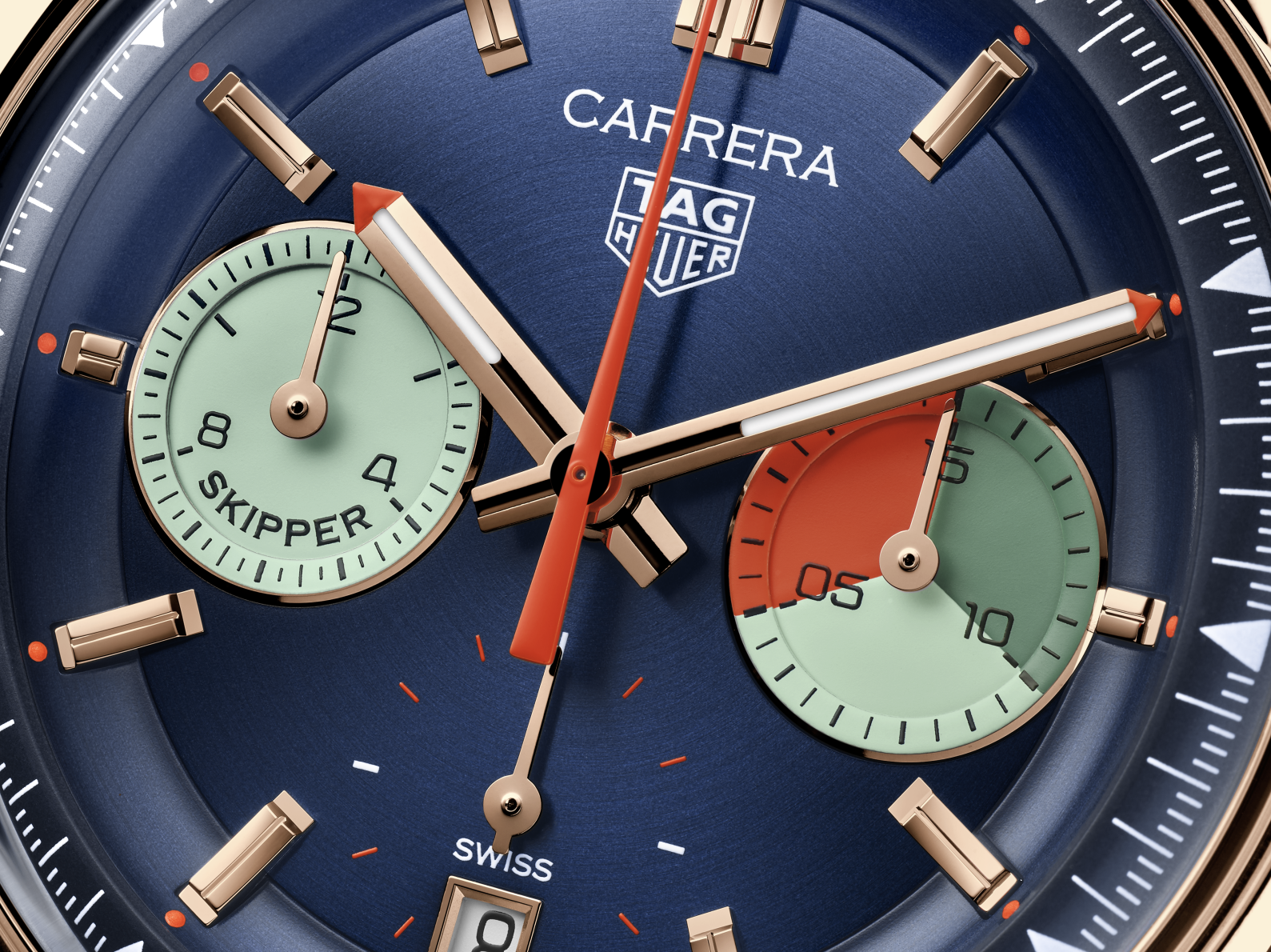
A few short months later, at Watches & Wonders Geneva (WWG), TAG Heuer unveiled the aforementioned Carrera Skipper, in a 39mm rose gold case. The Skipper was first produced under Jack Heuer’s leadership as the reference 7754, in 1968. The watch is a bit of an anomaly among the early Carreras as Jack had produced the Carrera with motor racers in mind. The Skipper takes an odd turn in that regard with its regatta timer.

Peculiarity aside, the watch is highly memorable with its incredible use of colours: its blue dial and the shades of teal and striking orange used on the regatta subdial, make for an unforgettable sight.

Now, the Skipper was sold in extremely limited quantities. Jack Heuer had produced the 7754 to mark the victory of the New York Yacht Club’s ‘Intrepid’ boat over New Zealand’s ‘Dame Pattie’ in the 1967 America’s Cup. The Skipper was a congratulatory gesture on Jack’s part, because he had earlier equipped the team with hand-held yachting timers and Aquastar wristwatches to use during the competition.

The colours used for the regatta timer on the Skipper are in direct reference to the winning vessel: lagoon green (inspired by Intrepid’s rigging); Intrepid teal (the colour of the sailboat’s deck) and, for the final five-minute ‘get ready’ sector, Regatta Orange. Orange tends to be the colour of choice on a lot of sailing apparatus due its contrast against the blue of the waters.

The 2024 Carrera Skipper, now, builds on the 7754’s grand legacy with a rose gold case that gives the timepiece an elevated sense of formality. Not to mention that the blue of the dial really does pop against the rose gold.

Not an Average Panda

Carrera Chronograph with panda dial

The other Carrera launched at WWG, and the final watch of our focus here, is a Carrera Chronograph with the beloved “panda” dial. Jack Heuer first produced Carreras with the “panda” and “reverse panda” dial configurations in 1968 (roughly) as the reference 7753, powered by the manual Valjoux 7730 movement. Silvered dials with black subdials were designated 7753 SN, SN meaning “silver” and “noir”, while “reverse panda” dials were designated 7753 NS by logical convention. TAG Heuer has now applied these important pages from the Carrera’s history books to the new "Glassbox" Carrera.

The 2024 timepiece (opposite) begins with its silvered sunray dial bearing the now familiar “Glassbox” Carrera’s complex dial silhouette. The dial is set with black subdials. Interestingly, thereafter, the sloped flange is in black and marked with a tachymeter in white print. Really a clever use of contrast here, as on first sight it almost appears as though the tachymeter is engraved on an external bezel insert.

While TAG Heuer has called it a “panda” dial, said dial does deviate from monochromatic norms. As you can see, the brand opted for a pop of colour with the hands on the chronograph 12-hour and 30-minute totalizers: a very distinctive red, which is repeated on the tip of the large central chronograph second hand.

Keeping to all things contemporary- Carrera, the watch is powered by the calibre TH20-00, which is, once again, in clear view when the watch is turned over. What is different here from the new Carreras we have encountered thus far is that this one comes fitted on a three-row steel bracelet that has been designed to work seamlessly with the “Glassbox” case. While the end result looks effortless, designing bracelets to work with an established case design is never an easy feat and for this we must applaud TAG Heuer.

Sixty years on, the strength in Jack Heuer’s blueprint for the design of the Carrera is self-evident not just in the collection’s longevity, but also in the many Carrera expressions the company has delivered. Of course, every extrapolation was made while keeping the mantra of clarity and legibility front and centre. Now, as the Carrera embarks on its seventh decade, it is amazing to see how much the design of the original 2447 still holds watch enthusiasts captive.

The present generation Carrera wristwatches, specifically the “Glassbox” cased examples, bear a striking resemblance to the original. Only thorough inspection gives away the contemporary angles and refinements, and the newly minted TH20-00 family of automatic movements, visible through the watches’ display casebacks. Having said that, the present state of the Carrera does however raise a pressing question: Can Jack Heuer’s blueprint remain relevant for decades more, and beyond? What we can say for sure is that for as long as clarity and legibility remain pertinent to the universe of horology, so will the TAG Heuer Carrera.

This story was first seen on WOW’s Summer 2024 Issue.

For more on the latest in luxury watch news and releases, click here.