Why Buying Luxury Watches is a Waiting Game

Arguably, buying a watch has always been a journey of discovery, but when it comes to exploring an entirely new brand, it becomes a literal opening up of an undiscovered country. If you are a Joy Division fan, you might even think of Unknown Pleasures realised. Even if one is not so poetically inclined, getting into a new name in watchmaking is equal parts trepidation and transcendence. This is where I find myself now, with the Christopher Ward C1 Bel Canto, a watch I failed to buy on its launch last year.

Those of you who may have read this very section last year might recall the heavy presence of this watch, which came to represent all my failed attempts to buy a variety of popular watch models, from mainstream brands to independents. Trust me when I say there have been many, only the most famous of which graces the opening section of this recurring missive. It is no exaggeration though to say that Christopher Ward changed everything and not just for me. It did so in a way that put enthusiasts and collectors first, and I believe is what makes it particularly worthy of the Petite Aiguille at the GPHG in 2023. It is for this reason, aside from the purchase decision of course, that I decided to push out this story.

To get things off on the right foot though, I must note that I took possession of my Bel Canto, when this issue was being sent to the printer, and this sentence was part of a running change. It was meant to arrive in November, which would have given me just enough wiggle room to shoot the actual piece. That date turned into December and, well, you know the rest. However, while I continue to be against the practice of making people wait for an indeterminate period of time for a choice timekeeper, I do understand that some waiting is necessary. If nothing else, waiting gives you the chance to change your mind and – to be completely honest – you should definitely do that if your doubts cast too large a shadow. There are few things worse than buyer’s remorse over what amounts to a discretionary purchase of an object that is meant to make you feel good about yourself.

Brand Equity

So, before even getting to the watch in question, the brand must be addressed. Swiss Made is absolutely necessary for some, and that is perfectly fine. Despite being British, Christopher Ward fulfils this; the watches are certainly conceived and designed in the UK though. A. Lange & Söhne and Seiko probably have something to say about this sort of thing, and with good reason. Reasons even but then again, even Glashütte brands do use Swiss suppliers, and the Swiss themselves have suppliers outside the EU. I am of the Tony de Haas school of thought here, in the sense that I do not care a whit about who made the screws.

Despite being a recent arrival in watchmaking, Christopher Ward has fulfilled what I consider to be a reasonable grace period, from its inception in 2004, to be taken seriously. It now fits properly into the constellation of brands I regularly look at when considering a new watch. Of course, the price and nature of the Bel Canto ultimately convinced me to push Christopher Ward ahead of many brands whose watches I have wanted for decades, in some cases (see the second the watch on the list for an idea of why that might be). Although I am about to spend a little time extolling the virtues of the brand, I have only been properly aware of it (beyond a vague notion that it exists) since 2017, to my great shame.

Now, this story does not get into specifics about the C1 Bel Canto – that will have to wait for another time, preferably when the watch is actually here and I have images of it as well as a report of the wearing experience. Instead, I want to focus on the (ongoing) acquisition itself. Christopher Ward discovered it had a hit of unparalleled proportions with this watch, although whether that was before or after Watchfinder & Co and Swiss Watch Gang talked up the model is uncertain. Brand representatives have said that they would have had second thoughts had they known how challenging such a watch would have been, and how much demand they had to satisfy. Honestly, though, what did Christopher Ward expect would happen when it offered a chiming watch for approximately USD 5,000? It is certainly the most handsome hour-striker at its price point, and arguably superior to many other more expensive tickers.

No Issue Reissue

What made a consequential difference to me here was how Christopher Ward handled the mad scramble for the original C1 Bel Canto. It would have been all too easy for the watchmakers to have patted themselves on the back for a job well done with the watch, thanked everyone who bought the watch and expressed consternation that so many had been disappointed. That could have been all there was to it, but not for Christopher Ward.

With orders closed for that now-famous watch, the brand bothered to go through the list of people who tried and failed to buy it. It then came up with a process for all of us to find a little satisfaction – the second run of the C1 Bel Canto in the colours you can see on the brand’s website. Crucially, this was far in advance of any news of a renewed run for the Bel Canto, and all the failed buyers of the original watch were taken through a process to confirm our interest, and subsequently to order the version we wanted. This was not a wait-list, strictly speaking, because everyone paid a deposit; this process is now precisely how orders for all future Bel Canto watches are handled on the website.

That Christopher Ward reached out to me, I found deeply impressive. Of the many pieces I expressed an interest in, the attention of both brands and dealers have been, shall we say, tenuous. When demand is plentiful, this is unsurprising but I must dutifully report to those of you knew to this hobby that it was like this even 10 years ago (with some caveats, as noted below). Receiving an email, automated though it appeared to be, from Christopher Ward noting my interest in the Bel Canto and then moving from there in a clear and structured manner was very notable. Just knowing that they wanted to keep the connection going was refreshing and reminiscent of how authorised dealers used to treat people.

Online First

A pioneer in the online space back in 2005, Christopher Ward knows a thing or two about how to keep people interested in its story – without the luxury of physical contact. In the case of the Bel Canto, this took the form of a series of six staggered emails that explained a variety of production details relating to how the watch is made. Aside from being extremely informative, especially if you like to nerd out as I obviously do, these emails served as tactical instruments. The last one was meant to mark the imminent arrival of the watch, and now I shall see how closely the watch tracks, especially since I know that the new watches have made their way to collectors in a variety of countries. On a final note on buying watches online, the C1 Bel Canto is my first significant online watch purchase (believe it or not) and paying for this – even if it was only a deposit – then just twiddling my thumbs while waiting indefinitely could have been anxiety-inducing. The consistent updates and production updates besides went a long way towards avoiding this...well, until now that is.

As some of you no doubt are curious about, the C1 Bel Canto does pop up occasionally, and very unreliably, on resale platforms. If you believe the listings, if you want to skip the wait then you will have to pay an unhealthy premium. For a watch still in production and available via the brand at a standard price, this is egregious – it might just be trolls and scammers because however amazing the unrivalled Bel Canto might be, it cannot compete with major brand offerings.

Now, by dint of some luck, I do know at least one other person who is waiting for his Bel Canto watch. I had no idea that he too had tried to buy the original and had fallen short but we did compare notes once he saw the story in last year’s Many More Hands story. No doubt you will see the photographic evidence on Instagram when we both receive our watches. Strangely enough, I apparently know yet another person who is also on standby while he awaits his watch. If nothing else, the fact that Christopher Ward has managed what amounts to a reissue so effectively is amazing. For me, all that remains is managing the waiting game.

Vacheron Constantin Overseas 41mm

Unlike the C1 Bel Canto, the Vacheron Constantin Overseas has been a constant companion in my dreams for years. I trust I need not repeat any refrains about Vacheron Constantin’s long and storied past to explain this but the choice of the Overseas itself is a bit of a personal idiosyncrasy. Amidst the madness surrounding luxury sports watches in recent years, I had to strongly consider how to proceed. In other words, I needed to decide if I wanted in on the action. As I have explained over the years in the pages of this magazine, I feel the ascendance of the sports watch is about as irreversible as the big watch trend. Thus, if you want one of the big standard bearers, you need to already be in good standing...and be willing to compete with speculators. As far as the Overseas goes, I might selfishly suggest to the alternative asset guys and flippers that they are barking up the wrong tree. Properly speaking, this is because the Overseas is really in its own odd little space.

While I would argue that the love for Gerald Genta-designed watches is properly separate from an appreciation of the luxury sports watch, there are overlaps. The Overseas is not one of them, with this watch having a rather interesting history that I do not have space to get into. Suffice it so say though that the Overseas is a sports watch, its history begins in the 1990s, and continued to evolve up to the early Aughts. The last revision to the collection happened in 2016, which was relatively minor. Even Vacheron Constantin does not make the case that the Overseas was meant to be the successor to the 222 in 1979, which was the brand’s proper contribution to the design language pioneered by Genta (though he did not design the 222 or the Overseas, just to be clear). It will not surprise you that this was when I discovered the Overseas because I was learning and writing about watches around about this time (especially the 2000s), when I first discovered the magic of mechanical watches in the 1990s. The watch today is quite different than it was at the start but it still says something about the era of its birth.

For the longest time, prior to the launch of the Fiftysix collection, the Overseas family served as the gateway to Vacheron Constantin. I feel positive about the change, although it did not influence my decision as far as reference 4520V/210A-B128 goes. Vacheron Constantin just wised up to the fact that a legend of fine watchmaking cannot use a design-forward luxury sports watch as an introduction to the brand. Now, this does open up pricing options for the brand, which admittedly might be very bad for me and for anyone hoping for a bargain here – the Overseas can be had for $16,500, although that is for the quartz model. Prices have been trending upwards with this collection for years, although resale prospects here were never in outlandish territory.

Something to note about this model here is that it is a boutique exclusive, at least in Singapore. That means buying it is a matter of when you expressed interest in it. Now, I have been on this list for a number of years now and I have not tired of waiting yet. This is one of the upsides to waiting for more than a minute (to put it mildly) to commit to a watch because neither the brand nor market conditions are responsible. Just me and my wallet. I will close with a brief note on why I decided to finally buy the watch. In a word, it was fear, just as it was with the Rolex Oyster Perpetual Milgauss in 2021.

Inflationary pressures aside, all brands continue to aggressively push their prices skywards and, as mentioned, the introduction of the Fiftysix signals as much to me. The Overseas is, in my view, no competitor to the Audemars Piguet Royal Oak or the Patek Philippe Nautilus, even if it plays in their arena. Like those watches, it tested the boundaries of watch design (by channelling the brand’s Maltese cross logo) to the breaking point. It may have passed that post and then waited for the market to catch up to it, which is a decision I continue to salute Vacheron Constantin for. Happily, the Overseas has not only finally found the audience it deserves but it also no longer needs to languish in the shadow of giants, thanks to Vacheron Constantin introducing the Historiques 222.

This article first appeared on WOW’s Legacy 2024 issue.

For more on the latest in watch reads, click here.

This Watch Partnership Will Have Collectors Rejoicing

Sincere Fine Watches is bringing famed German independent brand Kudoke to Singapore and Malaysia in a move sure to please local collectors. Kudoke gained international acclaim with its GPHG win in 2019; the watchmaker earned the Petite Aiguille award for the Kudoke 2 timepiece. Of course, collectors will have been aware of the brand founded by AHCI member Stefan Kudoke in 2008 for some years now; Stefan runs the business with his wife and partner Ev.

Stefan Kudoke

WOW Thailand and Singapore featured an interview with Stefan in 2020, which emerged within a few years of the editors discovering Kudoke watches. For those who think German fine watchmaking is all about Glashutte, Kudoke offers an excellent rejoinder. Kudoke’s base of operations is just outside Dresden, which is the city closest to Glashutte; Stefan worked as a watchmaker at Glashutte Original and Blancpain, with stints at Breguet and Omega as well.

Kudoke watches

Kudoke watches are today famed for creative skeletonisation, and indeed started that way, fuelled by Stefan’s passion for the art and his recognition of a market gap for such timepieces. This foreshadowed the fine engraving and hand-finishing evident on the brand’s in-house Kaliber 1.

Kudoke watches

Collectors can discover all the fine details about Kudoke at Sincere boutiques and SHH salons in both Singapore and Malaysia.

For more on the latest in luxury watch reads, click here.

LUXUO's Coverage of LVMH Watch Week 

Watch fairs are funny things – are we most interested in a show like the LVMH Watch Week for the experience or for the new watches? What if those new watches include a heavy-hitter such as the Hublot MP-10, or an icon such as the Bulgari Bulgari Bulgari, which is the only watch we know of that makes one say the brand name not once but three times! What about the return of a classic, as heralded by both the Carerra Chronograph Dato for TAG Heuer and the Chronomaster Original Triple Calendar for Zenith? For the independent-minded enthusiast and collector, it must be a different sort of return: a public celebration of the rebirths of Gerald Genta and Daniel Roth brand names.

Bulgari Bulgari

A year-opening affair like the one organized by the LVMH group to pump up its new watches is no way to judge the novelties of the year, nor is it an appetizer for the coming Watches and Wonders Geneva show. That said, just the list we rattled off cannot be taken lightly, and it certainly makes us wish we could make it to the Miami show in person. We sat out the season-opener in 2024 this year because it is simply too close to the Geneva show for comfort and Miami is a bridge too far. For some context, Hublot, TAG Heuer and Zenith all show at Watches and Wonders, and some (if not all) will be sharing the key talking points at the later fair.

Hublot Mp-10 Tourbillon Weight Energy System

For us, the watches are then the meat of the LVMH Watch Week, and the subject of this briefest of notes. While the important watches are not exactly listed in the order we noted, we do want to begin with the MP-10, which to give it its due, is the MP-10 Tourbillon Weight Energy System Titanium. That word salad is really shorthand for all that makes the watch special: Hublot has done away with hands, dial and completely reinvented the automatic winding system. While we will get into it in more detail later, the gist of it is that the MP-10 uses its movement to display the time, as you can see.

Hublot Big Bang Unico Saxem Green

Read More: Takashi Murakami Discusses His Latest Hublot Creation

On that note, perhaps the most significant thing to discuss here is how that winding system works. Hublot’s watchmakers have set aside the traditional winding rotor here, relying instead on the force generated by the white gold blocks that move freely around the vertical axis. The result is perhaps one of the most attention-grabbing watches we have seen in recent years, and certainly at the LVMH Watch Fair.

Bulgari Bulgari

Moving on to something with a different flavour, there is also that Bulgari to get into. First of all, this watch will be celebrating its 50th birthday in 2025, and it is perhaps one of the last of Genta’s seminal designs of the 1970s. The Bulgari Bulgari is a watch so lovely they named it twice, and it gets two new sizes this year: an automatic (calibre BVL 191) in 38 mm and a 26 mm quartz model. Other than size, everything else is proportionately the same as the watch you already know.

Read More: The TAG Heuer Carrera Chronograph Drips in Gold

Standards get a lot more play at the LVMH timekeeping party this year, with TAG Heuer and Zenith both playing to their respective strengths. For those who might be scratching their heads in wonder at the teal green Carrera Chronograph, we addressed it as the Dato but that is not its name. Indeed, although this is a new contemporary reference for Carrera Chronographs, it will share the same naming convention as all other Carrera Chronographs. The Dato reference was meant to put you in mind of the 1968 Heuer Carrera 45 Dato, so-named for its distinctive date at 9 o’clock. The date is back there (there are several date positions for the Carrera) now and the chronograph is thus mono-register and sans any running seconds indication. Calibre TH20-07 has a vertical clutch to accompany its column wheel so you could safely keep the chronograph seconds going if you wanted.

Zenith Chronomaster Sport

Finally, the Zenith Chronomaster Original Triple Calendar throws a lot of information at the wearer – or any onlooker really. This too is a watch evocative of the past, when Zenith made the El Primero calibre to not only be an integrated automatic chronograph. Yes, not only, because the brand made some examples of triple calendar watches, with moon phase indicator, with the El Primero movement by 1970, just a year after the launch of the chronograph movement. Zenith today says that this is a watch that took 55 years to get here, but the chronograph with full calendar and moon phase display was in the collection in 2014, as the 410 Triple Calendar and Moon Phase Chronograph.

Read More: Zenith Defy Extreme Mirror High-Speed Polish

That closes out this initial report on the LVMH Watch Week novelties, which was written in advance of the fair via disclosure-protected releases. When we do have the chance to touch and feel the real deals, we will have more of a story to tell about all these highlights – and the many more we have not got to (yet).

For more on the latest in luxury watch reads, click here.

Bell & Ross' BR 03-Cyber-CE Hits All the Right Angles

Bell & Ross BR 03-Cyber-CE

Mechanical watches can be beguiling and bewildering all at once, as the Bell & Ross BR 03-Cyber-CE demonstrates. While you might identify the design-forward watchmaker with the circles-within-squares aesthetic, it is really so much more ambitious. By the way, even here in the Cyber-CE limited edition (a celebration of angularity if we ever saw one), there are plenty of circles interacting with squares; curves and straight lines too. On the face of it, the Cyber-CE is a simple automatic time-only watch that modestly eschews any indication of seconds. Yet, this is no humble dress watch and its complexity is evident in its shape - that goes for both the matt ceramic case and the manufacture movement. 

Bell & Ross BR 03-Cyber-CE

At first glance, the enthusiast will recognise the BR 03-Cyber-CE, given that it is an evolution of the special piece proposed by the brand for the abortive OnlyWatch auction last year. Both the case and the movement, calibre BR-Cal.383, appear to be descendants of the colourful B03 Cyber Rainbow. For the Cyber-CE though, Bell & Ross has made a 180-degree turn and gone for a stealthy appeal. Perhaps surprisingly, the approach has yielded a watch that draws the eye in with its faceted case in a way that the brightly hued piece unique ever quite manages to (we have seen the Cyber Rainbow in person but not the Cyber-CE – Ed). 

Bell & Ross BR 03-Cyber-CE

In its press information for the Cyber-CE, Bell & Ross never mentions the word ‘skull’ anywhere yet the impression is clearly present. Just look at the watch and consider Bruno Belamich’s description of it as “a nod to the digital arts. When a digital image freezes, it reveals the pixels of which it is made;” Belamich is co-founder and lead designer of Bell & Ross. Thus, we suggest that the digital image here conveys the sense of the Jolly Roger or memento mori, itself an important motif for Bell & Ross (the brand was amongst the first to popularise skull-motif watches in fine watchmaking).  

Bell & Ross BR 03-Cyber-CE

To close on the movement, it is certainly skeletonised to within an inch of its life, although certainly via the wizardry of contemporary industrial production. In the case of the relatively new BR-Cal.383, this is perfectly acceptable (considering its appeal to digital sensibilities anyway). Bell & Ross has not released many details on the movement since it debuted in the Cyber Rainbow; the brand did not even note that the Cyber-CE and the Cyber-Rainbow share the same engine. This is unfortunate because the movement is rated highly enough to allow for a five-year warranty, although the power reserve of 48 hours is a little below the standard offered by many manufacture movements.  

Bell & Ross BR 03-Cyber-CE

The propositions of the Cyber-CE reflect the classic BR 03 at 42 x 43.7 mm, but there is an adaptation here as far as the lugs are concerned. Belamich asserts that the rubber strap is effectively connected directly to the case, without traditional lugs at all; this is once again exactly like the Cyber-Rainbow. The watch is a limited edition of 500 pieces.

For more on the latest in luxury watch reads, click here.

Akio Naito, CEO of Grand Seiko Manages Brand Demand With Customer Expectations

There is a certain charming story about Grand Seiko that kept springing into my head on my recent whirlwind tour of the brand’s manufacturing sites across Japan. Of course, I invite you to read that story too, and perhaps in advance of this interview with Grand Seiko CEO Akio Naito. In any case, this anecdote did not make it into the watchmaking story so I will include it here. The short of it is this: Grand Seiko presentations are legendary for being packed to overflowing with information - perhaps so dense that one might fairly call the proceedings dry. No matter what though, one will never feel one’s eyelids getting heavier because the watches are so invigorating. As with all such received wisdom and jokes, there might be something to it, although Grand Seiko is hardly alone in organising rigid (dare we say mechanical even) press briefings.

So how does an interview with the top brass at Grand Seiko go? Well, this is our second full encounter with Naito, and he remains charmingly candid about his brand and his role. In a few words, it leaned heavily into information overload without ever making us feel the call of the Sandman. Of course, Naito’s office was nothing if not meticulous, having gotten our questions in advance, they got the answers typed out, and Naito handed it to us at the interview itself, which was in person, at the Seiko House in Ginza. This was a surprising move as press offices typically just look at the questions and perhaps veto some of them, which is not a big deal because we can ask whatever we want in person anyway. There was no vetoing of any questions here, and everything was answered properly and fully. You might be even more surprised, dear reader, to learn that Naito still availed himself to us for the full length of the promised in-person meeting. Happily, we did have questions that we had not submitted to the press office...

If you know anything at all about Grand Seiko, it is likely to be about the second part of its name, and the favourable comparisons the brand’s watches have earned, versus some of the most famous names in Swiss watchmaking. Having just witnessed the making of Grand Seiko watches at Suwa and Morioka, as well as right here at Ginza House, it was obvious that these little bits of information were but mere morsels. One thing that was not a morsel is Grand Seiko’s steadfaast – assiduous even – need to correct the record when the press gets a little carried away with those favourable comparisons. When, in passing, we asked about Grand Seiko’s somewhat unique position, with exceptionally finished cases that are also very robust, Naito went out of his way to set us straight there. He noted, quite rightly, that there are a number of brands doing something similar, and perhaps the deeper point here is that such comparisons are unnecessary. For more on this, and the relationship between Seiko and Grand Seiko, as well as Seiko Epson, see the aforementioned manufacture story in Time Stamps. For now, it is time to hear directly from Naito.

Grand Seiko CEO Akio Naito

Congratulations on the Tentagraph SLGC001! We wonder why Grand Seiko waited so long to create purely mechanical complications?

I am aware that fans were waiting for a Grand Seiko mechanical chronograph (for a long time) but ever since its birth, Grand Seiko has pursued creating the ultimate watch with its core values being accuracy, legibility, beauty, and ease of use.

In 2009, we introduced Caliber 9S85, which was the first (high-beat) movement in almost 40 years. Since then, there have been constant requests for a high-beat Grand Seiko mechanical chronograph, but in creating it we wanted to achieve a standard of precision required of Grand Seiko, and at the same time, (a power reserve of) three days.

In 2020, Caliber 9SA5 was successfully produced, and the performance of a (high-beat) movement with 80 hours (of) power reserve was achieved. The conditions of producing a Grand Seiko high-beat chronograph were now set. With a development period of two years, we were able to create the Tentagraph.

With the Tentagraph, we set a new Grand Seiko standard for chronographs. Like all Grand Seiko mechanical movements, the Tentagraph is assessed in six positions and three temperatures over 17 days, but with an additional three days of testing in which its accuracy is assessed in three positions while the chronograph is in operation. With this new standard, we were able to introduce the (high-beat) chronograph with the longest power reserve in the industry today, still keeping the precision that Grand Seiko is renowned for.

Following up on this, should we expect to see more complications from Grand Seiko? Since accuracy is of paramount concern for Grand Seiko, is that something you will bring to any new watch?

While it is not our intention to focus on complications in the future, we aim to create unique watches that go beyond our imagination. We will consider other complications as long as it is in line with Grand Seiko's core values of high accuracy, beauty, durability and ease of use. For Kodo, we did not create the watch for the sake of creating a patented complication; (instead) it was a result of pursuing high-precision watchmaking.

Last year, we established the Atelier Ginza (located at Ginza House). The new studio aims to create truly unique and innovative timepieces of the highest order. At Atelier Ginza, some of the finest designers, craftsmen, and watchmakers work together to create, assemble, and adjust timepieces that highlight their creativity and expertise, all of which is underpinned by traditional Japanese aesthetics.

We will carefully consider future developments based on our core values. Please look forward to it.

While editors and journalists may obsess about complications, what do you find your customers asking for in a watch, that you have not yet made?

All of our watches are designed and produced carefully through the collaborative efforts of our very best designers, planners, watchmakers and manufacturers in pursuit of higher levels of accuracy, legibility, beauty, durability and ease of use. At the same time, our customers’ voices are also very important to Grand Seiko. (For example) I hear more demands for slimmer watches. We do have slim watches in our line-up that achieve the durability and reliability that are required for Grand Seiko, such as the manual-winding Spring Drive creations.

We have also introduced Grand Seiko creations that do not (adhere) to the traditional “men’s” or “lady’s” watch sizes. For example, we released several creations from Grand Seiko with a 34mm case size, including a watch with the celebrated snowflake pattern in blue.

We offer a wide collection from our Masterpiece, Evolution 9, Elegance, Heritage, and Sport collection. Each watch has a unique story, and if we communicate them effectively, I am confident that watch fans from around the world will find a watch that resonates with them.

Moving on to brand positioning and aesthetics, we are often confronted by collectors on the question of exceptional dials at Grand Seiko and at Seiko, in the Presage collection. Please explain how Grand Seiko dials are different?

Grand Seiko dials are different in two ways. First, the dials are designed and based on Grand Seiko Style. Grand Seiko established its grammar of design, the Grand Seiko Style in 1967 with the 44GS. Since then, this design principle has guided the design of every Grand Seiko creation, not only in case design but dial design as well. Grand Seiko’s dials catch even the slightest light from every angle to enhance legibility and create the sparkle of quality that Grand Seiko is renowned for.

Second, Grand Seiko dials are inspired by (the natural surroundings of) Grand Seiko studios. The dial patterns and colours embody the brand philosophy: “The Nature of Time.”

For something exceptional such as the SBGZ009, it is easy to see and feel the Grand Seiko difference. How important is this textural approach, where the dial decoration is matched by something the wearer can feel?

The watch is unique in that it fully expresses the brand philosophy in every detail, not only on the dial but also on the case engraving. This special creation is inspired by the white birch forest in (the deepest) winter, and expresses delicate Japanese sensibility and craftsmanship through engraving by a master craftsman. We will continue to take a similar approach to capture our brand philosophy through special creations like SBGZ009.

Moving to Watches and Wonders Geneva, how did you find the experience this year, now that more people can visit? Has your perception of the fair evolved or changed at all?

I was happy to meet many journalists and fans from Asia. Especially this year, we felt people are coming back to join real events, which is a great sign, as I feel strongly about the importance of holding real events and meeting people face- to-face.

With the newly established Public days (the Geneva fair has several days that are open to the general public – Ed), more people have been able to visit. We had the opportunity to communicate directly with consumers and fans, and have them understand our brand more. We felt the need to appeal to a wider audience and the fair encouraged us to do so.

While the fair continues to evolve, my view of the fair continues to be a positive one. (It is the) ideal showcase to introduce our novelties together with many of the prestigious brands from the industry. (It is a) distinguished platform where members of the industry can get together. By participating in the fair, our recognition has further increased as a true luxury watch brand with unique qualities, which I believe benefits the luxury watch industry.

We spoke previously about the incredible level of popularity of Grand Seiko outside Japan. How is the brand now coping with this demand, and how do you manage expectations in terms of collectors who may not be able to get the watch they want?

Grand Seiko is experiencing significant growth in demand worldwide. The balance of responding to high demand while consistently offering high-quality products is a challenge for any watchmaker, but we will never make any compromise in the quality of our watches and do our best to answer to the demands.

In 2020, we inaugurated the Grand Seiko Studio Shizukuishi (GSSS) in Iwate Prefecture which you just visited, dedicated to creating Grand Seiko’s mechanical watches. It is where we also train and develop the next generation watchmakers. We have also installed new (components) manufacturing equipment to increase production.

This article first appeared on WOW’s Legacy 2024 issue. 

For more on the latest in luxury watch reads, click here.

WOW Festive Issue 2023 Roars Onto Newsstands

WOW #71 Festive Issue Cover

The Festive issue of WOW Singapore is back with the most appropriate cover theme, featuring the Parmigiani Fleurier Tonda PF Xiali Calendar. This is perhaps the best watch to bridge the festive traditions of east and west, sandwiched as we are between Christmas and Chinese New Year.

TAG Heuer Monaco Chronograph

The editors of Singapore, Malaysia and Thailand gathered around a metaphorical fireplace and regaled each other with tales of their 2023 watch acquisitions. They were joined by a special guest, the Men’s Folio Singapore Editor, in what is now an annual crossover tradition for WOW. This very personal celebration of new timepieces is complemented by a visual presentation of curated watches you could get for yourself in one of WOW’s trademark celebratory spreads.

Grand Prix d’Horlogerie Geneve in Kuala Lumpur, Malaysia

Between the remaining highlights of the year and our own lists, the editors get down to brass tacks in a frank discussion about how to separate the wheat from the chaff, so to speak. The answer might lie in the stories we tell ourselves about our favourites, or it might be in the accolades they earn, including the at recently concluded Grand Prix d’Horlogerie Geneve. The timepiece awards show is covered extensively as a result of a collaboration between the Singapore and Malaysia editions. 

CEO of Bulgari, Jean-Christophe Babin

Finally, the editors hold court with some of the most important personalities in the trade, including the legendary CEO of Bulgari, Jean-Christophe Babin (a WOW exclusive). Roger Dubuis marketing wizard Sadry Keiser speaks truth to power while Bell & Ross Managing Director Fabien Nonancourt explains how every millimetre counts when it comes to case shapes and sizes. 

Bell & Ross Managing Director Fabien Nonancourt

The Festive issue of WOW Singapore is out now, on digital and physical newsstands.

For more on the latest in luxury watch reads, click here.

A. Lange & Söhne Product Development Director Anthony de Haas Speaks on the First Automatic Chronograph

Without giving too much away, we can say that Anthony de Haas is one of our favourite interview subjects. Not only is he a charismatic personality and, consequently, always a great interview, he is also disarmingly honest about his work and A. Lange & Söhne in general. This is not to say that other spokespeople such as Wilhelm Schmid and Tino Bobe are less forthcoming, but de Haas just has a certain vibe. Or it might be all down to de Haas being Dutch.

Now, de Haas is hardly a stranger to us, and to you, being one of only three people who speak on the record for A. Lange & Söhne (all of whom have obliged us with face- time in the last five years or so). As such, you could be forgiven for thinking we would have little to discuss with de Haas. Nothing could be further from the truth though because this watchmaking legend is a popular and much sought-after interview subject. The reason – there are many but this one works as an indicative illustration – is that de Haas gives great quotes and is a hurricane of information. Getting swept away by a deluge of information is a real possibility every time one engages de Haas.

On the occasion of this latest meeting, WOW Thailand editor Ruckdee Chotjinda is with us because we are visiting the A. Lange & Söhne manufacture in Glashütte. The conversation happened in a nondescript conference room with journalists from our region; also present are representatives from Robb Report Malaysia and QP Thailand. For the most part, the questions and answers presented here are from Ruckdee and this writer, although interjections did occur but have been excluded for the sake of brevity. The second question, on double-assembly, came from the Robb Report journalist.

Read More: An Exclusive Interview With A. Lange & Söhne Production Director Tino Bobe On The Future of Luxury Watchmaking

On that note, de Haas’ first answer is presented largely unedited, just so you can see how garrulous he can be, even when confronted with the simplest of questions (mine, as it happens, which is unusual for me). Both the question and the answer have been edited for clarity, language, and even length, but are otherwise unaltered. In case you are wondering, de Haas’ answer unfolded over 10 mins, which took up all of my time for the interview, but he graciously carried on for well over the time the group was originally assigned. We honestly have enough material for quite a personal piece on de Haas, but unfortunately, neither time nor space is on our side. No doubt we will get the chance again!

Congratulations again on the Odysseus Chronograph, which Tino Bobe showed us at Watches and Wonders Geneva this year. Everyone wants to know why you made this as a limited edition, and only a limited edition, which is a first for A. Lange & Söhne...

Yeah, now we thought it's a very, very, very complicated chronograph (so) frankly, we said, you know what, let's start with a limited edition in (steel), and then we'll see. Let us first deliver these hundred pieces, then we'll see. Making the world mad with (a claim that) “it's available everywhere...” when we know that we struggle a little bit (with production)...we have long waiting lists for the steel Odysseus, the standard one. And we have titanium and white gold (versions of the standard time-only Odysseus); we were really overwhelmed by the success...by the demand for the Odysseus.

When we launched the watch in October, 2019 it was very polarizing and that was good. But by December already we had to have a production meeting because, you know, we don't make dials, we're not dial makers; the bracelets, we don't make (this) in house. So, we had to order extra pieces (of everything that we required suppliers for) and we did. Then we all went into (COVID-19) lockdown and all those things got delayed and we never were able to catch up with the backlog...

On the watchmaking (movement) side, in-house, we had another problem, and maybe it is also because we were caught off-guard (about the demand for the Odysseus): the watchmakers who work on the calibre (L155.1) are the same ones who work on the Lange 1 (calibre L121.1). It is the same level of qualification needed to make either, so now we have a problem because is the Odysseus more important than the Lange 1? No! So, poor Tino and his team (have to manage this)...you can’t say to a watchmaker this week you make Odysseus and the week after you work on the Lange 1. It doesn’t work like that; for a watchmaker, it is annoying [de Haas himself is a trained watchmaker – Ed] but we are actually about to do (something like this).

Read More: A. Lange & Sohne Lange 1 Time Zone: WOW Editor’s Pick

On the other hand, there is also planning – I have planning and development (under me) and you could (suggest) that I postpone development but that messes up my whole programme. We have (for example, another complication planned for the Odysseus) and this takes between two to three years. If I postpone this, then something else gets delayed, and it all starts to eat into the life cycle of the collections (so there are a lot of wheels turning and there is a lot at stake).

At the moment (returning to the matter of the Odysseus Chronograph), we have two watchmakers in training to make the calibre L156.1 [this is the Odysseus Chronograph calibre – Ed]. I say they are in training but they are not absolute beginners – they were previously working on the Triple Split. But the Odysseus Chronograph is so different to all the chronographs we have made before. I mean, yes there is a vertical clutch here but, as a watchmaker, when I hear ‘vertical clutch’ I think of something made industrially. We wanted to make something completely different, and that is the challenge we gave ourselves. (The two new guys) are excited to be working on the Odysseus Chronograph and if they start in November, maybe the first pieces will be delivered by (early 2024).

Do not also underestimate complexity. For something like the zero-reset (function of the Langematik Perpetual and 1815 Tourbillon)...I get questions about why we do not have a zero-reset across the collections because it is so genius... We could do it, in the regular Lange 1 for example, but then the price of the watch would explode...it would be EU10,000 more expensive (or more) because the zero-reset is almost like a chronograph mechanism itself. You have more parts, and so you need more space.

So (back to the Odysseus Chronograph), because it is so different and so challenging for us, we make a lot of laboratory tests for it. We test the start-stop chronograph action 50,000 times, and then another 50,000 times after letting the chronograph run 10 minutes (all of which is done by a machine, there is no person who is sitting there to start and stop and restart the chronograph). We are German here, and we would like a little German quality control! This is why we said just 100 pieces, although – on the first day of Watches and Wonders Geneva – our sales guys asked why we do not make 250 pieces. We know that there are maybe 500 people we could sell the Odysseus Chronograph to [and probably much more than this – Ed] but (again, because of the complexity of doing something so challenging for the first time) we said let us first make and deliver these 100 pieces. How fast – relatively – we can even make these watches is something we don’t know. We do not know if we could make one watch in one year, or two years... Selling the watches is one thing, making them is another thing.

Developing (something like the Odysseus Chronograph), that is what you [meaning journalists and collectors – Ed] will never see because we are making something completely new. Maybe, these two watchmakers who will work on the Odysseus Chronograph will say “Oh, this is easy; I can do one a month,” but we just don’t know before we start. We need a reliable plan that tells us how much time we need to actually deliver. Look (bottom line), we are not playing games here...it is not like we have 50 ready already, but we’re waiting a little bit because it is interesting...

Sorry, this is a very long answer to a relatively short question, but I’m bad at short answers.

Tell us more about double-assembly, which is a signature at A. Lange & Söhne.

You know, second assembly is, in the world of complications, a very common thing. I used to work at Audemars Piguet in Switzerland [close to 20 years ago now because de Haas celebrates his 20th anniversary at A. Lange & Sohne in 2024 – Ed]. We did the same thing. In the process of the first assembly, you might get oil all over the movement, and you don’t want to sell something in that state. So you take it apart and clean it; that is what we do here too. The special thing we have at A. Lange & Sohne is German silver and this material is a bit sensitive. If you touch it, it will oxidise – but of course no watchmaker will ever touch any component with (bare) fingers. Never, whether here or Patek Philippe or Seiko [component manufacturing is another matter though, no matter where you go, and contact with bare skin might happen – Ed].

So, you did not see our CNC machines because it is all the same stuff as they have in Switzerland, and you have probably seen more manufacturers than me. But there is one machine we have that no one else has, and if I were to give the (A. Lange & Söhne) tour that would be the only machine I would show. It is a washing machine for the German silver parts. We developed this with the technical university here in Dresden. So when, for example, you make a base plate or a gear train bridge, the machine does first one side and then the other. In between, the parts all go into the specially made washing machine. That, to me, is really interesting (and different here at A. Lange & Söhne).

Double-assembly (where we do a first assembly of every calibre and then take them all apart and do everything again) has been standard at A. Lange & Söhne since the start. It is just how we work. Now, we tried to do just single assembly, with the Saxonia, once and it was a disaster. You think we would save time but we didn’t; we wasted time!

On that note, A. Lange & Sohne does not do everything in-house, so how do you decide what things you will do?

We do not make dials and cases (as mentioned earlier), but there are exceptions. We do make our own enamel dials, which was a huge project for us and we even got support from Vacheron Constantin when we encountered issues. You know, in Glashütte, there are maybe eight or nine watchmaking brands, and zero dialmakers. This means a dialmaker won’t have enough business here to survive. Can you now imagine the kind of investment it takes to start and run a dialmaker? It is not something we want to touch, generally.

Similarly, we make some complicated cases ourselves, but the rest we leave to the great casemakers that we have in (Richemont) over in Switzerland. You may have heard that we do not make our own screws, and it’s true. We know how to make them, and we do make these parts for prototypes. We send the specifications to specialists who have 40 times the number of machines that we have (or can have). It makes sense for such a specialist to produce these components.

On the other hand, you know we make hair springs, and this we want to do. Sure we have the capacity to produce for others, and we do, but I prefer to experiment with that capacity. You know the remontoir system we use in the Zeitwerk? There is a second hairspring there, and you must know we never would have found this solution... even had the idea of a remontoir system in the Zeitwerk, if we didn’t have hairspring manufacturing capacity.

This article first appeared on WOW's Legacy 2024 issue.

For more on the latest in luxury watch reads, click here.

Here's Why Breguet is the "Bold Type"

From Top: Breguet Type XX reference 2067 and Type 20 reference 2057

The phrase time flies has something to do with the speed with which time passes. Typically, this is only used when discussing how quickly time seems to pass when we are engaged in something fun. It is, to use the most relevant example, what magazine editors hope happens as you traipse across our pages. Happily, it is also relevant to the opening salvo of this potentially rambling missive. Ambling about in the Petit Palais in Paris, wine glass in hand while waiting for dinner to begin, I cannot help but consider how fast everything seems to be drawing to a close. Breguet has brought us all (that includes my co- pilot for this story, Ruckdee Chotjinda) to Paris for its first proper international launch in years, and certainly the first in the after-times. It has been a pastis-fuelled affair that has taken us across the city and its aerospace museum – for once, the museum visit here is not incidental but an integral part of the celebration...

We will come back to that museum, the Musée de l’air et de l’espace, briefly, but first I must return us to our narrative. We are assembled at the Petit Palais (the Grand Palais was under renovation during the launch in June and will be till next year) for the official launch of the Breguet Type 20 and Type XX, more specifically references 2057 and 2067, which happens to be one of the most significant chronograph-specific launches this year. As we mentioned in our Autumn issue, the watchmaking world is deep in the throes of a passionate love affair with the chronograph, and Breguet is hardly missing in action.

Having said that, this article warrants quite the introduction because Breguet has very specific reasons to celebrate the time-writer in 2023 and that has to do with accidents of history. Specifically, there is one connection in particular that is so fantastic that it could hardly be expected, yet it is a fact. More on that in a moment because there is a lot unpack here. Not for nothing, Breguet also has cause to celebrate because the two new references are really contemporary gems rather than tributes to the past. That alone would have warranted an extensive story such as this one.

Breguet 19 bomber and reconnaissance aircraft from 1922

As usual, this story will include the relevant history of Breguet, as far as it relates to the two new watches. History is of paramount importance in any issue that dares to label itself ‘Legacy’ after all. First though, this introduction concerns itself with several unique problems as far as the Breguet Type 20 is concerned... or is that the Type XX? As you can see, the first issue to resolve is the naming convention, for which we will rely on the official convention at Breguet, as noted on its website. The collection is called Type XX, although there was originally just one model called the Type 20, but that was a so-called mil-spec watch, made exclusively for the French Air Force. Confusingly, this model was known as both Type XX and Type 20 until 1955...

While that does settle things somewhat, you may be wondering what is going on here, especially if you are looking at Breguet with fresh eyes. And rightly so, but you will have to bear with us because the answer lies in the peculiar history of this most significant of chronographs. It is precisely that significance that is most problematic because of the power of the brand that is Breguet, and the legend that is its founder Abraham- Louis Breguet. This is the second year that Breguet has the cover of our Legacy issue, and it is quite possibly the brand most worthy of the legacy moniker. And yet, as we noted in our chronograph special last issue, that vaunted complication is not closely linked with either Breguet or its founder. We will eschew listing Abraham-Louis’ many accomplishments, but suffice to say that his spirit lives on in every watch with Breguet numerals, Breguet hands and, yes, every watch ever made that is endowed with a tourbillon. Not just every Breguet watch, but every watch.

The chronograph has an interesting story that is Abraham-Louis adjacent, shall we say, but that is neither here nor there. Yet, neither he nor his brand is responsible for it, nor the flyback function that defines an aviator’s watch such as the Type XX. Instead, it is a confluence of passions – for watchmaking and powered flight – that resulted in the collection we are examining. In fact, this collection is the tale of two Breguets, with one being the watchmaking brand we are all familiar with. The other one was called Breguet Aviation, and still exists today, as part of Dassault Aviation; Breguet Aviation was founded by Louis-Charles Breguet, the great-great-grandson of Abraham-Louis. This is extremely fitting, given that there are also two sides to Abraham-Louis – he was both a French watchmaker and a native of Neuchatel, who is today largely claimed by the Swiss while the brand that bears his name straddles both cultures. And on that note, let the history of the Type XX unfold...

Historical Landmarks

What did the French Air Force, the Aéronavale, otherwise known as the airborne wing of the French Navy, the French national airline Air France, the makers of the supersonic aircraft Concorde, and the Presidency of the French Republic have in common? If you are cheeky, you might say they are all French, except Concorde which was Anglo-French. Not to worry if this is you because we have you covered. What links all these entities is something they all bought: on-board chronographs and/ or chronograph wristwatches from the Breguet watch company, or they did before the advances of electronic instruments. In the case of the Elysees Palace, the purchases were intended as official gifts, not for technical use, but it is worth mentioning all the same.

The first notable aviator known to own a Breguet Type 20 was the pioneering test pilot Jacqueline Auriol

The above speaks to Breguet’s intrinsic French character, but also to its aviation chops. To the contemporary world, Breguet may not be known as a producer of pilot watches or aviation-related instruments. This is unsurprising because the brand leans into its classical watchmaking roots, which, given the aforementioned legendary status of Abraham-Louis, is only logical. Hence, most watch enthusiasts are more familiar with the Tradition, Classique and Reine de Naples collections; Breguet even tells us that the Reine de Naples is a best-seller, which exposes our masculine biases and tells us that we need to pay closer attention. Anyway, these discreet yet characteristic timepieces are often seen gracing the wrists of collectors and socialites worldwide.

Breguet was, in fact, associated with the grittier and riskier world of aviation from its pioneering decades up until the 1980s. The firm’s famously detailed historical records show that their watches were sold to pilots of various backgrounds between the 1910s and 1920s, including one Alberto Santos-Dumont. Products with properties to withstand harsh conditions associated with the earlier days of flying and those with aviation-specific functionalities, such as the chronograph for essential in-flight timings, were subsequently introduced in the 1930s. From the 1910s onwards, this is where Breguet Aviation, known properly as Société d’Aviation Louis Breguet, comes into it.

Charles-Louis Breguet was active in the development of aircraft and helicopters during the two world wars and the ensuing decade. We saw real examples of his work at the aforementioned museum, and you can too, if you are so inclined. For the Breguet watch company, run from 1870 by former employee, Edward Brown and subsequently by his heirs, the very first chronograph wristwatches for pilots were documented in their sales records in April 1953 – the first watches sold that might have been used by aviators is another matter that requires more pages than we can spare.

The Type 20 in particular was designed to the specifications issued by the nascent French air force in the early 1950s. Said watch had to have a "black dial with luminescent numerals, luminescent hands, a high- quality movement resistant to changes in pressure and acceleration, a rotating bezel, and of course a “flyback” function..." according to the contemporary Breguet firm. This is confirmed by various other watch specialty titles, especially those that get into the Type XX aviator’s watch, but more on that below.

The resulting Breguet watch, in prototype form, was delivered to the Service Technique Aeronautique in 1952, and approved by the same in 1953. The production watch was referred to as Type 20 most of the time, but also Type XX on occasion; the ministry in charge of aviation (named the Ministry of Air, it is now defunct) actually named the watch the Type XX, when it issued the aforementioned specifications for it. Interestingly, the story of the Type XX is not limited to Breguet, with a number of storied names including Auricoste, Dodane, Matthey-Tissot and Vixa also supplying the French armed forces with watches of this type (no pun intended). The first notable aviator known to own a Breguet Type 20 was the pioneering test pilot Jacqueline Auriol – Charles-Louis Breguet presented this watch to Auriol himself.

Breguet appears to have led the pack, given the timing of the first prototypes as well as the first production models. Returning to the Type XX as made by Breguet, the firm reports that the naming irregularity between Type 20 and Type XX continued for a couple of years before a system was formally established in 1955, when watches being supplied to the Air Force would be marked with Arabic numerals and the ones for civilian customers would be marked with Roman numerals. Some 1,100 pieces were made, possibly making the Type XX the first serially produced chronograph for Breguet.

Incremental design improvements were introduced over time, with the chronograph minute counter being enlarged for extra legibility, or the additional 12-hour counter appearing at 6 o’clock on the civilian Type XX, for example. All of these watches produced until 1970 are classified as the first generation for the purpose of historical grouping. This also marked the end of the Brown family’s stewardship of the Breguet watchmaking firm and the start of the Chaumet family’s ownership of Breguet. The brothers moved the firm’s production to the Vallée du Joux later, and Swiss watchmaker Daniel Roth famously made his mark there.

The second generation Type XX ran from 1971 to 1986 during part of this era. However, the line went into hiatus for nine years, before returning as the third generation in 1995, now powered by Nouvelle Lemania movements. This was the era of Investcorp ownership of Breguet, and the private equity group had acquired the Lemania firm in 1992 to make the engines of Breguet watches. The Type XX watches of this time were called the Aéronavale 3800 and Transatlantique 3820 – they were versions without and with the date, respectively. Compared with the earlier generation, these new watches of the 1990s introduced major changes which included the use of a self-winding movement instead of a hand-winding one, and the Breguet signature fluting on the caseband. We believe many of our dear readers had an experience or at least an encounter with the third generation Type XX before it was overshadowed by the popularity of other Breguet collections.

One might think that Breguet has forsaken this utilitarian or sportive line of watches. This is not true. In 1999, Swatch Group took over from Investcorp and Breguet became the crown jewel of the late Nicholas G. Hayek. Hayek was amongst the leading lights of contemporary watchmaking, and set Breguet down the path of advancing traditional watchmaking, just as Abraham-Louis did. Though Breguet began, in this period, to reinforce its links with its founder (witness the Reine de Naples and Tradition, two collections inextricably tied to the image of the brand in the 21st century) but it did not simply ignore the Type XX. Indeed, this era saw the introduction of proper successors to the collection, with the debut of the Type XXI Reference 3810 and Type XXII Reference 3880. The later watch in particular is still cited widely for its maddening 10Hz escapement, which dazzled us at BaselWorld in 2010. While these watches now clearly belong to their own era, the Type XX collection moved into its current size of 42mm at this time.

Things have been a bit quiet since these developments but Breguet has hardly been idle; the watchmakers spent at least the last four years developing the fourth generation Type XX that launched in June this year.

Return To Form

Breguet made chronograph history with the launch of the Type 20 Chronographe 2057 and Type XX Chronographe 2067 in Paris recently. Let us reassure you that there really are two very different watches here; of course you could rely on just your eyes here but there are key details to consider, such as the bezel for one, which we will get to. A quick check on the Breguet website will show you that only the two most recent references remain in the collection. All chronograph lovers will also need to keep the price in mind because it is so significant that we are bringing it all the way forward in the narrative. Breguet says both references retail for USD 18,000 or USD 26,000, which makes this one of the best value propositions in prestige in-house Swiss Made chronographs in steel.

Breguet does not offer many chronographs, and the new Type XX models compare very favourably against the Marine 5527 (USD 36,000 in titanium), which uses a different movement besides. It might well be the most accessible Breguet model, which is consistent with the Type XX’s recent history within the collection. Both references 2057 and 2067 share the same case specifications, meaning both are 42mm in diameter and 14.1mm thick. It may be visible from these photographs that Breguet has chosen to go back to the original design without fluting on the caseband, in order to pay homage to the tool watch spirit. While the size may raise some eyebrows, the style of the lugs (now sculpted and altogether more elegant, again in keeping with a certain style of lug design not seen since before Reference 3800) keeps it wearable across a variety of wrist sizes. As plenty of other commentators have pointed out, the Type XX watches are pilot’s watches, and these tend to wear large.

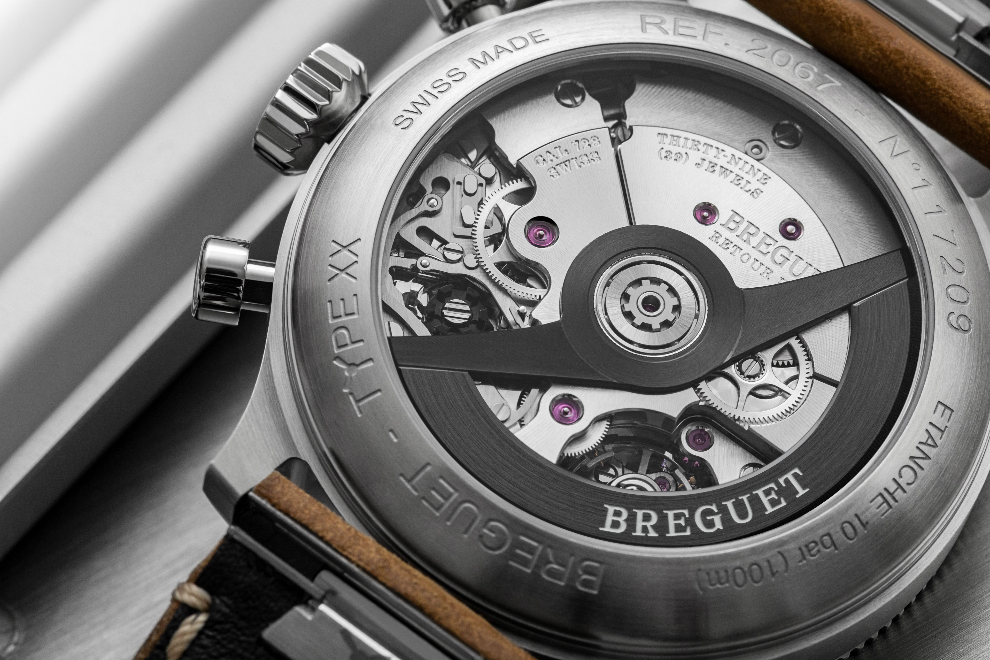
Perhaps contentiously, both watches keep the date between 4- and 5 o’clock, which might be the least popular date positions as far as collectors are concerned. On that note though, this position has been chosen very deliberately, given that the Swiss Made mark is below the window. The movement was also not simply thrown together, with both calibres 728 and 7281 being integrated chronographs. We salute the manufacture for the courage of its convictions.

Aside from size and ergonomics, References 2057 and 2067 differ entirely, right down to the type of lume used and the style of hands. Where Reference 2057 features pencil hands and fresh green lume, Reference 2067 has lance hands and aged lume. The former is a bicompax chronograph (small seconds at 9 o’clock and 30-minute totaliser at 3 o’clock), the latter is tricompax (small seconds at 9 o’clock, 15-minute totaliser at 3 o’clock and 12-hour totaliser at 6 o’clock). The arrangement of subdials is indicative of the different movements here, calibre 7281 for reference 2057, and calibre 728 for reference 2067. In terms of substance, both calibres have a lot in common though, especially in the fast-beat (5 Hz) all high-tech silicon escapements (hairspring, anchor and escape wheel), and the 60-hour power reserve.

The two chronograph calibres are new, and are integrated rather than modular. In our original story on the Type XX watches, this was a mere supposition on our part, but we see that Breguet CEO Lionel a Marca has confirmed this (in comments to Revolution). For some context here, it would have been simpler for Breguet to use a base movement that it could mount slightly different chronograph modules on, but the brand rightly concluded that this would be decidedly unattractive for Breguet, given the history of the name. Thus we have two integrated chronograph movements that add to the value proposition of the Type XX collection.

Both calibres are distinguished by column wheels and vertical clutches; of course, this chronograph is of the flyback variety so that function is in the mix too. We published an extensive read on the chronograph in our last regular issue (#70) but, in short, the vertical clutch here means that the chronograph wheel, which must connect with the movement to get the chronograph going, is held above and away from the seconds wheel by a pair of clamps. These disengage when the chronograph is activated, dropping the chronograph wheel onto the cannon pinion that also holds the seconds wheel. In this way, the chronograph is driven by same force as the seconds wheel, without any meshing of gears.

Type 102 Siderometer split-seconds chronograph for aircraft use from 1945

In practice, you will not see anything much, which is a downside of the vertical clutch – the horizontal clutch offers far more visual spectacle – but there will be a real performance upside. Chronographs with vertical clutches can typically run without negatively impacting the amplitude of the balance, which is caused by the above-mentioned meshing of teeth. Dial-side, this typically means there will be no jerk or backlash when the sweep seconds hand starts.

As far as finishing goes, Breguet demonstrated how bevelling and other fine touches are done at the Paris launch (during the museum tour), without calling attention to anything that is done by hand in these new calibres. Nevertheless, we note that the finish is as good as anything at this level of fine watchmaking, including the aforementioned bevelling on the chronograph levers. Breguet collectors will note that the finishing here is much simpler than what one might expect for the Tradition and Classique collections, but again stand up quite well to what one will find in the Marine collection.

With regards to Reference 2057, the bidirectional rotating bezel is fluted and free of markings, except for the triangle at the top. The onion-shaped crown stays true to the original design of the military Type 20. One black calfskin leather strap and one black NATO fabric strap are provided. They are both designed with interchangeability in mind so you can swap them quickly without the need of a tool. The lugs are pretty standard, with spring bars and all, so other strap options are open too.

On the other hand, Reference 2067 follows the code established by a civilian Type XX watch of 1967. Here, it is interesting to note that the enlarged minute counter at three o’clock is graduated for 15 minutes (and not 30 minutes like most chronographs). This allows the minute chapters to be farther apart for easier reading, and there is the 12-hour counter at 6 o’clock to provide a longer overview of the timing session.

Note also how the main hour and minute hands are more triangular and reminiscent of the lances used by cavalry than Reference 2057 – this explains why watch enthusiasts everywhere call this type of hands "lance hands"; the lume is now in a shade of ivory. Other differences include the 12-hour graduation on the bezel and the straight-sided flat crown, which is the same design as the civilian Type XX back in those earliest days. Reference 2067 is worn on a brown calfskin leather strap and the extra NATO fabric strap comes in black, same as its sibling.

Both models are delivered in an interestingly designed box that resembles a vintage aircraft wing when viewed from the side. It comprises a leather flap atop a wooden structure. A built-in, internal slot provides practical storage for the strap not currently in use. For WOW, it is the perfect antidote to the trend where watch boxes are made of recycled or recyclable materials.

This article first appeared on WOW’s Legacy 2024 issue

For more on the latest in watch reads, click here.